





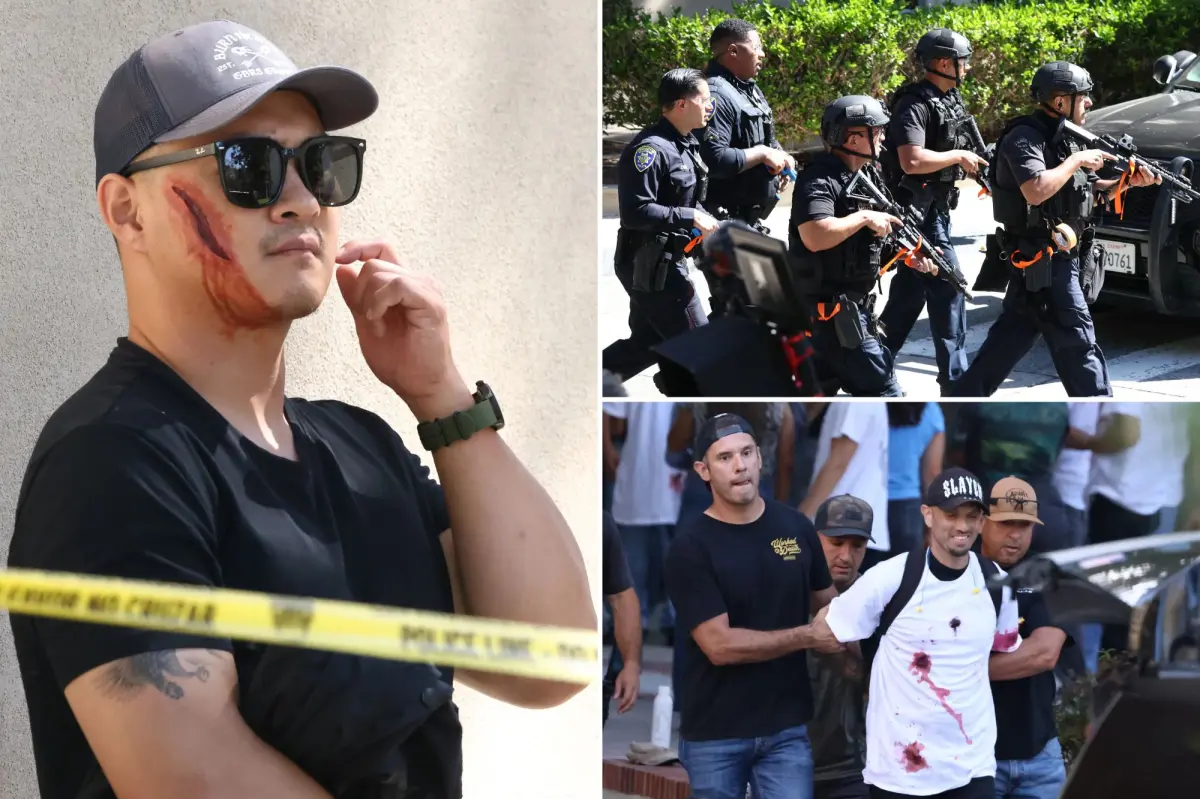
The quiet, ivy-covered campus of UCLA was shattered just before dawn on Wednesday as the sharp crack of gunfire echoed across the muted streets of Westwood. What sounded like a nightmare was actually a meticulously orchestrated symphony of chaos—a five-hour, full-scale tactical simulation staged inside Hendrick Hall, a dormitory that will house the world’s most elite athletes during the 2028 Summer Olympics. Dozens of LAPD officers, clad in heavy tactical vests and armed with automatic weapons and battering rams, swarmed the eight-story building with a terrifying urgency. Police helicopters thundered overhead, lowering black-clad figures onto the roof in a seamless display of vertical assault, while roughly sixty actors played their parts with chilling realism—terrified hostages screaming for help, “crazed shooters” moving with deliberate, deadly intent, and bloodied victims crumpled in hallways, their simulated wounds painting the pristine dormitory floors in shades of crimson. The air was thick with the smell of cordite and sweat, the rat-a-tat of fake gunfire mingling with the high-pitched wails of distress. This wasn’t a real attack, but it was the definitive dry run, the ultimate test of muscle memory, designed to prepare the city’s guardians for the unthinkable event of a terrorist assault on the international athletes who will call this building home.
Chief Jim McDonnell watched the drill unfold with a careful, piercing gaze, his demeanor shifting from that of a commanding officer to a concerned parent. “Everything fell into place,” he announced afterward, the words heavy with relief and a grim sense of validation. But as he elaborated, McDonnell was quick to frame this massive exercise not just as preparation for the glitz and spectacle of the LA28 Games, but as a furious rehearsal for the mundane, terrifying dangers that strike daily. “We focus on training for the Olympics, but it’s also training for every day, what could happen on a campus or on any other kind of facility,” he reflected. The same fluid maneuvers used to breach a dormitory and neutralize a simulated threat could one day save lives during a school shooting in the valley or a barricaded suspect in a downtown apartment. The exercise was a brutal reminder that the line between sporting glory and tragic violence is razor-thin. Observing the officers move with practiced precision, their movements sharp and rehearsed, one could almost forget the sheer weight of the responsibility they carry. For the men and women on the ground, however, this was more than just a drill; it was a declaration of intent. They are the thin blue line meant to protect the dreams of thousands of athletes, and the drill demonstrated a willingness to meet terror head-on—not merely to react, but to conquer, to save as many lives as possible when the world’s spotlight is blindingly fixed on Los Angeles.
Yet, when the smoke cleared and the helicopters retreated to the horizon, a far more sobering and unglamorous equation emerged from the tactical wreckage—the bleak arithmetic of manpower. The 2028 Games will demand a staggering security force of approximately 7,500 officers per day. To put that colossal number into perspective, the LAPD currently has just 8,550 uniformed officers in its entire force, a number that barely covers a city sprawled across nearly 500 square miles. The chief acknowledges that the department cannot possibly shoulder this burden alone; it will rely on a patchwork of reinforcements from agencies across California and beyond. However, this mathematical jigsaw has a darker, troubling edge. If 2,500 officers are deployed to the Olympic venues, that leaves a paltry 6,000 officers to police the rest of Los Angeles—a city of nearly four million souls. Imagine a frantic 911 call from a resident of Watts or the San Fernando Valley, answered with a dull, automated reassurance that officers are currently assigned to a fencing competition. The reality of this shortfall sends a chill through the heart of the city. “We’re going to have an awful lot of people in town for the Games,” McDonnell stated, his voice carrying an undercurrent of anxiety, “Our goal is to provide enhanced service everywhere.” Yet the promise feels hollow when weighed against a force stretched impossibly thin, already exhausted by the daily grind of violence that plagues its streets, now being asked to run a marathon of security with the stamina of a sprinter.
The human strain of this monumental task is further compounded by the gnawing specter of budget shortfalls. Beyond the bodies needed on the ground, the logistics require capital. The LAPD’s Olympics Special Events Unit has identified a desperate need for 700 to 800 additional patrol vehicles to manage the massive influx of people, VIPs, and traffic. This vital equipment remains unfunded. When funding does materialize, it arrives with bureaucratic strings attached—procurement delays, usage restrictions, and endless red tape that hobbles preparation. An LA28 spokesperson offered a diplomatic, if opaque, response, noting that the organization is “in the planning process with local, state, and federal partners to determine what security and other related costs for the LA28 Games will be.” But for the rank-and-file officer walking the graffiti-covered streets of Los Angeles today, this translates into a chilling, simple truth: the city is hosting the world’s premiere event in a fortress built of sand. The very drill that showcased military-grade excellence drained overtime budgets, wore out equipment, and consumed resources already earmarked for community policing. There is a profound disconnect between the shiny promise of a global spectacle and the gritty, harsh reality of a department struggling to fix its own leaky roof. Every bullet fired in simulation, every actor bleeding fake blood, represents an expense that tightens the vice on a budget already depleted by an exodus of personnel.
This exodus is perhaps the most insidious enemy of all. Chief McDonnell has been brutally honest about the department’s crisis, sharing with The Post just last month that the existing shortage has worsened. Within a single month, the LAPD lost roughly 200 officers, plunging from approximately 8,700 to its current 8,550. The chief has revised his ideal staffing needs to a staggering 12,500 officers to adequately police the city under normal circumstances, a 4,000-officer gap that represents far more than just missing numbers on a grant report. This deficit symbolizes burned-out veterans taking early retirement, young officers fleeing to cozier suburban departments, and a morale crisis that seeps through the hallways of police stations like a slow leak. When a patrol officer is asked to manage a triple shooting in the early hours and then report for a security detail at a swimming venue hours later, the fatigue becomes a matter of life and death. The simulation at UCLA showcased performers at their absolute peak, but that peak is fueled by adrenaline and caffeine, not by systemic, sustainable support. The city is asking its protectors to run a marathon they never trained for, with a fractured limb, and expecting them to cross the finish line with a smile for the cameras. The hearts of these officers are pulling double duty—one part aching for the communities they swore to serve, the other dreading the impending 87-day lockdown that will turn their city inside out.
Looking toward the horizon, the security blueprint is drawn with meticulous, if strained, precision, prioritizing the sanctity of the venues themselves. The plan initiates a fortified “inner sanctum” around each Olympic site, a bubble of undeniable control. Surrounding that lies a “yellow zone,” a buffer area heavily patrolled and checked, designed to absorb potential threats before they reach the athletes. Beyond the yellow zone, “extra coverage” will be dynamically deployed based on real-time intelligence. Chief McDonnell describes the sheer endurance required to maintain this posture: “We’re going to maintain a strong posture over the event areas for the duration of the entire Olympics, the two weeks in between, and then the Paralympic Games as well.” He notes that this strict security lockdown will persist for an exhausting 87 days—nearly three months of heightened martial vigilance. For Angelenos living adjacent to these venues, this represents a profound upheaval of daily life: instance of being blocked from your own driveway by a security checkpoint, finding routine grocery trips transformed into shuffled, D.I.Y. convoys through metal detectors. The grand spectacle of the Games comes with an equally grand imposition on human freedom and routine. As the eerie silence descends over the empty, blood-spattered hallways of Hendrick Hall, the real battle looms ahead—a war against time, financial scarcity, and the deep-seated question of whether a beleaguered city can genuinely shield its inhabitants and its honored guests. The SWAT teams have mastered the art of breaching doors, but securing the collective peace of mind, the sanity of a nation holding its breath, and the safety of a city under such immense strain remains the most profound, unspoken challenge of the decade.