



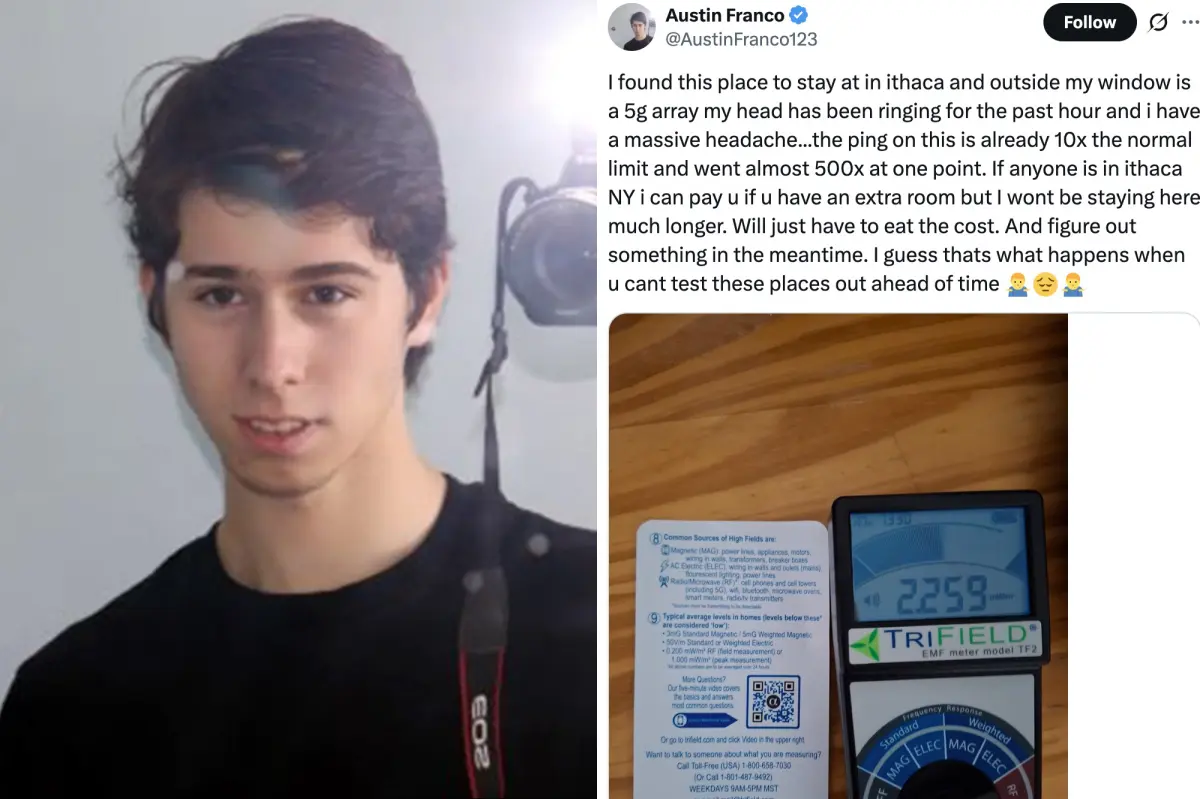
The transition from a secure, supportive home environment to sudden independence and public scrutiny can place an immense psychological burden on an individual, often manifesting in heightened states of stress and physical discomfort. For Austin Franco, a nineteen-year-old student at Cornell University, this transition occurred under highly publicized and turbulent circumstances. Following a severe ideological rift with his family that resulted in his departure from their Virginia residence, Franco relocated to a new apartment in Ithaca, New York. Shortly after his arrival, he began utilizing social media to express profound personal distress, detailing acute physical symptoms such as persistent, severe headaches and a continuous ringing in his ears. Rather than viewing these symptoms as potential physiological responses to the intense emotional and situational stress of eviction and public backlash, Franco attributed his discomfort to a 5G cellular communication box located outside his window. This situation highlights how sudden, drastic changes in life circumstances, combined with a loss of traditional support networks, can leave a young person feeling deeply vulnerable and disoriented in their new physical surroundings.
In his public communications, Franco described his living space in highly technical but scientifically ungrounded terms, monitoring what he perceived as fluctuating radiation levels and expressing an urgent need to flee his new home. This state of hyper-vigilance, wherein common physical symptoms of anxiety—such as tension headaches and subjective tinnitus—are interpreted as the result of external technological threats, reflects a well-documented psychological coping mechanism. When individuals experience a profound loss of control over their personal lives, relationships, and public reputation, they may externalize their internal turmoil onto tangible, external objects within their environment. Franco’s active search for alternative housing in the Ithaca area, despite the financial burden of abandoning his lease, demonstrates a desperate search for safety and sanctuary. This behavior underscores the fundamental human need for a secure space to process stress, even when the perceived source of discomfort is rooted in subjective experience rather than scientifically verified environmental hazards.
To navigate his sudden displacement and financial instability, Franco turned to the internet, launching crowdfunding campaigns that quickly mobilized support from specific online subcultures. Through platforms like GiveSendGo and fundraisers organized by sympathetic digital media figures, he managed to secure significant financial contributions from individuals who aligned with his controversial public stances. This rapid financial mobilization illustrates the powerful role that specialized online communities play in reinforcing the behavior of alienated individuals. For a young person cut off from their family and mainstream social structures, the receipt of thousands of dollars from anonymous internet donors provides not only immediate material relief but also a powerful form of validation. However, while these funds solve immediate logistical challenges, they can also create a digital echo chamber that discourages self-reflection, deepens social isolation, and complicates the individual’s ability to reconcile with their family or reintegrate into broader society.
The diverse nature of Franco’s financial supporters further reveals the complex sociological dynamics of online grievance networks. Among those who contributed to his cause were individuals with their own histories of public controversy, such as former political candidates who drew parallels between Franco’s current situation and their own past experiences of public scrutiny. This intersection of support demonstrates how individual crises can become a canvas for broader, collective narratives of grievance and perceived persecution. For these donors, contributing to Franco’s fund is a way to participate in a shared, symbolic resistance against mainstream social norms and institutions. This parasocial solidarity, while providing temporary comfort to the recipient, often serves to entrench divisive viewpoints, as the individual is encouraged to view their personal struggles not as a consequence of their own actions, but as part of a larger, systemic conflict.
The origin of Franco’s current isolation stems from a series of highly controversial, discriminatory messages sent on a professional recruitment platform, which led to widespread public condemnation and a decisive rupture with his family. His parents publicly distanced themselves from his views, evicting him in an effort to draw a clear boundary against what they described as repugnant beliefs, while expressing deep concern that their son had fallen victim to extremist online content. This tragic breakdown of the parent-child relationship highlights the devastating real-world consequences of digital radicalization, which can quietly erode the foundational bonds of family long before manifesting in public controversy. The loss of a family’s emotional and financial safety net leaves a young person highly susceptible to further alienation, as the very algorithms that contributed to their initial radicalization continue to feed them content that validates their anger and isolates them from moderate, grounding influences.
Psychologists and sociological experts note that the modern digital landscape is uniquely equipped to accelerate radicalization and monetize notoriety, making it increasingly difficult for individuals to find a path toward healing and reconciliation. When algorithms continuously reward extreme behavior with attention and financial gain, the incentive to de-escalate conflict or seek professional guidance is severely diminished. To counter these negative influences, it is essential to emphasize the importance of digital well-being, media literacy, and the cultivation of healthy, real-world relationships. Navigating intense periods of stress, isolation, or physical discomfort requires grounded coping strategies, such as seeking support from qualified healthcare professionals, practicing mindfulness, and engaging in open, constructive dialogue with trusted community members. By focusing on holistic well-being and reconnecting with physical reality, individuals experiencing overwhelming life transitions can find healthier, more sustainable ways to manage anxiety and rebuild their lives.