




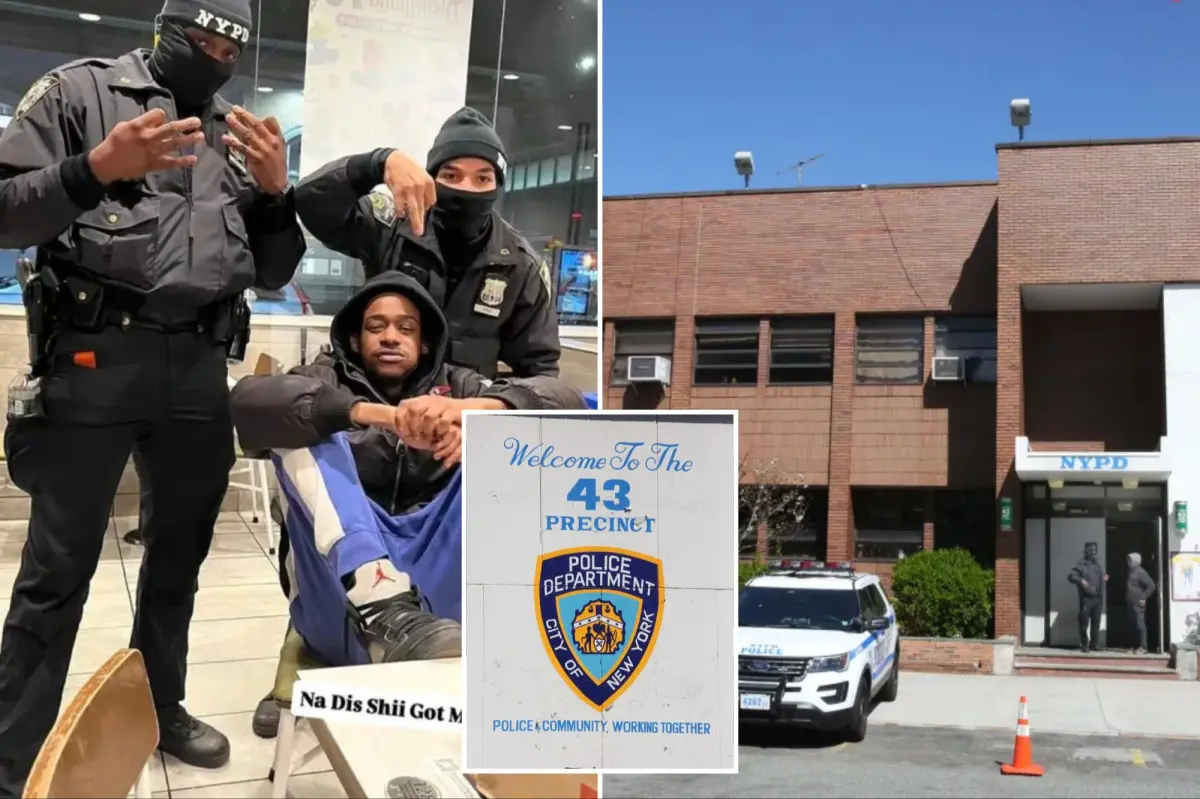
Under the harsh, fluorescent glow of a Bronx McDonald’s, a single, fleeting moment captured on a smartphone camera quickly escalated into a high-stakes crisis of institutional trust, shaking the foundations of the nation’s largest police force. The undated photograph, which began quietly circulating on Instagram before exploding across wider social media channels, shows two fully uniformed New York City police officers standing shoulder-to-shoulder with an unidentified young civilian. Rather than presenting the disciplined, reassuring posture traditionally expected of the blue line, these officers chose to obscure their faces behind balaclavas and beanies, adopting a casual, street-oriented stance. Most alarmingly, both officers are captured frozen in time flashing hand gestures synonymous with the Mac Baller Brims—a highly violent, Bronx-born subset of the Bloods street gang. In a digital age where images serve as instant public verdicts, this visual alignment of law enforcement with the symbols of the very criminal elements they are sworn to dismantle sent shockwaves through both the community and the higher echelons of the department. What might have begun as a thoughtless, real-time interaction in a fast-food joint rapidly transformed into a symbol of a deeper, systemic disconnect. As the image gained viral traction, it forced an urgent Internal Affairs Bureau investigation, laying bare the incredibly fragile nature of community-police relations. For a city already grappling with questions of police accountability, the photograph did not just depict a minor lapse in professional conduct; it presented a sobering, visual paradox of public servants masquerading as the forces of disruption they are paid to deter, leaving observers to wonder where the authority of the badge ends and the culture of the streets begins.
The specific mechanics of the hand gestures captured in the image reveal a troubling familiarity with the intricate lexicon of New York’s gang underworld, a detail that quickly caught the attention of both gang specialists and former law enforcement officers. In the photograph, one of the masked officers is seen pointing his fingers downward while crossing his middle finger over his ring finger—the distinct, undeniable calling card of the Mac Baller Brims. Beside him, his anonymous partner bends back his index finger while extending his remaining three fingers outward, executing another gesture closely associated with Bloods gang culture. Eric Sanders, a prominent civil rights attorney and former NYPD officer, wasted no time in validating the authenticity of these signs, emphasizing that such behavior demands immediate administrative discipline, or “modification,” which would strip the officers of their gun and shield and relegate them to desk duty. However, Kevin O’Connor, a retired NYPD Assistant Commissioner of Youth Strategies, offered a slightly more nuanced, though equally critical, perspective on the incident. While agreeing that the officers were indeed attempting to mimic Bloods gang signs, O’Connor pointed out their sloppy execution, suggesting a performative rather than pathological alignment with the gang. He urged investigators to look deeply at the surrounding context of the photograph, noting that the young civilian posing between the officers was dressed in blue, the traditional color of the Crips, who are the archrivals of the red-wearing Bloods. This physical detail introduces a puzzling dynamic: were these officers engaging in a reckless, highly inappropriate form of street banter, or were they attempting a bizarre, misguided method of neighborhood rapport-building by mimicking the complex rivalries of the local youth they are assigned to monitor?
Beyond the technical decoding of the hand gestures, the emotional fallout of the image has reverberated deeply through a public already cynical about police behavior and a rank-and-file workforce that feels unfairly tarnished by the actions of a few. On social media platforms like X, commentators reacted with intense frustration, with one popular post describing the officers’ appearance as a form of high-stakes “cosplay” for the very criminals they are supposed to deter, questioning the caliber of individuals currently being recruited by New York’s leadership. But the deepest wounds were felt by the everyday, street-level officers who patrol the city’s most challenging neighborhoods. For the hardworking men and women of the NYPD, who spend years attempting to build fragile, hard-won trust in skeptical communities, the photo was viewed as a profound betrayal of their collective professional integrity. An active Bronx officer spoke anonymously of his raw disgust, labeling the image a “complete disgrace” that instantly undoes decades of community policing and gang-mitigation efforts for the sake of a cheap joke. This internal backlash highlights a growing, painful divide within the department itself, where seasoned officers find themselves increasingly alienated by younger colleagues who appear to view the uniform not as a sacred civic responsibility, but as an aesthetic to be played with, highlighting how easily a single moment of digital vanity can destroy the hard-earned credibility of an entire police precinct.
At the heart of the burgeoning scandal are two young officers whose identities and motivations are now being meticulously dissected by Internal Affairs investigators. One of the officers has been identified as Shane Cruz, a relatively green recruit who joined the force in 2024 and was initially assigned to the 43rd Precinct in the Soundview section of the Bronx, before being transferred in February to the 73rd Precinct in Brownsville, Brooklyn—a shift sources claim was unrelated to the photo incident. The identity of the second officer remains officially shielded from public view, as his physical badge is obscured in the viral snapshot. In the wake of the uproar, law enforcement sources have rushed to defend the pair, painting a picture of two young, naive officers who merely saw a local teenager they recognized and engaged in a moment of foolish, lighthearted playfulness. According to this narrative, the officers had absolutely no inkling that their fast-food antics would escape the walls of the McDonald’s and ignite an international digital firestorm. While this defense attempts to humanize the officers as well-meaning but foolish, it simultaneously exposes a staggering, dangerous lack of situational awareness. In a hyper-connected metropolis where law enforcement officers are under constant scrutiny, the failure of these officers to anticipate how their actions would be interpreted reflects a profound disconnect from the sobering realities, immense responsibilities, and constant public gaze that come with wearing the NYPD uniform.
To understand why this image provoked such an intense, visceral reaction across New York City, one must look past the immediate defenses of “joking around” and confront the violent, bloody legacy of the Mac Baller Brims. Established in the Bronx in 2001 as a powerful, highly organized offshoot of the West Coast Bloods, the gang is far from a harmless subcultural trend; it is a ruthless criminal enterprise that has spent decades terrorizing local communities. Named in honor of the notorious gang figure O.G. Mack, the Mac Baller Brims have built their reputation on a devastating foundation of racketeering, narcotics distribution, armed robberies, and homicides. The grim reality of their operations was brought to light in 2019 when federal authorities indicted thirteen members for a wave of terrifying violence, including street shootings and murders, in the Mount Hope section of the Bronx. More recently, in 2023, the gang made headlines again when its members were indicted for a series of incredibly brazen, gunpoint robberies targeting local smoke shops across lower Manhattan. When uniformed police officers casually flash the symbols of such an organization, they are not merely engaging in harmless slang; they are invoking a history of trauma, mocking the grief of families who have lost loved ones to gang violence, and deeply insulting the victims of a criminal syndicate that has actively worked to destroy the very neighborhoods these officers are paid to protect.
Ultimately, this disturbing incident serves as a stark window into a broader, systemic crisis currently unfolding within the NYPD, defined by a shifting generational culture and a desperate struggle to maintain recruitment standards. Michael Alcazar, a former NYPD detective and current professor at the John Jay College of Criminal Justice, pointed out that the department is dealing with a vastly different generation of recruits—young people heavily influenced by internet culture and drill music who may foolishly mimic gang gestures seen in rap videos without fully comprehending their real-world weight. This cultural shift is happening alongside a severe hiring crisis that has forced the department to systematically lower its long-standing entry requirements to fill empty patrols. The NYPD recently eliminated rules that disqualified candidates with minor past marijuana arrests and, under the department’s leadership, slashed the required college credits for applicants from 60 down to 24 in response to a massive 29% disqualification rate in 2023. As the department lowers its educational and behavioral thresholds to combat recruitment shortages, incidents like the McDonald’s photo raise critical, urgent questions about the maturity, psychological readiness, and cultural sensitivity of the new generation of officers being trusted with the safety of New York’s streets, reminding us that when institutional standards are compromised, public trust is inevitably the first thing to fall.