


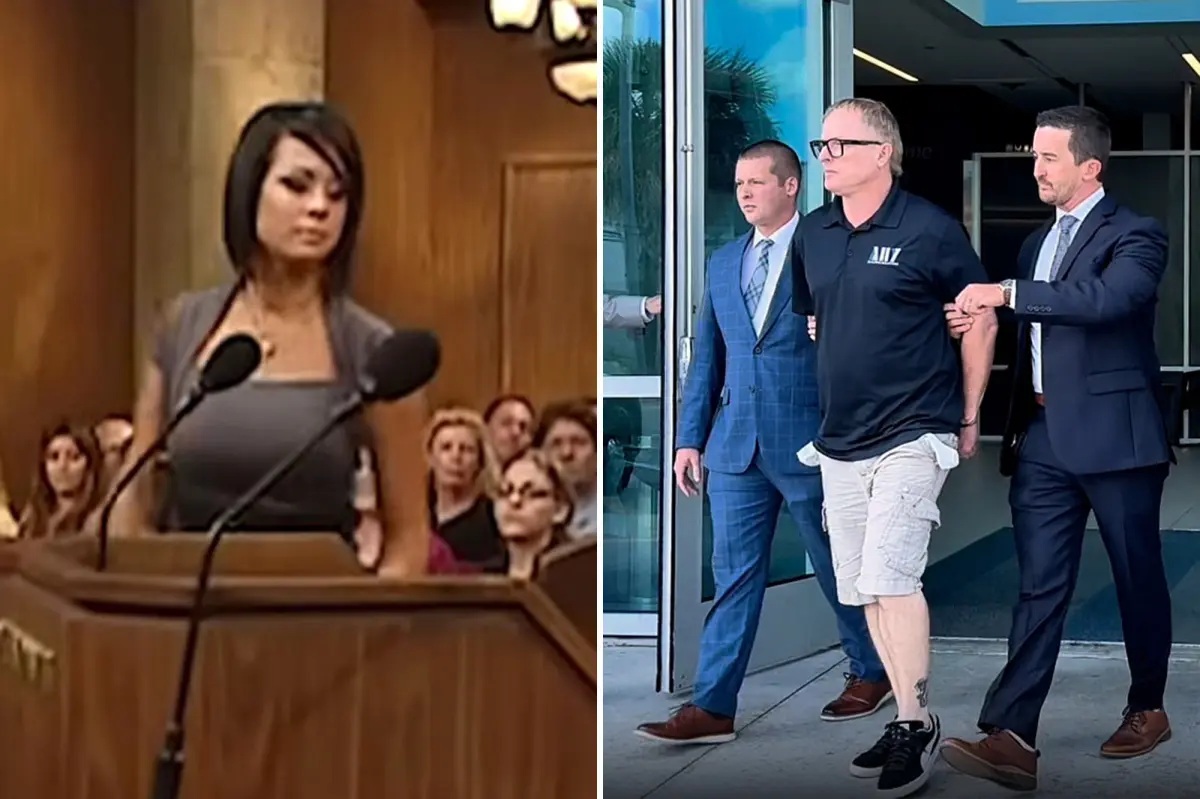
For nearly fifteen years, the mystery of what happened to Michelle Parker has haunted her family, her friends, and an entire community in Orlando, Florida. Michelle was a thirty-three-year-old mother of four, a woman who loved her children fiercely, and who had gone through the painful, messy process of ending a relationship with a man she had once planned to marry. She was vibrant, outspoken, and determined to move forward with her life, even as the shadows of her past with Dale Smith Jr. continued to pull at her. On November 17, 2011, she made a simple, routine decision that would prove to be the last ordinary act of her life: she dropped off her then three-year-old twins at Smith’s gated condominium complex. She was never seen again. For years, the case went cold, with questions piling up and no answers. Then, in a dramatic development, unsealed documents and a forty-six-page arrest affidavit revealed the disturbing words and actions that led authorities to finally arrest Smith and charge him with murder. The filing painted a portrait of a relationship in its final, corrosive days, filled with manipulation, humiliation, and barely contained rage, and it offered the clearest picture yet of what may have happened to Michelle.
The months and weeks leading up to Michelle’s disappearance were marked by a toxic dynamic that, according to prosecutors, was steadily escalating. In April, a former friend came forward to tell investigators that roughly two weeks before Michelle vanished, Smith stood outside his condo and uttered a chilling wish: “I wish someone would kill this b–ch.” It was a casual, venomous remark, the kind of thing that might be dismissed as bitter anger if it were not followed by something far more sinister. Just days later, Smith, then forty, tried to proposition Michelle with an offer of two thousand dollars for a night of sex. The text messages, now part of the public record, show Michelle rejecting him with a striking combination of dignity and frustration. “Thought about your offer … & will have to decline,” she wrote. “I’d rather have a personal legal loan, than feel like a whore. I can’t do it. I won’t!!!! It’s not ethical, or right.” When Smith tried to soften his request by saying he simply wanted “one last time to be with you,” Michelle held her ground. “Having sex for the exchange of $$$ makes me a high dollar prostitute! I can’t do it for the $$, against my morals,” she shot back. In those few lines, Michelle’s voice comes through loud and clear: she was not going to be used, degraded, or bought. She knew her worth, even when the man who was supposed to love her treated her like a commodity.
The day Michelle disappeared was supposed to be just another Thursday. It happened to be the day an episode of “The People’s Court” aired, featuring Michelle and Smith fighting over the expensive engagement ring he had given her. The couple’s private conflict had been dragged into the public eye, and Smith was reportedly furious about how the episode framed their dispute. About forty minutes before the show aired, Smith texted Michelle with a message that was both crude and revealing: “I’m sexually frustrated lol.” Michelle, already exhausted by his behavior, fired back with raw honesty: “that’s your f—king fault! U were never frustrated b4, even while with me… & [half] the time it wasn’t me u were f—king.” It was a heated exchange, but nothing about it seemed to suggest it would be her last. Just over two hours later, she arrived at Smith’s condo to drop off the twins. She stayed for a while, and then, according to investigators, she was killed. Her body has never been found, leaving her family in a cruel, suspended state of grief, unable to lay her to rest, unable to close the door on the nightmare. The television episode that was supposed to resolve a dispute over a ring became the backdrop to a murder that remains one of central Florida’s most agonizing cold cases.
The evidence that eventually led to Smith’s arrest includes photographs taken the day after Michelle disappeared. They show scratches across Smith’s mouth and lips, a bruised forearm, and scrapes on his elbows. Investigators believe these injuries were defensive wounds, inflicted by Michelle as she fought desperately for her life. The images are haunting because they suggest a violent struggle, a woman doing everything she could to survive against a man who had her at a terrible disadvantage. Yet for years, authorities did not pursue these wounds as aggressively as they might have. The affidavit also contains testimony from another former fiancée of Smith, who claimed that he routinely choked her to the point of passing out, using his bare hands or a belt, both during sex and during arguments, and that he threatened to make her disappear. This pattern of violence, so familiar in cases of domestic abuse, paints a chilling picture of a man capable of extreme cruelty. It also highlights the quiet terror that Michelle may have lived with long before that final day, and the bravery it took for her to leave him, even though leaving is often when the danger becomes greatest.
Perhaps the most damning evidence against Smith lies in the inconsistencies of his own story. In an initial interview with police on November 18, 2011, he claimed that Michelle arrived at his condo and stayed for only ten minutes. But re-analyzed cell phone data told a different story. Michelle’s phone arrived at Smith’s home at 3:16 p.m. and stayed there for over an hour. Then, at 4:18 p.m., both her phone and Smith’s phone traveled together westward toward Lake Conway. Dive teams eventually found Michelle’s phone in that lake, and digital forensics revealed that all of her text messages up to 4:27 p.m. on the day she disappeared had been manually deleted. Why would someone delete those messages? What were they trying to hide? And perhaps even more telling, records show that Smith never once called or texted Michelle after her disappearance, despite telling investigators that he hoped she was just “laying low.” For a man supposedly concerned about the mother of his children, the silence was deafening. These details, painstakingly pieced together over years, slowly built a case that was impossible for authorities to ignore, even as Smith continued to insist he had nothing to do with her disappearance.
The arrest of Dale Smith Jr. on a charge of murder has brought a measure of relief to those who have waited so long for justice, but it cannot bring Michelle back. Her family has spent fifteen years attending vigils, holding out hope, and grieving a woman whose life was cut short in the most brutal way imaginable. The story of Michelle Parker is not just a true-crime tale of text messages and cell phone pings; it is the story of a mother who tried to build a new life for herself and her children, only to be caught in the crosshairs of a man who refused to let go. It is a story about the insidious nature of domestic violence, the ways it hides behind closed doors, and the devastating consequences when it is not taken seriously enough. It is also a reminder that words matter, that threats are often more than just words, and that women who try to leave abusive relationships are at their greatest risk. As the case moves toward trial, those who loved Michelle are finally hoping for the answer they have desperately needed for fifteen years. They want to see accountability, and they want the world to remember Michelle Parker not as a victim, but as a woman of strength who deserved far better than the fate she was handed on that November afternoon.