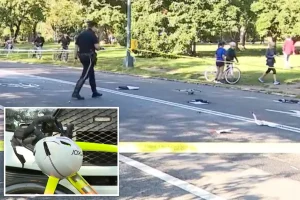





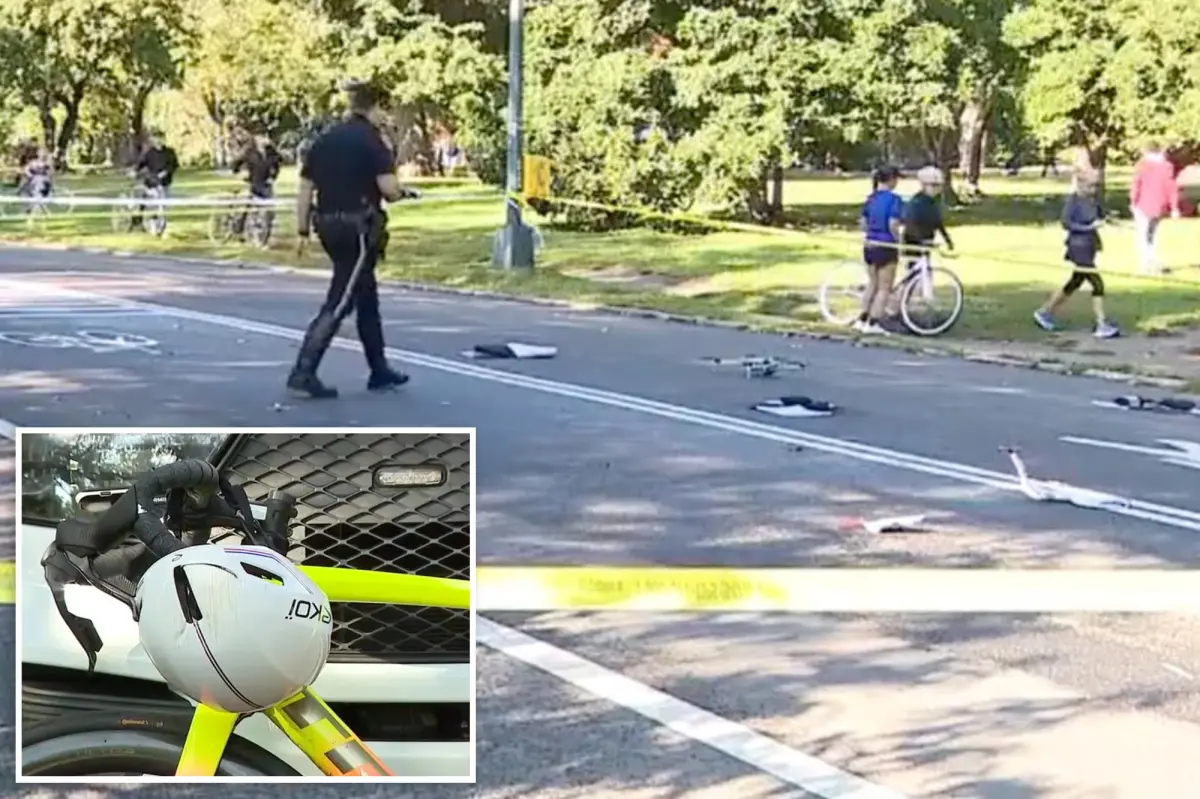
Early Monday morning, Central Park was still shaking off the quiet of dawn, with the first golden light filtering through the trees and the city not yet fully awake. Along the East Drive near East 84th Street, a 71-year-old man was doing something he had likely done countless times before: riding his bicycle, enjoying the fresh air and the rare sense of openness that the park offers in those early hours. It should have been an ordinary ride, a peaceful way to begin the week. Instead, it became a sudden and devastating tragedy. Around 8:20 a.m., a dog, running free and unleashed, darted into the cyclist’s path. The man struck the animal with a force that sent him flying over his handlebars and onto the hard pavement, his head taking the brunt of the impact. He was not wearing a helmet. Rushed to Weill Cornell Medical Center, he died from his injuries. The dog, remarkably, was unharmed. And the owner, a woman who had been letting her pup roam freely in a part of the park where that was perfectly legal before 9 a.m., was left to carry the unbearable weight of a moment that could never be undone.
There is something especially haunting about the mechanics of this accident, the way a single second can rearrange a lifetime. The man was riding north, likely moving at a steady pace, perhaps lost in thought, perhaps simply focused on the road ahead. The dog, full of morning energy, saw something worth chasing, darted without warning into the lane, and the collision became inevitable. The encounter was not one of anger or malice; it was pure, terrible timing. The moment of impact would have been a blur of motion, a sudden lurch, the sickening realization that something was wrong. For the cyclist, there was no time to brake, no time to swerve, no time to prepare for the violent arc that sent him over the handlebars and down onto the unforgiving asphalt. For the dog owner, the scene would have unfolded in nightmare slow motion: the beloved pet running free one second, then a man flying through the air the next. The silence after the crash must have been deafening, filled only by gasps, the sound of the bicycle skidding, and the frantic rush of passersby trying to help.
The aftermath of the accident carries a particular kind of cruelty, because nothing about it seems fully fair. The man was doing something healthy and life-affirming. The dog was doing what dogs do, chasing a moment of joy in a park that, at that hour, allowed it to run without a leash. The owner was following the rules, taking advantage of a legal window when off-leash dogs are permitted in that section of Central Park. Yet one life was extinguished, a family left in shock, and a dog owner left with a grief that will forever be tangled with guilt. The bicyclist was rushed to Weill Cornell Medical Center, where doctors did everything they could, but the head injury proved too severe. He died surrounded by medical professionals, never having the chance to say goodbye to his loved ones. The police would not release his identity, pending notification of his family. And so, for the time being, he remains a collection of facts: 71 years old, a cyclist, a man who loved the park enough to ride through it on a Monday morning. But behind those facts was a whole life, a story that his family now has to piece together through their grief.
Central Park has always been a place where the city comes to breathe, a green refuge where people of every age and background share the same winding paths and open spaces. It is also a place where different kinds of traffic have to find a way to coexist: cyclists, joggers, walkers, children, and the thousands of dogs who call the city home. The rules governing that coexistence are carefully designed, but no rule can account for the unpredictability of a living creature, or the split-second decisions that define a tragedy. On Monday, the dog was legally unleashed. That fact offers some comfort, perhaps, to a woman whose decision was not reckless but reasonable. It does not, however, soften the reality that a man died, and that his death was caused by a chain of events so ordinary that they could happen to almost anyone. The dog walked away without a scratch, which is its own strange mercy, but the owner must now live with the knowledge that her morning walk, her simple act of letting her pet enjoy the park, ended in catastrophe. There may be no legal blame, but the emotional burden is incalculable.
The loss of this 71-year-old cyclist also raises questions about the fragility of life, and the small decisions that can make all the difference. He was not wearing a helmet, a detail that seems almost unbearably significant in hindsight. Maybe he had ridden without a helmet for decades. Maybe he was on a short trip, feeling safe, never imagining that a dog would cross his path. His death is a stark reminder that even in the most familiar, peaceful settings, danger can appear in an instant. The park, for all its beauty, does not protect anyone from physics. A fall from a bicycle, at speed, onto pavement, is a serious event, and when the head is unprotected, the stakes become frighteningly high. This is not a judgment on him; it is simply a sorrowful truth. The city will continue to debate and refine the rules of shared spaces, deciding where dogs can run free and where cyclists should slow down, but no rule can replace the basic human need for care and attention in every direction. On Monday morning, everyone involved was doing something they had done before, something that felt safe. And then the world changed.
In the end, the story is not just about a cyclist and a dog, or even about rules and responsibility. It is about how people occupy the same city, the same park, the same morning, without truly knowing how much they depend on luck. The dog owner likely did not know the man’s name. The cyclist probably did not know the dog’s. They were strangers sharing a beautiful public space, each going about their own simple business. Now they are bound together by a tragedy that will follow them, and the man’s family, for a long time. The city will move on, as it always does. The park will fill again with cyclists and joggers and dogs, and the East Drive will once again be a place of morning routines. But for one family, the phone call has already come, and the world will never feel quite the same. For the woman who watched her dog survive an accident that killed a man, the park will always carry a shadow. This was not a crime. It was a tragedy in the oldest sense of the word, a terrible turn of events that no one intended. And the only thing left to do is remember the man, honor the fragility of life, and hope that all of us, in our own morning routines, hold each other a little more gently.