


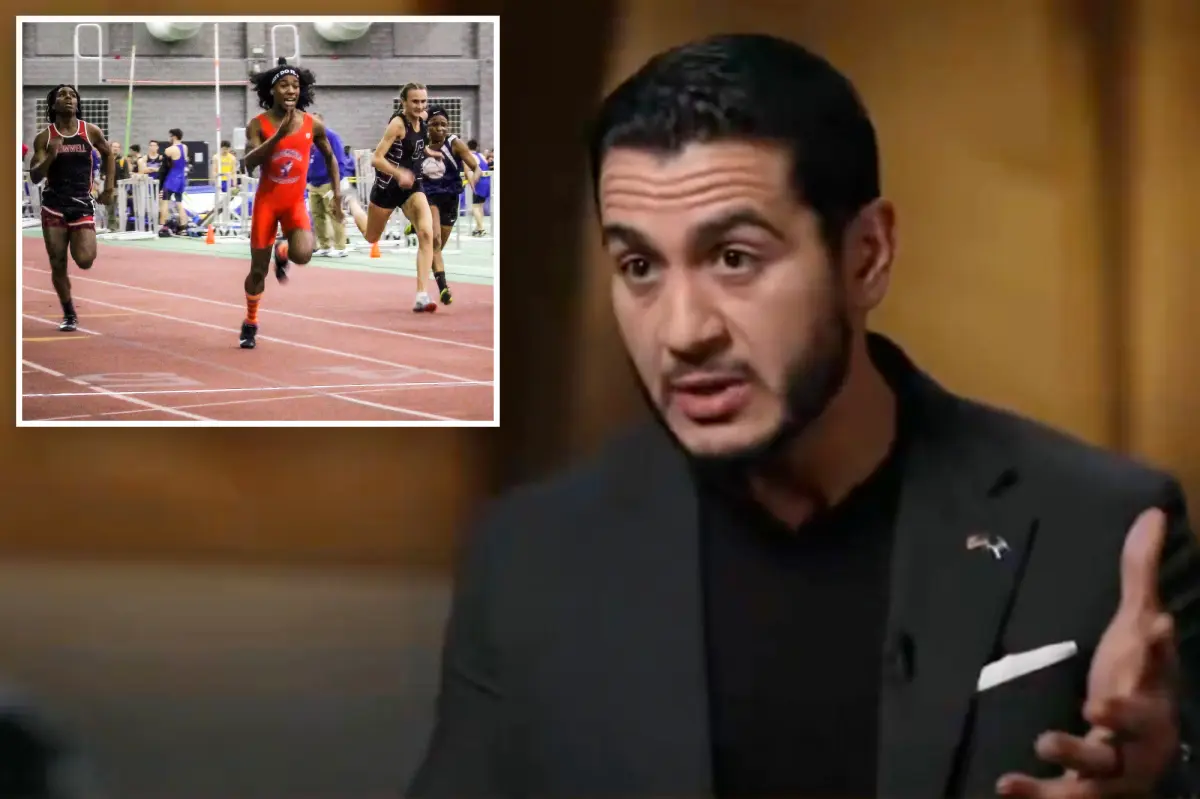
In a political moment when a single sentence can define a campaign, Michigan Democratic Senate hopeful Abdul El-Sayed stepped confidently into the firestorm. Appearing on CBS News’ “60 Minutes,” the physician and former Detroit public health official was asked about a subject that has become a defining cultural fault line in American politics: the participation of transgender female athletes in girls’ sports, and the accompanying question of whether those athletes should share locker rooms and intimate spaces with biological girls. Rather than soften his position or pivot to safer ground, El-Sayed met the question head-on. He argued that these issues are largely manufactured, the product of a political ecosystem that thrives on outrage and division. In his telling, the debate over transgender athletes is not a genuine crisis confronting ordinary families but a distraction, a way of channeling public anxiety into symbolic battles while deeper structural problems go unaddressed. He did not appear defensive or apologetic. Instead, he offered a philosophical defense rooted in the ubiquity of information in the modern age, suggesting that the very premise of protecting children from difficult or disagreeable ideas is outdated in a world where a smartphone contains the entire sum of human knowledge and experience. To El-Sayed, the attempt to insulate children from the reality of transgender lives is not only futile but fundamentally at odds with the free flow of information that defines contemporary society.
El-Sayed’s core argument, as he articulated it, was both simple and provocative. He observed that children today carry the world in their pockets. They can access, at any moment, information, images, stories, and perspectives that previous generations could only encounter through travel, literature, or direct experience. The idea that a school can function as a kind of moral quarantine, shielding a child from anything a parent finds objectionable, is, in his view, “profoundly outdated.” He suggested that parents who worry about what their children might see in a locker room or hear in a classroom are fighting a losing battle against a tide of digital exposure that children already navigate daily. And rather than mourning that reality, he embraced it, calling the free flow of information “a beautiful thing.” There is a certain logic to his position, one that resonates with parents who have watched their children scroll through social media feeds that make the school environment seem almost tame by comparison. But the logic only extends so far. The debate over transgender athletes is not simply about exposure to ideas; it is about material realities such as fairness, privacy, and safety. Parents might accept that their children will encounter LGBTQ+ people in various contexts, including online, while still believing that a biological male competing on a girls’ track team is a different matter entirely. El-Sayed, however, collapsed that distinction, treating the entire controversy as a symptom of an outdated worldview rather than a legitimate subject of public deliberation.
The political context surrounding El-Sayed’s remarks is tense and revealing. Democrats have been caught between the forceful demands of their progressive base, which insists on full inclusion of transgender athletes in female sports, and the views of the broader electorate, which remains deeply uncomfortable with that proposition. A recent Pew Research Center survey found that 73 percent of Americans are uneasy about allowing transgender female athletes to compete in girls’ sports. That is a number that should make any politician pause. For Republicans, it has become a potent wedge issue, a way to appeal to suburban parents and independent voters who might otherwise focus on economic matters. El-Sayed’s opponent, former Republican Representative Mike Rogers, reacted swiftly and harshly, calling the remarks “completely unacceptable.” Other conservative voices piled on with equal force. Will Chamberlain, a conservative influencer, tweeted that El-Sayed’s answer was “a terrible answer,” and Mike Davis, counsel to the Article III Project, offered an even blunter paraphrase: “Your daughters are going to see male genitalia anyway, so who cares if they see it in their locker room.” That framing, however reductive, captures the way El-Sayed’s comments landed in the broader culture. To his critics, he was not defending a nuanced policy position but dismissing the concerns of parents and reducing their anxieties to a form of irrational prudishness. The controversy illustrates just how difficult it is to have a measured conversation about these issues in a climate where every statement is weaponized and every nuance is flattened into an extreme caricature.
This was not the first time El-Sayed had found himself at the center of a culture war storm. In August, he participated in an interview with Fox News host Jesse Watters that quickly went viral for all the expected reasons. Watters, known for his combative and provocative style, pressed El-Sayed on the subject of transgender procedures for minors, specifically asking whether it was acceptable for a parent to “slash his kid’s ding-a-ling off.” The question was crude, deliberately shocking, and designed to elicit an outraged response. El-Sayed did not take the bait in the way Watters likely expected. Instead, he turned the question back on the host, asking, “Are you circumcised?” The exchange was startling, almost absurd, and it underlined El-Sayed’s willingness to engage in rhetorical combat on hostile turf. His point, presumably, was that American culture has long accepted irreversible medical procedures on the bodies of infants for religious, cultural, and health reasons, circumcision being the most obvious example. Why, he seemed to ask, is that considered normal while gender-affirming care is treated as a horror story? It was a provocative comparison, one that blurred the lines between medically established practice and contested surgical interventions, and it generated significant backlash. But it also demonstrated a deeper pattern in El-Sayed’s political style: he does not retreat from controversial ground, and he is willing to use discomfort as a rhetorical tool. In a political environment that rewards caution, such a willingness can be both a strength and a liability.
During his “60 Minutes” interview, which was conducted by correspondent Ross Douthat, El-Sayed tried to reframe the conversation around what he sees as the real issues facing Michiganders and Americans more broadly. He insisted that he was “not running to govern sports,” a line designed to dismiss the entire controversy as beneath the dignity of a serious Senate campaign. Instead, he argued that the cultural battles consuming the national conversation are a deliberate distraction from the more pressing problems of everyday life. He pointed to the rising cost of gas and groceries, the difficulty of accessing affordable health care, and the gnawing anxiety parents feel about whether their children will have good lives. In his view, the relentless focus on transgender athletes, locker rooms, and school curricula is not a spontaneous grassroots movement but a manufactured phenomenon, engineered by political actors who benefit when the public is divided along cultural rather than economic lines. There is undeniable appeal to this framing. It speaks to a genuine exhaustion among many voters who are tired of fighting about bathrooms and sports fields while their bank accounts shrink and their personal safety nets fray. By positioning himself as a champion of material concerns, El-Sayed is attempting to transcend the culture war entirely, casting himself as the sensible adult in a room full of screaming children. Whether that strategy will succeed in Michigan’s deeply polarized political landscape remains to be seen, but it is a coherent and in some ways courageous approach.
Despite the controversy, El-Sayed currently holds a 5.3 percentage point lead over Mike Rogers in the latest RealClearPolitics aggregate polling. That lead suggests a few possibilities: that Michigan voters are more sympathetic to El-Sayed’s position than the national polling would indicate; that they are uninterested in the issue altogether; or that they are weighing a broader set of considerations and have concluded that cultural grievances do not outweigh economic concerns. It may also reflect the fact that El-Sayed is an unusually articulate and unflappable candidate, one who can take a hostile question and turn it into a philosophical meditation on the nature of information and freedom. At the same time, the narrowness of a 5.3 point lead in a battleground state is hardly a mandate, and the cumulative effect of the controversies, from transgender athletes to the circumcision comparison, could yet erode his standing. What makes El-Sayed’s candidacy interesting, and his interviews so compelling, is that he refuses to engage with the culture war on the conventional terms. He does not say that these issues are unimportant or that people should not care; he says that they are manufactured, that they are a shell game, that they obscure the economic rot at the heart of the American experience. It is a risky message, because it asks voters to step back from their immediate visceral reactions and think structurally about the forces arrayed against them. Whether enough voters are willing to do that is an open question. But in an era of superficial political theater, El-Sayed’s willingness to force uncomfortable conversations, to push back against both conservative outrage and progressive pieties, makes him a genuinely singular figure in this election cycle. His fate will test whether the American electorate is ready for a politics that treats cultural panic as a symptom rather than a solution.