



The Failed Execution of Christa Pike: A Doctor’s Account of a Botched Lethal Injection
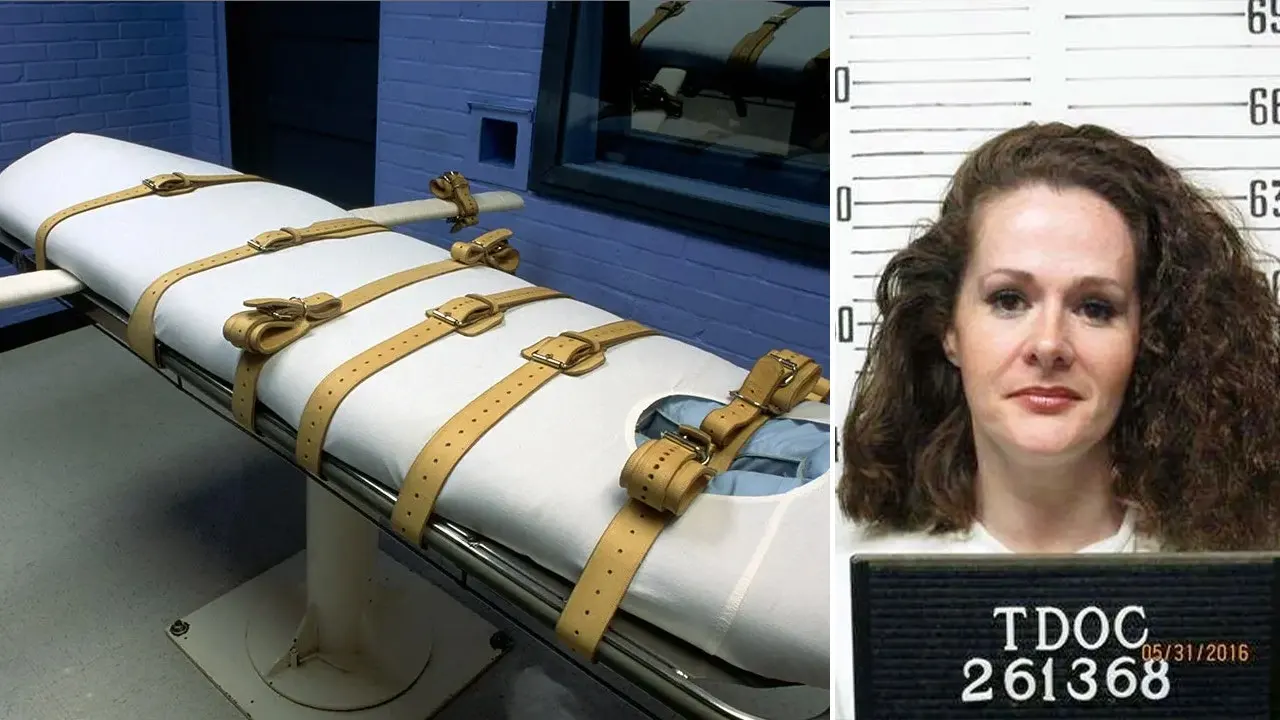
In a chilling revelation that has reignited debates about capital punishment in America, the doctor who participated in Christa Pike’s failed execution in Tennessee has come forward with a rare, firsthand account of what went terribly wrong in the death chamber. Dr. Mark Fowler, the physician present during the September 30 execution attempt, disclosed that an improperly placed IV delivered lethal drugs into the tissue of Pike’s arms rather than her bloodstream—a fundamental failure that turned what should have been a clinical procedure into a prolonged and agonizing ordeal. Pike, now 50 years old, somehow survived not one but two doses of pentobarbital, the powerful barbiturate intended to end her life, and was subsequently hospitalized for days before eventually regaining consciousness. The very notion of surviving an execution sounds like something from a gothic horror story, yet here it is, a stark reality that unfolded in a modern American state prison. This was not supposed to happen, and the details of how it happened raise deeply troubling questions about the machinery of state-sanctioned death.
Fowler’s account, shared with New York Magazine, paints a picture of a procedure spiraling out of control in real time. He revealed that he knew something was profoundly wrong when Pike’s execution stretched well beyond the expected timeframe, reaching approximately forty-five minutes before he was summoned into the execution chamber. What he found there was a scene no physician should ever witness in such circumstances: Pike was still alive, gasping for air, her body refusing to surrender to the drugs meant to silence it forever. Initially, Fowler considered the possibility that Pike’s biological response to the medication was simply slower than normal, and he decided to give the situation more time, hoping that nature would take its intended course. But as another agonizing half-hour slipped by, a new and even more horrifying concern emerged—that Pike might survive with irreversible brain damage, trapped somewhere between death and life, a living testament to the failure of the state’s ultimate punishment. Fowler eventually diagnosed her as comatose, and it was only then, after a deputy commissioner ordered the execution halted, that oxygen was administered and Pike was rushed by ambulance to Vanderbilt University Medical Center, clinging to a life that the state had tried—and failed—to take.
The human cost of this bureaucratic and medical failure cannot be overstated. Pike’s own words, released through her attorneys, offer a haunting glimpse into her experience of waking up in a world she never expected to see again. “My body hurts. My arms hurt. My hands hurt. My throat hurts,” she said, her voice still fragile and strained. “I still struggle to speak.” She spoke of being “deeply hurt by the incompetence that has put so many people in this terrible position.” Imagine the surreal horror of it—being prepared for death, accepting it as inevitable, and then finding yourself alive, in agony, grappling with the knowledge that the system meant to end you had failed in the most basic of ways. Pike’s attorneys had previously filed court documents describing how she complained of severe arm pain during the ordeal, telling those present in the chamber, “My arm feels like it’s about to burst open.” That image—of a woman feeling her own body threatened from within by the very chemicals meant to kill her—is devastating. Fowler himself conceded the obvious: “They should have stopped and reassessed, and they didn’t.”
This was not Fowler’s first brush with controversy in Tennessee’s death chamber, which makes his account all the more troubling. According to New York Magazine, Fowler was also involved in the 2025 execution of Byron Black and the failed May execution of Tony Carruthers. In the Carruthers case, after paramedics were unable to establish traditional IV access, Fowler attempted to place a line near Carruthers’ clavicle—a procedure that he ultimately abandoned because he lacked adequate anesthesia and the process was becoming too painful for the condemned man. The pattern that emerges is one of systemic fragility, where the success of an execution depends on the technical skill of medical professionals operating under immense pressure with limited resources. Fowler, understandably defensive about his role, insisted, “I’m not an evil, vicious person. I’m not unscrupulous. I’m not uncaring, and I’m not incompetent.” Yet his own acknowledgment that the execution team should have stopped and reassessed when Pike complained of pain undermines that defense. The question begs to be asked: how many warnings must a person offer before being heard? And what does it say about a system that proceeds anyway?
Fowler’s call for changes to Tennessee’s lethal injection protocol reflects a growing recognition that current practices are dangerously flawed. He specifically recommended fewer handoffs among execution team members, arguing that the individuals responsible for placing IV lines should remain in their positions to monitor those lines throughout the administration of the lethal drugs. “The people who place the IV lines should thereafter be observant about what’s happening with them as the medicine goes in,” he said. This seems like basic common sense, yet it was evidently not the practice during Pike’s execution. The botched procedure has had immediate political consequences: Tennessee Governor Bill Lee suspended all remaining executions for the year and ordered an independent review of what went wrong. Lee has also indicated that Pike’s death sentence is unlikely to change, stating, “I suspect her sentence will be the same as it was before unless determined otherwise by the courts.” Pike was sentenced to death for the 1995 murder of 19-year-old Colleen Slemmer, a fellow participant in a federal Job Corps program in Knoxville, and her attorneys have now called on the governor to commute her sentence to life without parole—a plea that seems increasingly urgent given the trauma she has endured.
The broader implications of this failed execution extend far beyond Pike’s personal suffering. This incident, in chilling detail, exposes the uncomfortable truth that capital punishment, as practiced in America, is not the swift and sterile procedure its proponents imagine—it is a profoundly human enterprise, subject to human error, human fallibility, and human frailty. When a state decides to take a life, it assumes an enormous burden of responsibility, and when that process fails, as it did here, it raises fundamental ethical questions. Can a system that makes mistakes be trusted with the ultimate power? Fowler’s account, with its grim details and sobering admissions, forces us to confront these questions. The image of Pike gasping for air, her arms burning with misplaced drugs, her body fighting against the very chemicals meant to end her—it is not the sanitized version of execution we might prefer to imagine. It is messy, painful, and deeply human. And it is a reminder that behind every policy debate, every legal argument, every procedural manual, there are real people whose lives are irrevocably altered by the choices we make as a society. As the independent review proceeds and the future of Tennessee’s death penalty hangs in the balance, one thing is certain: the ghost of this botched execution will not be easily laid to rest.