







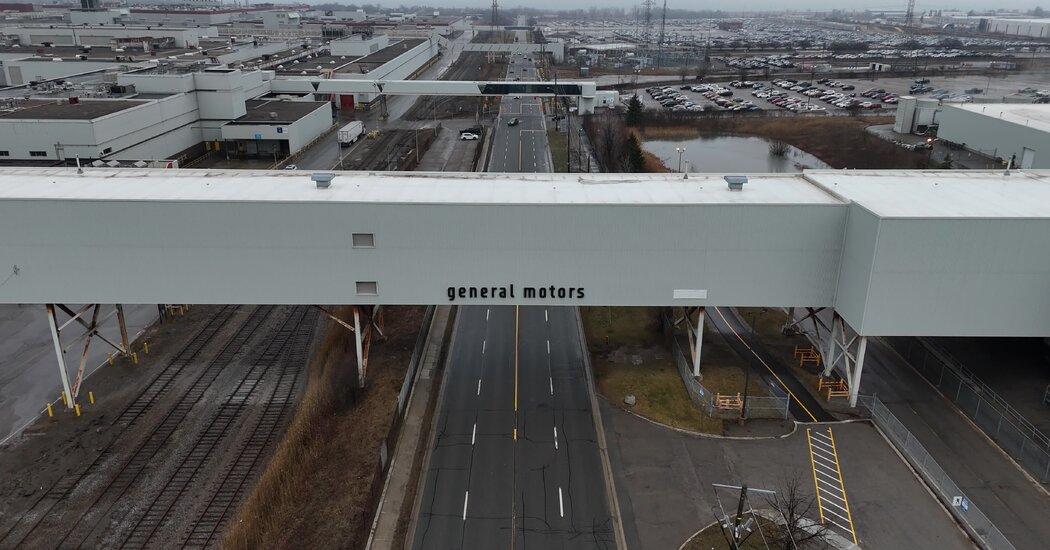
In the golden autumn of 1999, inside the cavernous, rhythmic hum of the General Motors assembly plant in Oshawa, Ontario, a white Chevrolet Lumina rolled off the production line to a sudden, reverent halt. This particular midsize sedan was never destined for a suburban driveway or a highway commute; instead, it became a moving testament to a vanishing era, embarking on a monthlong farewell tour through the labyrinthine aisles of the massive facility. Hand by hand, thousands of workers—whose lives had been measured in shifts, overtime hours, and the steady pulse of the assembly line—stepped forward with permanent black markers to sign their names upon its pristine white body. Today, that vehicle sits quietly in the Canadian Automotive Museum in Oshawa, its surface webbed with thousands of overlapping signatures that no curator has ever successfully counted. Yet the math of that moment remains staggering: in 1999, roughly 22,000 proud, unionized men and women had the opportunity to press ink to metal, representing the high-water mark of a century-long industrial romance. For generations, the American “Detroit Three” automakers did not merely operate in Canada; they built entire ecosystems, transforming towns along the fertile corridor of Southern Ontario into bustling blue-collar strongholds. Across the blue waters of the Detroit River, Chrysler sat as the economic kingmaker of Windsor, providing families with stable livelihoods, while Oakville hummed in harmony with Ford’s sprawling assembly lines and corporate offices. At the height of this industrial gold rush, passenger vehicles and heavy trucks accounted for nearly forty percent of all exports leaving Ontario, cementing a profound, cross-border alliance that promised that if you worked hard, the factory would take care of your children and grandchildren. It was a tangible, noisy, and deeply human manifestation of the American Dream successfully transplanted into Canadian soil, forged in the heat of heavy machinery and secured by the promise of shared, enduring prosperity.
Today, those bustling factory floors are haunted by an unsettling, spacious silence, as the historic footprint of American automakers undergoes a rapid and seemingly irreversible retreat. Under the pressure of shifting global currents and aggressive economic policy changes from Washington, the grand alliance that once defined Ontario’s industrial valleys is unraveling at a breathtaking pace. At the Oshawa GM plant, the once-mighty army of 22,000 autoworkers has dwindled to a mere 2,100 union members—a devastating ninety percent reduction that has left empty parking lots and quiet local diners in its wake. The historic dominance of Detroit’s automotive vanguard has been largely supplanted by the rise of Asian competitors, with companies like Toyota and Honda quietly claiming the lion’s share of domestic production. Where Detroit-based companies once accounted for nearly two-thirds of all auto assembly jobs in Canada just a decade ago, that figure has plummeted to a sobering thirty-eight percent, a decline that industry analysts predict will fall even lower following a string of recent closures. For the families who spent generations building these vehicles, the change is not just a statistic in an academic study, but a profound existential crisis that strikes at the very heart of their communities. Neighbors watch as the plants that paid for their mortgages, sponsored their children’s hockey leagues, and anchored their local economies are slowly hollowed out by forces completely beyond their control. The fundamental question hanging over the industrial parks of Ontario is no longer about seasonal layoffs or contract renegotiations, but whether the American auto industry has any long-term future in Canada at all. Economic historians and labor advocates alike look upon the landscape with a mixture of grief and pragmatism, openly wondering if this represents a temporary down cycle or the final, painful death rattle of a century-old industrial legacy.
The pain of this transition has been severely compounded by the sudden, whiplash-inducing reversal of the global green energy revolution, which has left Canadian workers caught directly in the crossfire of shifting US domestic politics. In an effort to future-proof its economy, the Canadian government poured billions of dollars into massive incentive packages designed to help legacy automakers transition their classic internal combustion facilities into state-of-the-art electric vehicle plants. But when political winds shifted in Washington, bringing a sharp rejection of electric vehicle mandates and a renewed embrace of traditional fossil fuels, those carefully laid plans evaporated almost overnight. Stellantis abruptly canceled its high-profile promises to manufacture a hybrid and electric version of its iconic Jeep in Brampton, moving that production line south to Illinois and hastily selling off its stake in a highly anticipated Windsor battery factory. General Motors followed suit, halting the production of its cutting-edge electric delivery vans and leaving its newly modernized Ingersoll plant in a state of suspended animation, while simultaneously slashing jobs on its traditional assembly lines. Ford, too, abandoned its ambitious, highly publicized blueprints to build next-generation electric SUVs in Oakville, opting instead to pivot back toward assembling massive, heavy-duty gas-powered pickup trucks. This erratic corporate behavior has left thousands of highly skilled Canadian technicians and line workers stranded in a state of constant, exhausting uncertainty, unable to plan for their futures as multi-billion-dollar investments are made and discarded at the whim of foreign political cycles. With the landmark United States-Mexico-Canada Agreement currently locked in a tense cycle of renegotiation, industry leaders openly acknowledge that making long-term business decisions in Canada has become an almost impossible gamble due to the complete lack of stable, predictable rules of the road.
This deepening economic freeze has sparked unprecedented political friction between Ottawa and Detroit, forcing Canadian policymakers to aggressively seek out non-traditional alliances to save their industrial core. The Canadian government has reacted with open indignation to the sudden, unilateral departures of American companies, demanding that corporate executives honor the multi-billion-dollar commitments they made to Canadian taxpayers in exchange for public subsidies. Yet, realizing that relying solely on a hostile or indifferent United States is a recipe for long-term economic ruin, Prime Minister Mark Carney’s administration has quietly begun a dramatic, strategic pivot toward other global economic powers. In a move that would have been unthinkable a decade ago, Canada has partially opened its highly protected domestic market to Chinese electric vehicle manufacturers, allowing a trickle of affordable foreign cars to enter the country under carefully calibrated, low-tariff structures. At the same time, Canadian trade envoys have traveled to Seoul, forging historic agreements with South Korean industrial conglomerates to explore building a parallel automotive ecosystem on Canadian soil that is entirely independent of Detroit’s historic influence. This bold diversification strategy represents a painful, pragmatic recognition that Canada can no longer afford to tie its economic destiny exclusively to the volatile political whims of its southern neighbor. For a nation that has historically viewed the United States as its closest sibling and premier trading partner, this diplomatic decoupling is a seismic psychological shift, driven by the cold reality that in a global trade war, there is no room for sentimentality. As international supply chains are redrawn along lines of national security rather than mutual prosperity, Canadian communities are being forced to adapt to a world where the old family station wagon is just as likely to be built by a foreign conglomerate as it is by a Detroit automaker.
There is a deep, poetic irony in the fact that the very tariffs now threatening to destroy the Canadian auto industry are the exact mechanism that catalyzed its birth over a century ago. At the sunrise of the twentieth century, an enterprising Canadian businessman named Gordon McGregor was struggling to keep his family’s horse-drawn wagon workshop solvent in the muddy streets of Windsor. Recognizing that the age of the horse was drawing to a close, McGregor set his sights on the emerging, miraculous world of horseless carriages, but he faced a massive obstacle in the form of Canada’s aggressive protectionist import duties. Using his unique background as a former customs collector, McGregor realized that while finished, American-made vehicles were heavily taxed at the border to protect local tradesmen, the individual parts needed to build them could be imported at a fraction of the cost. Armed with this crucial insight, he rowed across the choppy waters of the Detroit River and managed to secure a personal, history-making meeting with Henry Ford, who was then in the infancy of building his global empire. By 1904, just a single year after the Ford Motor Company was incorporated in Detroit, McGregor’s makeshift factory was turning imported parts into gleaming Model C cars, birthing the Ford Motor Company of Canada. This ingenious arrangement allowed Ford to bypass Canadian trade barriers entirely and, crucially, use Canada’s unique position within the British Empire to export duty-free vehicles to markets in Australia, India, and South Africa. A few years later, in 1907, another carriage-making family in Oshawa struck a similar bargain with Buick, paving the way for the creation of General Motors of Canada and demonstrating how local ingenuity could turn national trade barriers into a thriving showcase of industrial capability.
The chaotic, piecemeal system of early manufacturing eventually gave way to the historic 1965 Auto Pact, a landmark agreement that revolutionized the industry by allowing duty-free trade of vehicles and components across the border, provided American companies maintained strict production quotas in Canada. This created an era of unprecedented prosperity, transforming Oshawa into a manufacturing powerhouse where GM alone churned out over half a million vehicles annually, culminating in a national peak of over three million cars in 1999. Today, that golden age has dissolved into a quiet, grinding struggle for survival, with national production collapsing to nearly a third of its historical peak, and those remaining jobs largely sustained by the efficient, non-unionized operations of Toyota and Honda. The human cost of this decades-long decline is written on the faces of the thousands of workers represented by labor unions like Unifor, whose leaders carry the heavy burden of negotiating contracts for plants that feel increasingly temporary. As union president Lana Payne poignantly notes, Canada has historically bled more automotive jobs on a proportional basis than the United States, leaving working-class families to bear the brunt of geopolitical posturing and corporate boardroom decisions. Ultimately, the story of Canada’s auto industry is a powerful reminder that global capital holds no loyalty to the communities that built its fortunes, and that even the deepest historical bonds can be severed by the stroke of a politician’s pen. As the signed white Chevrolet Lumina sits quietly beneath the fluorescent lights of the Oshawa museum, it remains a beautiful, heartbreaking relic of a time when an entire city could write its name on the future, reminding us of the dignity of the hands that built the country and the fragile nature of the dreams they forged.