






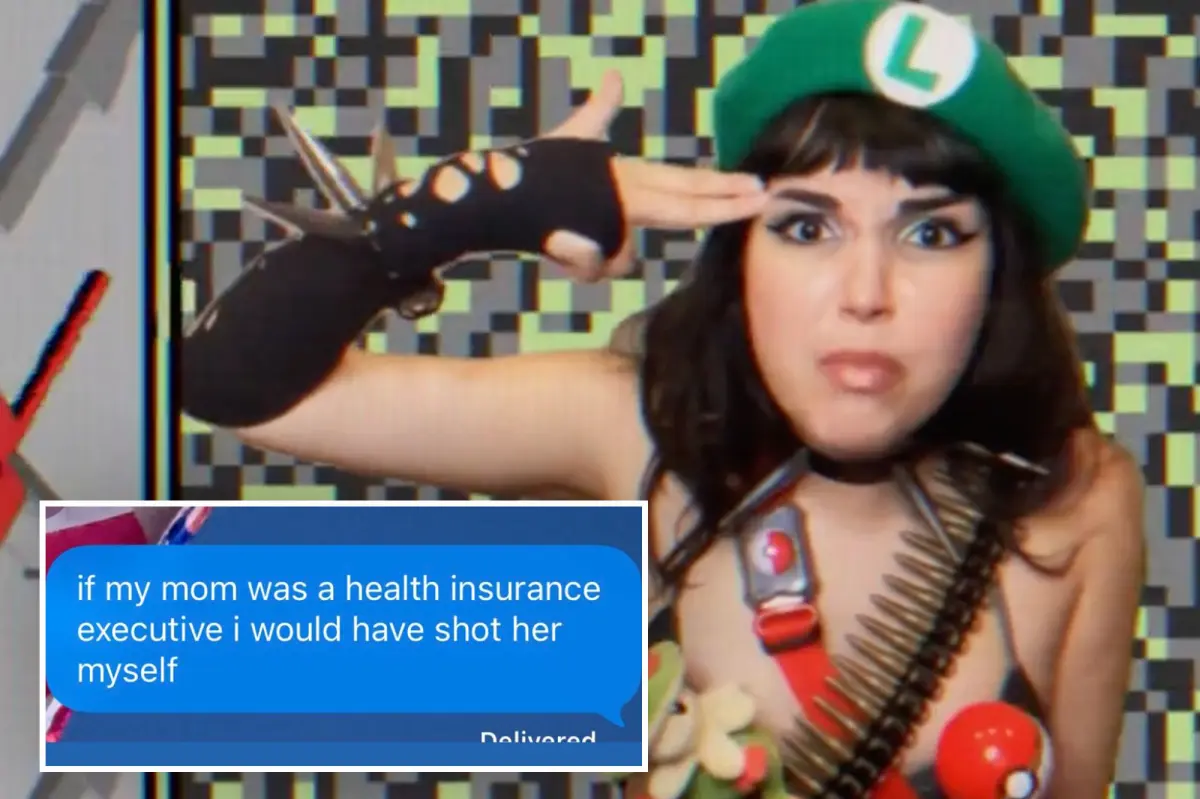
The arrest of Luigi Mangione, the young Ivy League graduate accused of assassinating UnitedHealthcare CEO Brian Thompson, did not merely spark a massive criminal investigation; it cracked open a profound societal fault line, giving rise to an eerie subculture of digital admirers who have found in him a bizarre vessel for their collective grievances. Among the most vocal of these figures is thirty two year old Lena Weissbrot, a Brooklyn based creative whose life and controversial public pronouncements have become a fascinating, if deeply unsettling, case study in modern internet radicalization and generational alienation. Recently thrust into the media spotlight after journalists revealed her fifty seven year old mother, Reina Natero, is a senior manager overseeing prescription drug insurance coverage rules at CVS Health, Weissbrot’s reaction was as swift as it was shocking. Rather than shrinking from the public eye or attempting to diffuse the mounting tension, Weissbrot took to her Instagram stories to deliver a sequence of chillingly provocative statements, going so far as to claim she would execute her own mother if she were a top tier healthcare executive. This explosive declaration, coupled with her cold statement to reporters outside a courthouse that Thompson’s grieving children “are better off without him,” represents a jarring manifestation of how systemic anger against the American medical industry can warp personal relationships, turning what should be private, familial bonds into ideological battlegrounds. By examining Weissbrot not merely as a sensationalized tabloid villain but as a complex human being caught at the intersection of performance art, systemic despair, and digital notoriety, we can begin to understand the deeper, structural rot that drives individuals to romanticize real world violence. Her public statements, cold and detached on the surface, reveal a profound level of alienation, showing how easily the rhetoric of social justice can be mutated into something deeply hostile when processed through the filter of internet echo chambers. By focusing on her words, we see the tragic dissolution of basic empathy in the pursuit of online dominance.
At the heart of Weissbrot’s public meltdown lies a deeply fractured, highly relatable, yet terrifyingly exaggerated mother daughter dynamic that illustrates the profound generational divide in contemporary America. Her mother, Reina Natero, is a corporate professional working within the labyrinthine bureaucracy of one of the nation’s largest healthcare providers, a position that, for many of Natero’s generation, represents stability, professional achievement, and a pragmatic engagement with the existing economic system. In stark contrast, Weissbrot belongs to a generation that has grown up under the shadow of crippling medical debt, soaring insurance premiums, and a widespread perception that the healthcare industry prioritizes profits over human lives. When the media connected these two disparate worlds, Weissbrot’s immediate psychological defense mechanism was to distance her mother from the corporate hierarchy, insisting in private text messages, which she later proudly screenshot and shared with her followers, that her mother was merely a worker rather than an executive. This split second categorization reveals a desperate attempt to reconcile her deep seated ideological hatred for the healthcare system with the reality of her own flesh and blood. However, this defense quickly devolved into an extreme, performative display of ideological purity when Weissbrot declared that she would have shot her mother herself if she had indeed been a health insurance CEO. This shocking projection highlights the tragic breakdown of familial empathy in the face of political radicalization, where the theoretical elimination of a family member is transformed into a badge of honor, signaling to her online peer group that her commitment to the cause transcends even the most sacred of human relationships. From a human perspective, one cannot help but wonder about the profound grief and confusion Natero must feel, seeing her daughter publicly weaponize her maternal relationship for digital clout and political theater, exposing a deep personal wound to a spectator sport of online outrage. This complex dynamic lays bare the terrible price of modern ideological extremism, where love is sacrificed on the altar of our contemporary political posturing.
To truly humanize and make sense of Weissbrot’s jarring statements, one must unpack the complex, often toxic psychology of internet irony, “shitposting,” and the performative fantasies of systemic redistribution that define modern countercultures. In her social media posts, Weissbrot did not merely stop at the hypothetical act of violence; she expanded on her matricidal musings by outlining a detailed fantasy of inheriting her mother’s wealth and redistributing it to families “destroyed” by corporate greed. She then punctuated this dark, theoretical crusade with the highly charged, provocative line, “A fantasy that makes me wet,” before abruptly warning her audience not to debate her on hypothetical situations that do not exist. This seamless blending of extreme political rhetoric with explicit, hyper sexualized language is a hallmark of highly online cultures where shock value acts as currency and irony serves as a shield against genuine accountability. By framing her murderous thoughts as a “fantasy,” Weissbrot attempts to occupy a liminal space where she can simultaneously express genuine, deep-seated resentment toward the super wealthy while dismissing her words as mere play, a defense mechanism that allows her to bypass the moral weight of what she is advocating. This duality highlights a profound sense of helplessness; unable to effect real, institutional change in a massive healthcare monopoly, individuals like Weissbrot retreat into dark, internal fantasies of violent correction, using outrageous statements to shock a system they feel is otherwise completely indifferent to their pain. Underneath the callous, attention seeking exterior lies a human spirit deeply distorted by the perception of an unjust world, choosing to wear a mask of terrifying apathy rather than confess to a vulnerability that feels entirely useless against corporate giants. Consequently, her words become a cry of aggressive despair, a performative shield designed to mask a deeper, desperate wish for societal equity that has been corrupted by the very hostility she claims to oppose. In this light, her shocking posts serve as a tragic testament to the radicalizing power of our digital isolation.
This bizarre blurring of the lines between serious political commentary, digital performance, and real-world tragedy became physically manifest when Weissbrot and her cohorts descended upon the New York State Supreme Court. Dubbed the “Mangionistas” by observers, this trio of self styled fangirl “journalists” managed to secure City Hall approved press passes to cover Mangione’s pretrial hearings, effectively inserting themselves into the formal machinery of the justice system. The presence of these alternative creators in a serious legal space underscores a profound shift in how our society processes and consumes news, where traditional journalistic detachment is increasingly replaced by highly partisan, deeply personal participation. For Weissbrot and her peers, attending the trial was not merely about reporting the facts, but about living out an active narrative, transforming a solemn court proceeding into a stage for their countercultural identities. This convergence of internet subculture and legal reality creates a surreal environment where a family’s private grief the loss of a husband and father is treated as background noise to a carnivalesque celebration of systemic defiance. By treating the court as a performance venue, these young women reveal a troubling detachment from the human cost of violence, yet this detachment itself is a human defense mechanism born from a media saturated environment that continuously treats real world tragedy as entertainment. It highlights a culture where the boundary between the digital screen and physical reality has completely dissolved, leaving individuals unable to distinguish between a provocative online persona and the gravity of a court of law where life and death stakes are decided. In seeking press credentials, they sought validation for their fringe views, forcing a system that they despise to acknowledge them as legitimate voices, further complicating the delicate task of parsing genuine public interest from sensationalist spectacle. This aggressive invasion of legal spaces by digital standard bearers signals a concerning trend where objective justice is reduced to aesthetic content for online consumption, leaving the real human tragedy entirely ignored in the messy judicial process.
To understand Weissbrot as more than just a one dimensional internet caricature, it is necessary to examine her background as an artist, musician, and game developer, which reveals a deeply creative, albeit highly transgressive, drive to process systemic frustration. In June, months before the assassination of Brian Thompson, Weissbrot wrote, produced, and starred in a music video for a song titled “Toolie Toolie,” a piece of disturbing art that directly anticipated the violent sentiments surrounding the CEO’s death. Rapping in a bikini, she delivered lyrics like “The CEO’s a parasite and now they getting shot up,” a shocking artistic statement that, in retrospect, feels like a dark prophecy of the violence that was to come. While critics and the public understandably view this video as a grotesque celebration of murder, it also represents an unsettling intersection of art, alienation, and political protest. For many marginalized or frustrated creatives, art becomes the only arena where they feel they have absolute agency, leading them to push boundaries to their absolute limits in search of a reaction from an otherwise indifferent society. Weissbrot’s creative work, ranging from erotic art to independent game development, paints a portrait of a person who has long operated on the fringes of acceptable culture, using transgression as a primary language to communicate a profound sense of societal sickness. When self expression shifts from critique to the celebration of actual bloodshed, however, the human element of art is lost, replaced by a cold intellectualization that forgets the real, physical pain of the victims and their families, showcasing the tragic point where creative rebellion curdles into genuine, dangerous apathy. This artistic background suggests a woman desperately trying to carve out an identity of significance, mistakenly believing that the loudest, most offensive noise is equivalent to historical impact, a common trap for those seeking purpose in a highly commodified world. Ultimately, her work stands as a poignant reminder of how easily creative energy can be misdirected when desperate individuals lack constructive channels for meaningful change.
Ultimately, Lena Weissbrot’s saga, her corporate employed mother, and her worship of Luigi Mangione serves as a sobering mirror to a fractured collective psyche, warning us of the dangers of unchecked societal polarization and the loss of fundamental empathy. When a population loses faith in its institutions to provide basic care, justice, and survival, the moral vacuum is quickly filled by extreme ideologies, dark online fandoms, and dangerous desensitization to violence. Humanizing this story requires us to look past the sensationalized headlines and recognize the immense tragedy occurring on all sides: a family grieving a murdered executive, a mother enduring the public humiliation of her daughter’s radical statements, and a young woman so consumed by systemic rage that she has lost touch with the sanctity of human life, including that of her own mother. Weissbrot’s path is a stark warning of what happens when societal critique is completely divorced from compassion, turning a struggle for systemic reform into a performative, destructive circus that alienates the very people it claims to want to help. If we are to heal the deep divisions that breed such extreme reactions, we must find ways to address the systemic failures of our healthcare and economic systems without sacrificing our collective humanity in the process. Only by restoring a shared moral vocabulary grounded in empathy, mutual respect, and a genuine commitment to justice can we hope to steer individuals away from the dark, violent fantasies of the internet and back toward the constructive, human work of building a fairer, more compassionate society for everyone. We must remember that behind every headline of internet outrage, real people navigate a chaotic world, and true systemic change can never be built on a foundation of hatred or the casual abandonment of our closest human connections. To prevent further social fragmentation, we must actively cultivate spaces of genuine dialogue that bridge generations, ideologies, and backgrounds, ensuring that the justified anger of a generation is channeled into healing rather than destruction.