






The sudden, painful intersection of raw human tragedy with the unrelenting, highly polarized machinery of modern statecraft has rarely been illustrated with such devastating clarity as in the announcement of Tulsi Gabbard’s retirement from public service. For a woman occupying the office of the Director of National Intelligence (DNI)—a position of immense geopolitical influence that oversees the security, espionage, and strategic operations of eighteen distinct intelligence agencies—the decision to step down is an event of seismic proportions. Yet, when Gabbard announced her resignation, effective June 30, she instantly shattered the unspoken illusion that those who hold the keys to global power are somehow insulated from the fragile, heartbreaking realities of the human condition. Her heavy decision was not driven by the typical motivations of political maneuvering, administrative conflict, or ideological policy disputes. Instead, the catalyst was a devastatingly personal and terrifying blow: her husband, Abraham Williams, had recently been diagnosed with an incredibly rare form of bone cancer. In a single moment, the complex equations of global threat assessments were rendered completely meaningless, violently eclipsed by the quiet, terrifying reality of a spouse’s battle for his life. This sudden shift from protecting the security of a global superpower to shielding the physical survival of a beloved husband serves as an enduringly profound and humanizing reminder of our shared mortality, exposing a fundamental truth that the hyper-political theater of Washington constantly seeks to ignore: that when tragedy strikes, the offices of state are revealed to be temporary, while the sacred covenant of marital love and family devotion remains the only true, unbreakable foundation worth defending. As the news reverberated, it forced a stark contrast between the cold, sterile marble of the Capitol’s corridors of power and the clinical, yet infinitely more frightening, reality of an oncology ward where a family’s true war is fought.
To fully understand the gravity of Gabbard’s choice, one must reflect on the unconventional and fiercely independent journey that brought her to the summit of the American intelligence apparatus, as well as the deep human cost associated with surrendering such a hard-won position. As a U.S. Army Reserve officer, combat veteran of the Iraq War, and former multi-term congresswoman where she passionately represented Hawaii, Gabbard has spent her entire adult life navigating the brutal, high-stakes arenas of national defense, leadership, and public scrutiny. Her political path has been defined by a rare and sometimes controversial independence, famously marching to the beat of her own drum as she transitioned from a rising star within the Democratic Party to an independent voice, and eventually to a champion within the Republican ranks before her appointment in February 2025. Yet, through every intense deployment, grueling election campaign, and storm of media criticism, her husband of eleven years, Abraham—a cinematographer who has quietly supported her ambitions from behind the scenes—has been her absolute anchor. In her deeply emotional, formal resignation letter, Gabbard did not hide behind the clinical language of bureaucracy; instead, she laid bare the profound reality of their life together, describing him as her unyielding “rock” through difficult overseas deployments and the relentless, unforgiving spotlight of the nation’s capital. She wrote with a raw, heartbreaking honesty that she “cannot in good conscience ask him to face this fight alone” while she continued to shoulder the overwhelming, 24/7 demands of a cabinet-level national security post. By choosing her marriage over her career, Gabbard redefined what it means to serve, reminding a deeply cynical public that the highest form of duty is not found in a title, but in the radical devotion of staying by a loved one’s side during their darkest hour.
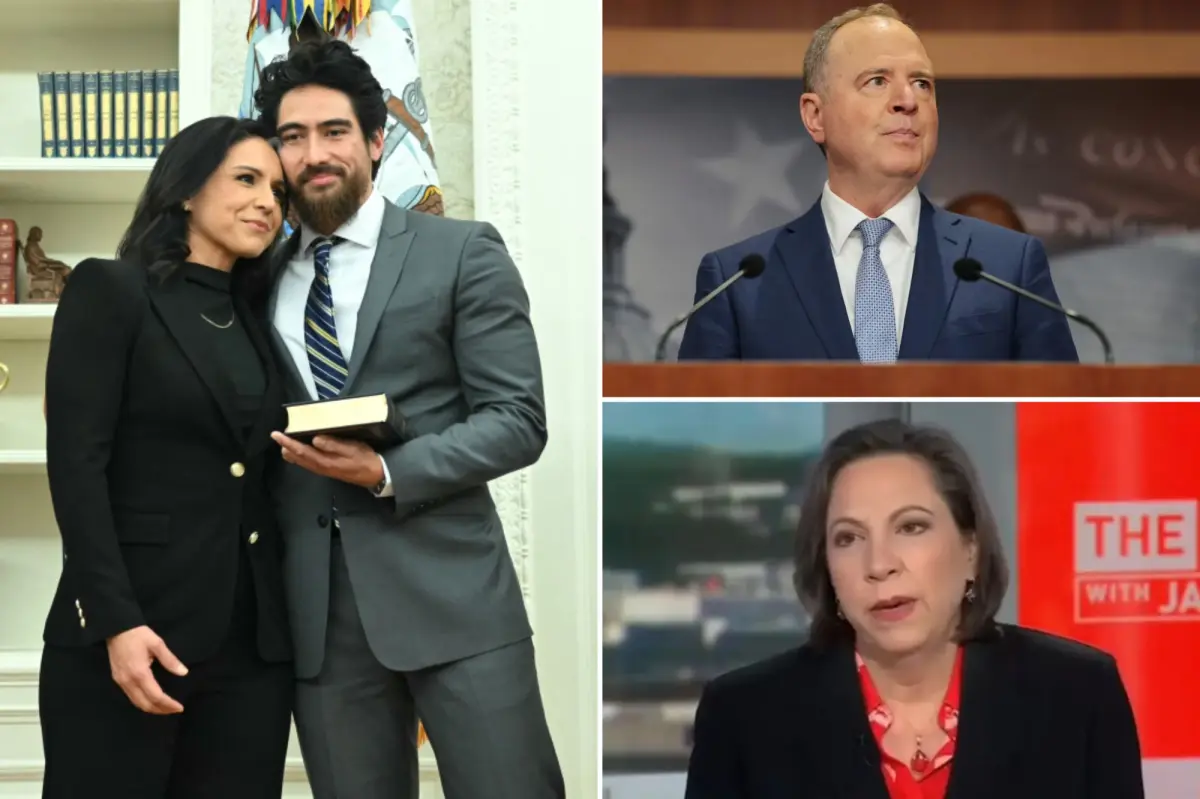
However, the response from the political establishment and the wider media ecosystem stood in chilling, almost grotesque contrast to this display of profound marital devotion, revealing a deep-seated rot in the heart of modern ideological discourse. Rather than prompting a bipartisan pause to offer basic human decency, prayers, or simple quiet respect to a family confronting a potentially fatal medical crisis, the announcement was immediately seized upon by partisan adversaries as an opportunity for political score-settling and cruel partisan mockery. Commentators and guests on major cable news networks wasted no time in reducing a deeply personal and heartbreaking family emergency into a cheap punchline for political television. On CNN, former Deputy Director of National Intelligence Beth Sanner offered a perfunctory, mechanical nod toward the tragedy before executing a sharp, mocking jab, joking that Gabbard’s “DNI” title actually stood for “Do Not Invite”—a comment that felt remarkably callous and unnecessary given the life-threatening context of the resignation. This disdain was echoed by high-profile elected officials, most notably California Democratic Senator Adam Schiff, who took to the digital public square of X to proclaim that while the circumstances of her departure officially deserved sympathy, Gabbard’s “only positive contribution to our nation’s national security is her resignation.” Such vitriolic responses from prominent national figures lay bare the terrifying extent to which political tribalism has anesthetized basic human empathy in modern America, proving that for many in the high-stakes arena of public commentary, a political adversary is never allowed to be a grieving spouse first; they must always remain a target to be demonized, even when standing in the very shadow of cancer. This aggressive lack of basic consideration indicates how deeply the public conversation has been deformed by the digital age, where outrage is incentivized to feed a relentless news cycle.
This swift and unvarnished descent into political cruelty did not go unnoticed, drawing fierce and necessary condemnation from commentators who see this reaction as a cultural bellwether of a society losing its moral center. Speaking on “Fox & Friends Weekend,” Tony Kinnett, a national correspondent for The Daily Signal, called out the immediate, unthinking political pivot, pointing his finger directly at the toxic hyper-acceleration of the modern “social media ecosystem” and the media punditry sphere. Kinnett slammed the contemporary landscape for being built entirely around the shallow, parasitic drive to generate the “spiciest” and most provocative takes the very second news breaks, entirely disregarding the human cost or the real lives caught in the crossfire. He argued that the immediate, venomous attacks on a woman departing her dream public-service job to care for her cancer-stricken husband did not diminish Gabbard, but instead cast a blinding, unforgiving light on the critics themselves, exposing a profound “lack of character” and a “disgusting” hollowness behind their public postures of progressive compassion and tolerance. Kinnett’s analysis touches upon a much deeper, more troubling cultural pathology: the modern societal tendency to worship careerism, institutional status, and professional power at the absolute expense of the quiet, self-sacrificial bonds of family life. In a culture saturated with hustle-oriented ambition, the concept of a spouse willingly stepping down from the physical peak of earthly influence to care for a sick partner is treated by critics not as a noble virtue to be praised, but as an opportunity for political exploitation. Kinnett’s defense of her choice as “the most principled thing you can do” stands as a vital challenge to a cynical world, reminding us that the integrity of our personal relationships must always hold a higher sanctity than professional success, and that prioritizing a loved one is a core measure of real character. When we prioritize the demands of an institution or the applause of a crowd over the quiet, desperate needs of those who depend on us for their very survival, we lose the right to call ourselves a civilized or empathetic society.
Deeply recognizing both the profound personal toll of the family’s diagnosis and the immense, unrelenting duties of the office Gabbard was leaving behind, President Donald Trump responded to the news with a rare public display of warmth and solidarity on his Truth Social platform. Trump defended Gabbard’s decision as entirely “rightful,” emphasizing that prioritizing her husband’s health during this fierce medical battle was the correct, most honorable path to take, while expressing his absolute confidence that Abraham would conquer the disease and emerge “better than ever.” This defense highlighted an administrative reality that often goes unacknowledged: the sheer, crushing scale of the Director of National Intelligence role. Having assumed office in February 2025, Gabbard was responsible for coordinating the defense of a nation facing unprecedented global instability, a duty requiring absolute, round-the-clock availability, constant travel, and exhausting crisis-management decisions that leave virtually zero space for personal life. To expect anyone to successfully lead the massive American intelligence community while simultaneously providing the intensive emotional, physical, and psychological care required by a spouse undergoing grueling bone cancer treatments is both unrealistic and profoundly inhumane. By choosing to depart before June 30, Gabbard made a conscious, courageous choice to step off the global stage of international conflict in order to enter the quiet, localized world of doctors and treatment plans at her husband’s bedside, leaving a vacancy in the administration that serves as a sobering reminder of the very real limits of human capacity. Bone cancer is a relentless, painful, and terrifying adversary that demands a patient’s full focus and a caregiver’s constant vigilance; by stepping down, Gabbard acknowledged that the quiet battles of the heart are ultimately more significant than the loud conflicts of the state, choosing the sacred role of a protective wife over the powerful title of a national security director.
Ultimately and profoundly, this entire episode serves as a powerful, diagnostic mirror for our contemporary culture, forcing us to ask uncomfortable questions about what we truly value when the noise of politics is stripped away. It presents us with two diametrically opposed visions of what it means to be human: one that is cold, transactional, and views every human event—even a life-threatening illness—through the lens of political leverage, and another that recognizes the sacred, non-negotiable primacy of love, marriage, and unconditional family protection. Tulsi Gabbard’s departure from public office may be recorded in the official archives of Washington as a brief, historically unique cabinet tenure, but in the deeper, far more significant narrative of human life, it stands as a triumphant testament to true moral courage. In an era where power is rarely abandoned willingly and where public figures regularly sacrifice their families at the altar of their careers, her choice to lay down one of the most powerful jobs in the world to stand beside her sick husband is a radical, beautiful act of defiance against a culture obsessed with status and influence. While her critics continue to engage in their performative hostility, trading away their basic humanity for fleeting moments of online validation, Gabbard’s quiet transition back to private life serves as a beautiful, enduring reminder of what truly lasts. When the fleeting spotlight of politics fades, and the titles and security clearances are stripped away, the only thing of real substance we leave behind is the depth of the love we had the courage to protect and defend. True strength is not found in the ability to command armies or direct spy networks, but in the quiet courage to actively protect and prioritize the vulnerable, to walk the path of devotion when the cost is exceptionally high, and to understand that our titles will eventually fade into history while the love we show to our families endures forever. In the final assessment, absolute humanity must always triumph over political warfare.