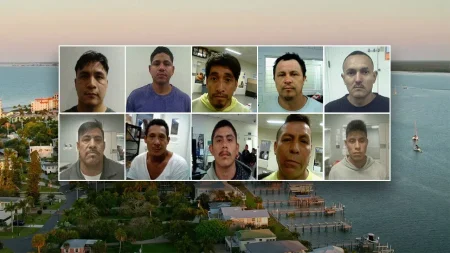






The Offshore Archipelago: How the United States Is Building a Covert Detention System for Deportees
Just seventy miles from the Florida shoreline, a fence rises out of the Caribbean. Behind it, in the same military compound where terrorism suspects were once held, dozens of men and women now wait in climate-controlled tents and repurposed shipping containers. They are not charged with crimes. Many have never seen a courtroom. They were intercepted along the border or picked up in American cities, then flown south to facilities managed by U.S. immigration authorities — far from any American judge, far from the cameras, and in many cases, far from any realistic hope of release. This is not a prison in the traditional sense. It is not a refugee camp either. It is something more ambiguous: an overseas detention site, one node in a rapidly expanding global network that the United States is quietly using to hold deportees indefinitely and without charge.
By now, that network stretches well beyond Guantanamo Bay. As Washington has struggled to project strength on immigration, officials have quietly assembled what human rights advocates describe as an archipelago of offshore detention sites across the Americas. In Panama, migrants have been held at remote jungle-edge camps after attempting to cross the Darién Gap. In Costa Rica, U.S. funded facilities have been used to house people awaiting deportation proceedings. In a series of cooperative agreements with foreign governments, American border enforcement has effectively been exported beyond the continental United States. The purpose, according to administration officials, is deterrence. The message to would-be migrants is simple: even if you make it to U.S. soil, you can be sent to a third country and held there with no clear timeline, no formal charges, and little legal recourse. For critics, however, the message is far darker. The United States, they say, is building a shadow immigration system designed to sidestep the Constitution itself — an offshore network of holding grounds where the rule of law fades the further one gets from Washington.
The legal architecture for this system has been assembled in bits and pieces, often outside public debate. For decades, the United States has relied on Guantanamo Bay’s naval base as a legal gray zone, a place where individuals can be held outside the jurisdiction of U.S. courts. After the September 11 attacks, that status made it the preferred location for suspected terrorists. More recently, however, the same legal ambiguity has been repurposed for immigration enforcement. Migrants intercepted at sea, asylum seekers who arrive at the southern border, and even some individuals already living in the U.S. with expired visas have been transferred to offshore locations while their cases are processed. In many cases, they are not officially designated as criminal defendants. They are not told when they will see an immigration judge. In fact, they are often not told when their detention will end at all. Legal experts point out that the geographic dimension is crucial: because these individuals are not on U.S. soil, the protections of the U.S. Constitution are difficult, if not impossible, to invoke. Habeas corpus, the ancient legal right that allows a prisoner to challenge their detention before a judge, becomes a distant abstraction when the detainees are held at a military base in a country where the host government has no authority over the compound.
The human cost of this approach has been documented by investigative journalists, legal clinics, and human rights organizations. One case that drew international attention involved a Bangladeshi man who had been living in the United States for more than a decade. After a routine check-in with immigration authorities, he was informed that he would be deported. Yet instead of being sent directly to Bangladesh, he was flown to an overseas facility where he remained for nearly two years without criminal charges. His lawyers were unable to visit him. His family, living in the United States, could only communicate with him through occasional encrypted phone calls. When they pressed for information, they were told that his case was under review — a phrase that became a bureaucratic placeholder for indefinite limbo. Cases like this have become common enough that advocacy groups have begun using the term “offshore black site” to describe the growing number of facilities used by U.S. immigration authorities. Not every site is shrouded in the same level of secrecy, but nearly all share a common feature: the detainees have committed no crime that would justify criminal imprisonment, and they are being held solely because of their immigration status. In the absence of formal charges, there is no bail hearing. No trial date. No appointed counsel. And, critically, no end in sight.
The political and financial dynamics of these agreements are equally troubling to observers. In exchange for hosting U.S. detention operations, some governments receive substantial aid packages, equipment, and diplomatic support. Panama, for instance, has received millions of dollars in U.S. assistance to manage migration flows through the Darién Gap, a treacherous jungle corridor that has become one of the world’s busiest transit routes for global migrants. Under the terms of these arrangements, Panamanian authorities often take custody of migrants at the request of U.S. officials, who foot the bill for detention facilities, transportation, and logistics. Costa Rica has similarly become an important partner in what officials describe as “regional migration management.” In public statements, U.S. officials frame these partnerships as humanitarian efforts — a way to prevent dangerous migrant crossings and provide temporary shelter for vulnerable individuals. But behind closed doors, the facilities function as annexes of the U.S. deportation system. Migrants held there are often awaiting transfer to the United States for formal removal proceedings, or in other cases, to countries that are unwilling to take them back. They remain, in effect, suspended between nations, neither accepted nor rejected, neither prisoners nor free men. The host countries themselves have largely avoided public scrutiny by insisting that the facilities are governed by U.S. immigration law. The United States, meanwhile, argues that its obligations end at the border. In this legal vacuum, the detainees have no one to appeal to and no one to advocate for them — except for small teams of lawyers and journalists who have managed to piece together an incomplete map of how the system actually works.
The expansion of this offshore detention network represents a quiet but significant transformation in the way the United States approaches immigration enforcement. For most of American history, immigration detention took place inside the country, under the supervision of courts that could at least theoretically review a case. The new model inverts that arrangement: instead of bringing the migrant to the law, the law is removed from the migrant. By holding deportees on foreign soil, the U.S. government is effectively outsourcing legal uncertainty, placing people beyond the reach of the judicial system while technically not violating any domestic statute. And the strategy appears to be a bipartisan one. Though the Trump administration initiated some of the earliest agreements, the Biden administration has continued and in many cases expanded them. Within Washington, the phrase “offshore processing” is used with increasing confidence, as though it were a normal and accepted policy instrument. But for the men and women caught in this system, the reality is far harsher. They are not criminals. Many are fleeing violence, poverty, or persecution in their home countries. Some are parents who left children behind. Others are young people who have never even seen the countries to which they are being deported. They are held indefinitely, without charge, in places where the American flag flies but American justice does not follow.
What comes next will depend largely on political pressure, litigation, and public attention. Already, a number of lawsuits have been filed challenging the constitutionality of offshore detention, and some federal judges have begun to rule against the government in limited circumstances. Legal scholars argue that the Constitution does not stop at the water’s edge, and that the government cannot evade its obligations simply by moving detainees to Guantanamo Bay or a Panamanian camp. But legal victories, if they come, will likely be slow and narrow. In the meantime, the archipelago is expanding. More countries have been approached about hosting future facilities, and the infrastructure of offshore detention is being normalized as a routine part of immigration control. For those who believe in the principles of due process and the rule of law, the trend is deeply alarming. The United States has long been a beacon to migrants seeking freedom from arbitrary power. But by building a system designed to hold people indefinitely without charge — beyond the reach of courts, lawyers, and public accountability — it is beginning to resemble the very regimes that many migrants risk their lives to escape. This is not a border policy. It is a human rights crisis, unfolding quietly and steadily across a vast, shifting archipelago of American-made detention. And without a strong wave of public scrutiny, it is likely to grow even darker in the years ahead.