






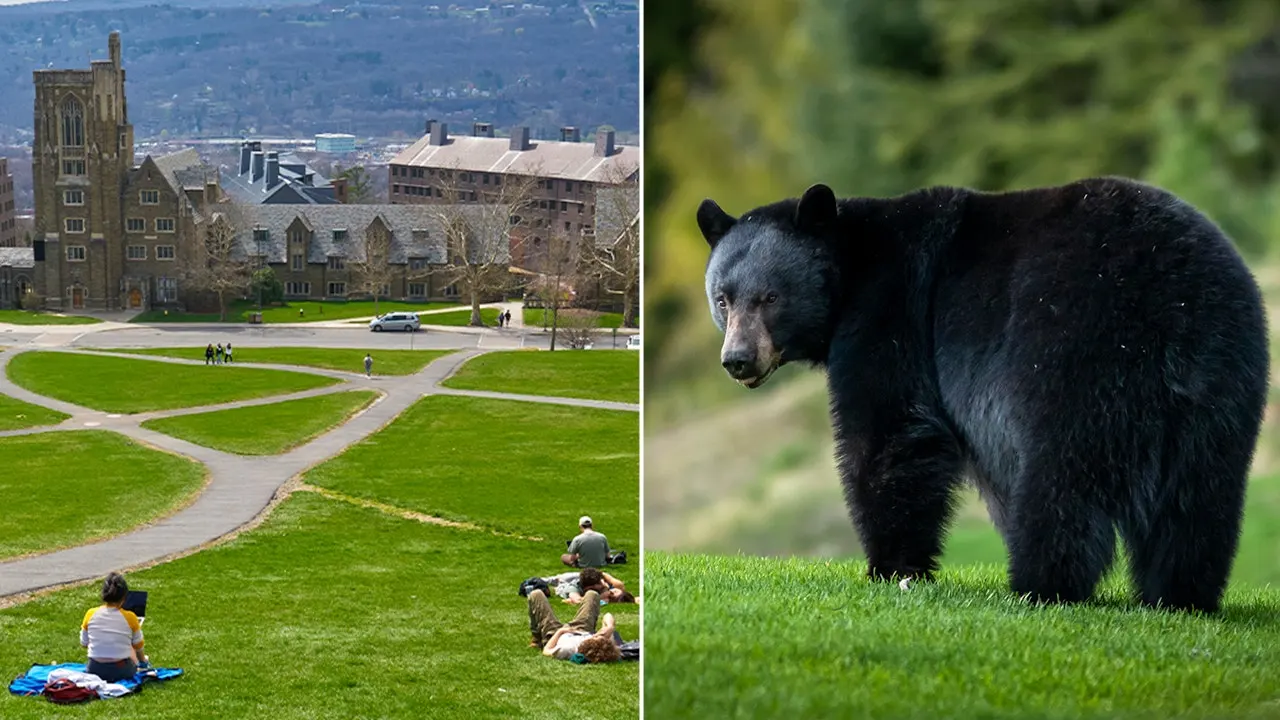
In the manicured, intellectually rigorous landscape of an Ivy League university, one expects to encounter late-night debates over political philosophy, complex scientific formulas scribbled on dry-erase boards, and the gentle, caffeinated hum of students cramming for final exams in historic, ivy-covered libraries. What one does not expect to find, however, is the raw, visceral reality of the North American wilderness splayed across the clean, stainless-steel countertops of a modern dormitory kitchen. Yet, this was precisely the surreal scene that greeted residents of Cornell University’s Ganędagǫ Hall, a state-of-the-art residential facility designed to foster close-knit community living, collaboration, and high-minded academic discourse among the next generation of global leaders. In an event that quickly transcended local campus gossip to become a national viral sensation, two students brought the ancient, primal tradition of the harvest directly into the heart of modern collegiate life by dragging the heavy, dark carcass of a freshly harvested black bear into their communal cooking space. The sight of the massive animal being systematically skinned and prepared for consumption where others normally microwaved instant noodles, steeped tea, or baked chocolate chip cookies sparked an immediate, visceral shockwave throughout the building. It was a bizarre, almost cinematic juxtaposition: the sleek, clinical lines of twenty-first-century institutional architecture serving as an improvised slaughterhouse for one of nature’s most formidable apex predators. This unexpected collision of worlds immediately raised profound questions about the boundaries of shared community spaces, the deep cultural divides that persist within elite academic institutions, and the sheer unpredictability of young adults navigating the transition from the wild outdoors to the highly regulated, sanitized confines of modern campus life.
To understand how a black bear ended up in an Ivy League kitchen, one must look beyond the initial shock value and delve into the lives of the young men behind the skinning knives, particularly Aaron Chin and his hunting partner. Far from being reckless pranksters seeking cheap internet fame or attempting a bizarre collegiate stunt, these two Cornell students were passionate, dedicated outdoorsmen who viewed hunting not as a barbaric sport, but as a deeply respectful, conservation-oriented pursuit and a practical means of sourcing their own sustainable, organic food. Having traveled nearly two hours away from the Ithaca campus to legal hunting grounds, the duo successfully harvested the bear after hours of patient tracking and close adherence to state wildlife management guidelines. Their original logistical plan was entirely conventional and respectful of campus sensibilities: they had arranged to transport the heavy animal to a friend’s off-campus home, where they could properly skin, clean, and butcher the meat in a private, appropriate setting designed for such tasks. However, as is so often the case in both hunting and youth, unexpected circumstances intervened when their friend experienced an emergency that suddenly rendered his property completely inaccessible to them. Stranded with a rapidly deteriorating, highly perishable carcass that represented hundreds of pounds of valuable, organic meat, the students faced a desperate logistical crisis. Refusing to let the animal’s life go to waste, and deeply conscious of the potential social fallout of their next move, Chin and his partner meticulously combed through the extensive Cornell University student handbook and residential guidelines. Finding absolutely no rules, bylaws, or housing regulations that explicitly forbade the processing of legally harvested wild game in communal areas, they concluded that as long as they maintained strict sanitary standards and worked with utmost diligence, they were operating entirely within their rights as tuition-paying residents.
However, the logical, rule-abiding calculations of the two young hunters did not translate well to the sensitive, highly connected ecosystem of a modern, politically progressive university campus. As soon as the first images and videos of the bear-carving session began to circulate on social media, they spread with the speed of wildfire, igniting an intense cultural and emotional firestorm that deeply polarized the Cornell community and captured the attention of the wider public. For many students, particularly those from urban or suburban backgrounds who had never witnessed the reality of meat production, the graphic sight of a large mammal being systematically disassembled in their shared living space was deeply distressing, triggering feelings of disgust, anger, and safety concerns. Online forums and campus dining halls buzzed with fierce debates, exposing a profound cultural chasm between those who viewed the act as a grotesque, disrespectful violation of communal sanitation and those who defended the hunters’ right to process their legally acquired food. Critics lambasted the students for their perceived lack of empathy and common sense, arguing that a public kitchen is a sanctuary of shared hygiene where no one should be subjected to the bloody realities of the wild. On the other hand, defenders of the students pointed out the hypocrisy of meat-eaters who happily consume factory-farmed beef and poultry while recoiling in horror at the ethical, self-reliant harvest of a wild animal. This digital and physical clash highlighted the deep-seated modern disconnect from the origins of our sustenance, turning a logistical emergency into a lightning rod for broader societal debates on conservation, animal ethics, and the clash between rural heritage and elite progressivism.
The escalating public outcry and the viral nature of the incident eventually forced the hand of state regulatory bodies, transforming a campus dispute into an official governmental investigation. Under intense scrutiny from both the public and university administration, inspectors from New York’s Department of Environmental Conservation (DEC) were dispatched to Ganędagǫ Hall to conduct a thorough, rigorous investigation into the kitchen where the carving had taken place. The inspectors meticulously reviewed the timeline of the hunt, verified the legality of the harvest, examined the students’ permits, and assessed the sanitary conditions of the communal kitchen post-butchery. To the surprise of many outraged critics who had called for severe academic and legal punishments, the state agency concluded its investigation with a finding of absolutely zero code violations. The students had indeed followed state hunting laws to the letter, harvested the bear during the appropriate season with all the correct tags, and ensured that the carcass was handled in a manner that met state environmental and health codes. Furthermore, the students had been incredibly diligent about cleanup, scrubbing the communal space to ensure no health hazards remained for their fellow residents. This official vindication highlighted the fascinating paradox of the situation: while the students’ actions were culturally shocking and socially disruptive to their peers, they were, from a strictly legal standpoint, entirely flawless. The DEC’s findings underscored the reality that the modern regulatory state is designed to police conservation and basic hygiene, not the unspoken social contracts and sensibilities of Ivy League dormitories, leaving the university administration to grapple with a loophole that no policy writer had ever anticipated.
Realizing that their existing framework of rules was utterly unprepared for the creative problem-solving of rural-minded students, the administration of Cornell University knew it had to act swiftly to restore a sense of normalcy and comfort to its residential halls. Months after the initial shockwaves subsided and the viral dust had settled, the university quieted the ongoing controversy by officially rewriting its residential code of conduct to close the bizarre loophole once and for all. The newly updated policy left no room for interpretation, stating with absolute clarity that the processing of wild and game animals in any and all community kitchens on campus is strictly and unconditionally prohibited. In confirming the policy change to the student newspaper, university officials did not mince words, openly acknowledging that this specific, highly unusual amendment was a direct, retaliatory response to the infamous Ganędagǫ Hall bear incident. This administrative intervention reflects the classic evolutionary pattern of institutional bureaucracy, where rules are rarely created in a vacuum but are instead forged in the fires of unprecedented student behavior. By formalizing this ban, Cornell sought to reassure its diverse student body that their shared living spaces would remain sanctuaries of predictable, sanitized comfort, free from the visceral and jarring intrusions of the wilderness. It was a decisive assertion of institutional control, drawing a firm, unyielding line between the rugged, untamed natural world of upstate New York and the manicured, orderly environment of its premier academic institution.
Ultimately, the saga of the Cornell dorm bear is much more than a humorous, fleeting internet meme or a quirky footnote in the history of college campus antics; it is a rich, symbolic parable about the complex, often fraught relationship between modern humanity and the natural world. In an era where food is sterilely packaged, wrapped in plastic, and purchased under bright fluorescent lights, the raw act of processing a wild animal serves as a stark, confronting reminder of where our energy actually comes from and the physical costs associated with life. Aaron Chin and his partner’s journey from the deep, quiet forests of upstate New York to the brightly lit, sterile kitchen of Ganędagǫ Hall exposed the fragile boundaries we construct to keep the wildness of nature at a comfortable, intellectual distance. Their story, while resolved by the cold strokes of administrative pens and the creation of restrictive new policies, leaves us to ponder the ongoing loss of practical self-reliance and traditional outdoor skills in an increasingly urbanized, specialized society. As universities continue to evolve into highly controlled, hyper-managed environments designed to shield students from discomfort, the memory of the black bear in the kitchen remains a vivid, defiant testament to the untamed spirit of youth, the enduring call of the wild, and the inevitable, chaotic friction that occurs when the ancient traditions of the earth refuse to be sanitized out of existence.