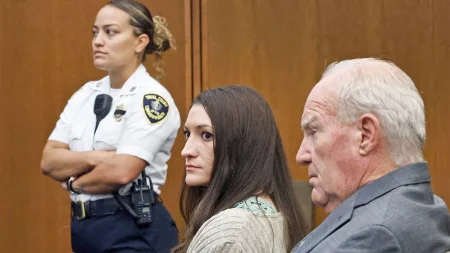







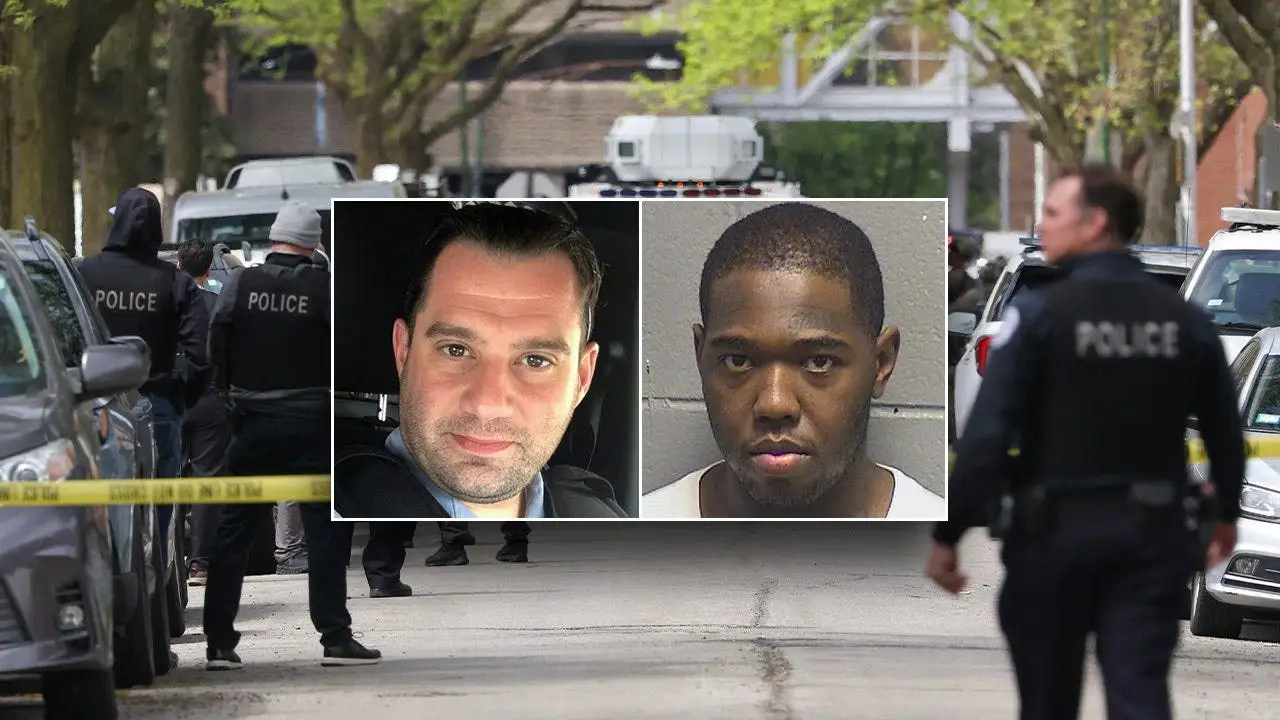
The solemn silence of an Illinois courtroom was broken on Wednesday morning as twenty-seven-year-old Alphanso Talley stood before a judge to plead not guilty to the devastating charges brought against him, marking another painful chapter in a tragedy that has left the city of Chicago deeply reeling. The physical space inside the hearing room became a crucible of raw human emotion, tightly packed with individuals representing two vastly different, yet agonizingly interconnected, realities of urban violence. On one side of the aisle sat the grieving family, friends, and brothers-in-arms of twenty-eight-year-old Chicago Police Department Officer John Bartholomew, a young man whose promise, career, and life were abruptly extinguished in the line of duty. On the other side, seated in the fragile proximity of the front row, were Talley’s mother and close family members, carrying their own silent, heavy burdens of shock, confusion, and sorrow. This profound division of pain was momentarily bridged in a chillingly human instant when, as Talley was being escorted out of the courtroom by county deputies, he turned back to the gallery and cried out, “Go hug my momma.” This raw plea suspended the formal, clinical tension of the court, prompting a man in the gallery to immediately step forward and envelop the weeping older woman in a tight, protective embrace. It was a stark reminder that beneath the clinical, heavily structured environment of the criminal justice system lies a devastating human tax, paid daily in the currency of shattered families, lost sons, and a community left to pick up the pieces of an avoidable catastrophe. This arraignment was not merely an administrative legal step, but a direct confrontation with the ultimate, irreversible consequences of systemic failure, leaving those left behind to grapple with a profound void that no legal ruling can ever truly fill.
The sequence of events that culminated in the fatal shootout at Swedish Hospital on Saturday, April 25, paints a terrifying picture of calculated desperation and the extreme vulnerability that law enforcement officers face in their daily service. Just hours before the tragedy, Talley had been taken into police custody following a chaotic and violent armed robbery at a neighborhood Family Dollar store. Prosecutors allege that during this initial robbery, Talley acted with brutal disregard, pistol-whipping a female store employee before fleeing into the night with her personal keys and wallet. Once apprehended by responding patrol officers, Talley utilized a tactical maneuver that authorities argue was a deliberate, pre-planned ruse specifically designed to exploit police safety policies and facilitate an escape. He informed his captors that he had consumed a dangerous amount of illicit narcotics, triggering standard police protocols that strictly mandate immediate, life-saving medical intervention over immediate punitive detention. Driven by a fundamental duty of care, Officers John Bartholomew and Nelson Crespo escorted the handcuffed suspect directly to the hospital ward, prioritizing his medical well-being over their own personal defense. It was during this period of medical evaluation, after Talley had been uncuffed from his gurney in order to receive proper clinical treatment, that the situation dissolved into absolute horror. Prosecutors claim that Talley had managed to secretly behavior and harbor a loaded firearm beneath his hospital sheets and blankets. Seizing on the officers’ professional compassion, the distraction of medical staff, and the non-combative layout of the clinical setting, Talley allegedly retrieved the hidden weapon and opened fire at point-blank range. This sudden barrage of gunfire killed Officer Bartholomew almost instantly and left Officer Crespo fighting for his life with grave injuries before Talley attempted to make a desperate break for freedom outside the hospital doors. This harrowing sequence of events exposes the dangerous intersection where professional empathy and calculated criminal exploitation collide, illustrating how quickly an act of basic human mercy can be weaponized against those sworn to protect the public.
As the public demand for swift and severe retribution intensifies, the defense presented by public defender Ryan Carlsen introduces a deeply complex, parallel narrative of systemic neglect, childhood trauma, and chronic mental illness that complicates the straightforward label of a violent offender. Following the highly charged hearing, Carlsen spoke candidly to reporters about his client’s profound psychiatric struggles, raising serious concerns regarding the inadequate psychological treatment Talley is currently receiving behind bars. According to his defense counsel, Talley’s entire life has been defined by extreme socioeconomic and emotional instability, characterized by a highly turbulent developmental period during which he was bounced repeatedly between various temporary foster homes within a fragile and overburdened child welfare system. This fractured, highly unstable upbringing left him completely without a consistent maternal structure, early emotional guidance, or the targeted, long-term mental health therapy necessary to address deep-seated trauma. By humanizing Talley’s history, the defense counsel does not attempt to excuse or diminish the horrific and undeniable violence of the hospital shooting, but rather seeks to offer a crucial contextual lens through which to view his tragic trajectory. This perspective shifts the narrative from one of pure, inexplicable malice to a sobering, systematic examination of a broken developmental pipeline that repeatedly failed a deeply troubled youth long before he ever stepped foot inside Swedish Hospital with a weapon. In an urban society that often prefers to view egregious criminal behavior in simplistic, black-and-white terms of absolute good versus absolute evil, the tragic reality of Alphanso Talley forces a painful confrontation with the long-term impact of untreated psychiatric disorders, the deficiencies of the foster system, and the devastating social cost that is paid when vulnerable individuals are allowed to slip completely through the structural cracks of community support systems, only to reappear years later as active threats in the headlines of a grieving city.
Beyond the immediate heartbreak of the courtroom and the sterile walls of the hospital ward, the slaying of Officer Bartholomew has ignited a fiery, nationwide debate centered directly on Chicago’s highly polarizing criminal justice reforms and the efficacy of its regional pretrial release programs. At the absolute heart of this intense, agonizing political firestorm is Illinois’ landmark SAFE-T Act, a sweeping legislative overhaul originally passed in 2021 that effectively abolished cash bail, rendering the state a controversial national proving ground for progressive judicial reform. Critics of this legislation argue that the local system has severely compromised public safety, pointing directly to the shocking fact that Talley—a seven-time convicted felon with a lengthy record including multiple counts of armed robbery with a firearm, unlawful weapon possession, battery on a peace officer, and possession of stolen vehicles—was walking the streets on electronic monitoring at the time of the fatal shooting. This simmering social tension exploded into public view outside the courtroom doors immediately following the arraignment, when an unidentified male citizen engaged in a spirited, highly emotional verbal exchange with Chicago Fraternal Order of Police President John Catanzara Jr., directly reflecting the deep-seated ideological fractures dividing the city’s residents over police accountability and suspect rights. Opponents of the cashless bail system assert that tracking devices and ankle monitors are a dangerously insufficient substitute for secure physical detention, citing troubling municipal statistics that indicate nearly one in twelve felony defendants placed on electronic monitoring in the Chicago area ultimately go AWOL. For law enforcement advocates and mourning citizens alike, Officer Bartholomew’s tragic death serves as the ultimate, heartbreaking proof that current progressive reform efforts, while well-intentioned in their pursuit of systemic equity, have inadvertently created a revolving-door justice structure that prioritizes the liberty of high-risk repeat offenders over the physical safety of community members and the police officers who put their lives on the line daily.
The legal machinery of Cook County continues to grind methodically forward, working to assemble a comprehensive criminal case against Talley that addresses the wide, destructive swath of violent behavior he allegedly exhibited both before and during the hospital tragedy. Following the formal entry of the not-guilty plea, Judge D’Anthony Thedford ruled decisively that Talley must remain held in secure custody without any option for bail as he awaits his upcoming trial, a decision that stands in stark, tragic contrast to the electronic pretrial release he had been granted prior to the shooting. This permanent detention order consolidates an overwhelming mountain of severe, interconnected legal charges, including first-degree murder, attempted murder of a peace officer, armed robbery, aggravated battery, unlawful restraint, escape, and unlawful possession of a high-caliber weapon by a convicted felon. This custody ruling was further reinforced by Judge John Lyke Jr., who moved swiftly to formally revoke Talley’s previous pretrial release terms stemming from his unresolved carjacking and retail robbery cases, effectively closing the controversial legal loophole that had allowed him to walk free with a monitoring ankle bracelet just weeks earlier. The massive scope of the prosecution’s case reflects the sheer velocity of the violence Talley is accused of unleashing over a single weekend, leaving the local prosecutor’s office and defense investigators facing the monumental task of parsing through ballistic evidence, body-worn camera footage, hospital security surveillance records, and dozens of emotional witness testimonies. As both legal teams prepare for the critical June 25 discovery hearing, these ongoing judicial proceedings serve as a highly clinical, methodical attempt to impose structural order onto a sequence of events characterized by sudden, lawless chaos. Yet for the legal professionals involved, the technical complexity of the upcoming trial cannot obscure the raw undercurrent of a community demanding justice, seeking deep accountability, and wanting absolute reassurance that municipal systems can still protect the innocent.
As Chicago braces itself for the long, painful legal road that lies ahead, the true, enduring challenge for the community lies in navigating the profound human cost of this tragedy and finding a way to prevent similar systemic failures from claiming more innocent lives in the future. For the devastated family of Officer John Bartholomew, the passing days and months will do little to diminish the permanent empty seat at their family dinner table, nor will the complex legal process easily heal the deep psychological and physical trauma inflicted upon his surviving partner, Officer Nelson Crespo, who continues his excruciatingly grueling path to recovery. At the same exact time, the family of Alphanso Talley remains caught in their own quiet, agonizing purgatory of grief, confusion, and profound public shame, left to wonder how a young boy who once struggled to survive the foster care program ultimately evolved into a man accused of such a devastating, historic act of violence. This tragedy fundamentally forces the city of Chicago to look far past the simplified political theater of standard press conferences and confront the deeply uncomfortable, interconnected failures of its public institutions: a child welfare system that routinely struggles to protect vulnerable youth, a community mental health network that desperately lacks the resources to treat severe psychiatric illnesses before they escalate into violence, and a criminal justice reform framework that has yet to successfully balance humane judicial progress with the non-negotiable duty of public safety. True healing for this deeply wounded metropolis will not be found solely within the dry confines of an eventual courtroom verdict or the symbolic signing of new state legislation, but through an honest, collective societal effort to repair these fractured municipal systems at their core. Only by addressing the root sociological causes of systemic breakdown, while simultaneously honoring the immense, brave sacrifice of dedicated officers like John Bartholomew who laid down their lives to protect total strangers, can Chicago eventually hope to build a much safer, more compassionate future where justice and public safety are no longer treated as mutually exclusive ideals, but are instead forged together as two sides of the very same protective shield.