





Anatomy of a Stalemate: Whispers of Peace and the Threat of Perpetual War Within the Kremlin’s Elite
Whispers of an Endgame: How Putin’s Ambiguous Rhetoric Sparked Panic and Hope in St. Petersburg
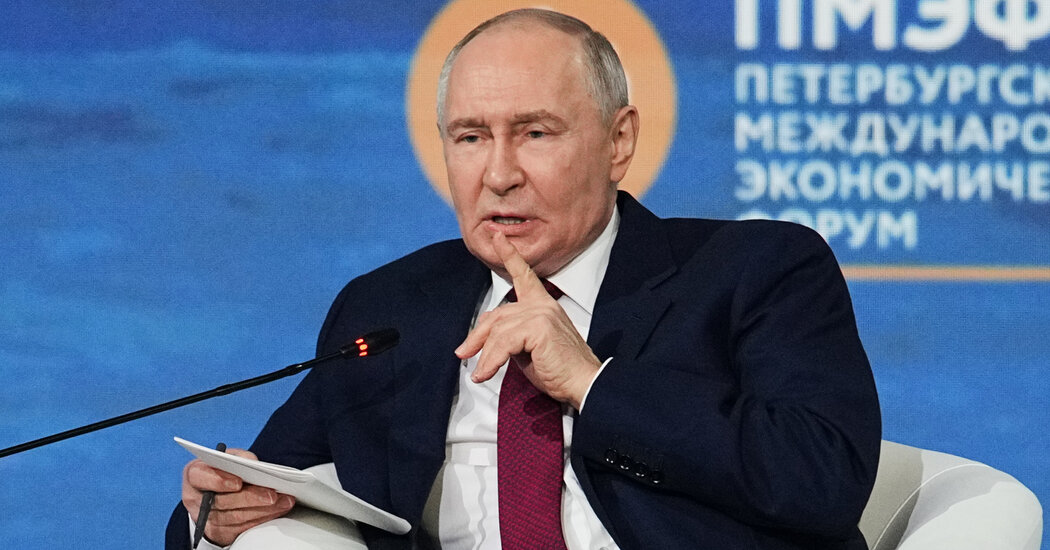
Over the past month, a series of enigmatic statements from President Vladimir V. Putin has sent shockwaves through the upper echelons of Russia’s political and business aristocracy, igniting a quiet frenzy of speculation about the ultimate trajectory of the Russia-Ukraine war endgame. Speaking on two separate public occasions, the Russian leader declared that the devastating conflict was “moving toward its conclusion” and “coming to an end,” phrases that immediately became the most muttered-about topics at this week’s St. Petersburg International Economic Forum—historically the jewel of Russia’s integration into global capitalism. For an elite class that has watched Russia’s global standing fracture, its military stall along bloody frontlines, and its domestic markets warp under the weight of unprecedented Western economic sanctions, these cryptic remarks acted as a highly combustible Rorschach test. To the embattled moderate technocrats and business titans quietly desperate for a return to macroeconomic normalcy, Putin’s words offered a fleeting sliver of hope that the Kremlin might be preparing to wind down its grinding war of attrition before the structural damage to the domestic economy becomes truly irreversible. Conversely, to the hardline hawks who dominate state media and the military-industrial complex, the president’s rhetoric signaled something entirely different: a supreme, unshakeable confidence that Russia has successfully weathered the worst of the Western economic siege and is now poised to dictate the terms of a victorious peace on its own uncompromising conditions. As state-controlled television broadcasts begin to craft a narrative that frames Russia’s current territorial holdings as an unmitigated triumph, the anxious assembly in St. Petersburg found themselves desperately trying to decode whether their leader is genuinely seeking a pragmatic diplomatic exit ramp or merely laying the ideological groundwork to freeze the frontlines while maintaining his sweeping, long-term geopolitical ambitions in Eastern Europe.
The Kremlin’s Crossroads: The High Price of Perpetual War and the Threat of Mobilization
On the heavily guarded sidelines of the glittering St. Petersburg forum, away from the choreographed optimism of the official panel presentations, a sobering consensus emerged among Russia’s power brokers: the nation has arrived at a critical, highly volatile crossroads more than four years into its brutal invasion of Ukraine. For years, the Kremlin has successfully insulated the core domestic population—particularly the affluent and politically sensitive middle classes of Moscow and St. Petersburg—from the grimmest realities of the battlefields in eastern Ukraine, relying instead on marginalized regional recruits, prison populations, and massive financial incentives to sustain its manpower. However, the elites gathered in St. Petersburg increasingly whisper that this delicate social contract has run its course, and that any further prolongation or escalation of the military campaign will require agonizing, politically perilous sacrifices from society at large. To push deeper into Ukrainian territory would necessitate a massive, highly unpopular wave of military mobilization that could shatter the illusion of domestic stability, dragging the children of the privileged class into the trenches and stoking deep-seated public resentment. This internal pressure is precisely what Ukrainian policymakers are banking on; officials in Kyiv have openly stated that their defense strategy is designed to construct an intolerable choice for the Kremlin, forcing Putin to either accept a genuine, negotiated settlement or make the politically destabilizing decision to enact a broad, national wartime mobilization that reaches deep into the heart of metropolitan Russia. This strategic friction has exposed a widening and bitter chasm within the Russian establishment, pitting pragmatic, market-oriented technocrats who see the preservation of the modern Russian state as inextricably linked to a swift end to the conflict against a powerful faction of conservative ultra-nationalists who view the war as a historic, existential crusade that must be waged to the bitter end, regardless of the domestic human toll or economic devastation.
Disconnect on the Frontlines: Putin’s Confidence Clashes with Ground Realities and Rejected Terms
Despite the deep anxieties rippling through his inner circle and the broader business community, President Vladimir Putin himself has dropped the guise of ambiguity, signaling with supreme swagger that he intends to side with the hawkish elements of his regime. Addressing the heads of major international news agencies on the second day of the economic forum, Putin exuded an almost theatrical level of confidence, boldly asserting that Russian forces were advancing steadily along the entire line of contact—a glowing assessment of military prowess that stands in stark, undeniable contrast to the grueling stalemate observed on the ground. Military analysts and even Russia’s own ultra-patriotic pro-war bloggers have pointed out that the Kremlin’s forces have failed to achieve any meaningful territorial breakthroughs for months, leading some to openly question whether the president is receiving accurate intelligence or if he is willfully projecting a fantasyland of military dominance to bolster his bargaining position. This rhetorical gap between battlefield reality and executive boasting extended into the diplomatic sphere, where Putin insisted that any future peace talks would be contingent on Kyiv surrendering its claims to the highly contested eastern Donbas region, pointing back to contested parameters he claimed to have established with former U.S. President Donald J. Trump during an referenced summit in Alaska. He contemptuously dismissed a recent open letter from Ukrainian President Volodymyr Zelensky—which offered a structured framework for a ceasefire and direct negotiations—as an insincere, highly personal public relations stunt designed to denigrate the Russian leadership rather than a serious proposal for peace. By framing Zelensky’s diplomatic overtures as personal insults that destroy the very possibility of face-to-face negotiations, Putin has signaled to both his domestic audience and foreign observers that he remains deaf to the quiet pleas of his own economic elite, choosing instead to double down on his maximalist demands while keeping the door to a genuine compromise firmly shut.
The Chimera of Prosperity: The Looming Threat of an Economic Depression or a Soviet-Style Reconversion
Beneath the thin veneer of state-sponsored optimism that defined the public face of the St. Petersburg forum, the structural fragility of the Russian economy cast a long, inescapable shadow over every commercial interaction. A preeminent Russian economist, who currently directs a critical governmental institution and spoke only on the absolute condition of anonymity to protect his safety, illuminated the terrifying macroeconomic paradox that now traps the nation’s financial planners. According to this insider, the Kremlin has engineered a deeply precarious form of wartime Keynesianism, pouring astronomical sums of state capital into military manufacturing and soldier compensation to artificially inflate gross domestic product numbers and mask the loss of foreign investment. The dark irony of this strategy is that Russia is now entirely dependent on the very conflict that is draining its long-term future; as the economist warned, a sudden end to the war and its associated state expenditures would immediately trigger a cataclysmic domestic depression, as thousands of factories lose their military contracts and demobilized soldiers return to a barren civilian job market. Conversely, prolonging the conflict forces Russia down an equally disastrous path, requiring the state to gradually cannibalize its remaining free-market mechanisms and transition toward a heavily planned, Soviet-style command economy to sustain the war effort amidst dwindling cash reserves and soaring inflation. While high-ranking officials like Finance Minister Anton Siluanov attempted to project fiscal competence by assuring the media that military expenditures were being brought under control to stave off financial destabilization, the structural realities of a ballooning budget deficit and astronomical interest rates remained the polite fiction that everyone at the forum acknowledged in secret but carefully avoided discussing on any public stage.
Backchannels and Shifting Coalitions: The Quiet Struggle for Diplomatic Relevance in a Fractured World
As the official panels focused on highly manicured discussions of domestic development, a far more intense and unpredictable game of shadow diplomacy was playing out behind closed doors, fueled by the complex, shifting dynamics of global geopolitics. Kirill Dmitriev, a prominent Russian envoy who has long acted as a vital, informal conduit between the Kremlin and Washington, painted a surprisingly optimistic picture of ongoing backchannel negotiations, insisting that a quiet dialogue with senior American intermediaries remains highly active despite public hostility. Amid rumors that the administration in Washington is increasingly preoccupied with escalating crises in the Middle East, Dmitriev claimed to have maintained direct contact with influential American figures like Jared Kushner and Steve Witkoff, asserting that the contours of an ultimate settlement—including the highly controversial premise that Western security guarantees for Ukraine are contingent on Kyiv ceding the Donbas region—are well understood by all parties involved. This Russian framing of a bilateral, U.S.-driven peace process, however, is met with deep skepticism in Kyiv, where President Zelensky is actively executing a sophisticated diplomatic counter-strategy to bypass potential American disengagement. Recognizing that political distractions in Washington could freeze vital military and diplomatic support, Zelensky has intensified efforts to draw European heavyweights like Britain, France, and Germany more deeply into the negotiating fold, organizing high-stakes summits in London to forge a robust, security-guaranteed European coalition that can withstand a sudden shift in American foreign policy. Meanwhile, Russian state emissaries continue to mock these European initiatives, framing the intense anger of British and continental policymakers as proof of their failure to prevent a direct, pragmatically driven dialogue between Moscow and Washington, demonstrating how the eventual path to peace remains hopelessly mired in a chess match of competing international alliances.
The Battle for Russia’s Soul: Ultranationalist Hawks Clash with the Technocratic Old Guard
This deep-seated geopolitical stalemate has ultimately catalyzed a profound and public battle for the ideological soul of the Russian state, a civil war of ideas that spilled directly into the open during several explosive sessions of the economic conference. In crowded, suffocatingly packed auditoriums, the hawkish, ultra-nationalist wing of the Russian political class laid out a chilling vision of the future, arguing that society must abandon any lingering fantasies of Western reconciliation and prepare for a state of perpetual, decades-long global conflict. Figures like Andrei Bezrukov, a former deep-cover intelligence officer turned corporate adviser, and Konstantin Malofeev, an ultra-conservative media tycoon, dominated highly popular panels where they advocated for a radical restructuring of Russian society, demanding that the country adopt elements of a rigid, planned economy and even prepare to deploy tactical nuclear weapons to secure an absolute victory in Ukraine. Yet, this aggressive drift toward totalitarian militarism met with surprisingly sharp public resistance from the remnants of the country’s technocratic elite, most notably Igor I. Shuvalov, the head of the state development bank and a former first deputy prime minister. In a powerful, coded defense of the modern capitalist structures that Russia spent three painful decades constructing, Shuvalov warned his compatriots that true technological and economic leadership cannot survive in an environment of total state control, admonishing the government not to repeat the catastrophic economic mistakes of the Soviet Union. As these two irreconcilable factions openly clashed over whether Russia’s future lies in total military isolation or a carefully managed return to global markets, it became abundantly clear that while Vladimir Putin may casually muse about an endgame in Ukraine, the internal war over the political, economic, and moral future of Russia itself is only just beginning to intensify.