




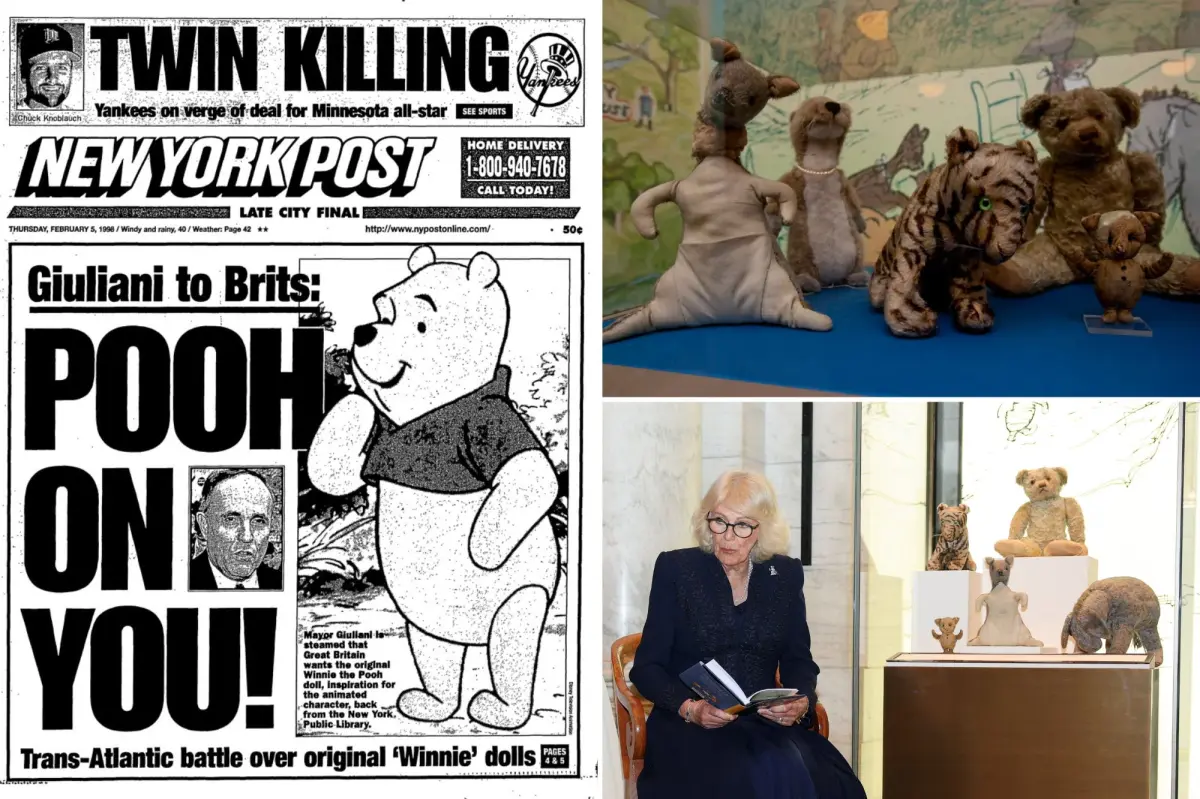
Nobody ever said Winnie-the-Pooh was a diplomat, but the 105-year-old stuffed bear has somehow become the star of a trans-Atlantic tug-of-war. Stuffed animals do not usually appear in diplomatic cables, but this one is no ordinary toy. He is the original teddy bear that belonged to Christopher Robin Milne, the little boy who inspired his father, A.A. Milne, to write one of the most beloved children’s books of all time. For decades, that bear and his well-worn companions—Eeyore, Piglet, Kanga, and Tigger—have been living behind glass at the New York Public Library’s landmark Stephen A. Schwarzman Building on Fifth Avenue, the one guarded by marble lions, just steps from Bryant Park. Now, on the eve of the 100th anniversary of Winnie-the-Pooh’s first publication, the British monarchy has decided to try to bring him home, at least for a visit. Queen Camilla is reportedly leading the gentle pressure campaign, offering the bear lodging in royal castles as though he were visiting royalty himself. Meanwhile, Britain has thrown itself into a full-blown Pooh birthday celebration, with anniversary editions, commemorative stamps, LEGO sets, and a newly authorized sequel called “A Little Boy and His Bear.” But the original bear is not at the party. That has sparked a wave of British displeasure, and an equally firm response from New York, where library officials and politicians insist that Pooh has put down roots. The bear, they say, is a certified New Yorker now, and the royals can fuggedabout it. It is a strange, charming, very human conflict—one that mixes childhood nostalgia, national pride, and a small, threadbare bear who means something different to every generation that has met him.
To understand why an old, worn teddy bear and his friends matter so much, you have to go back to a nursery in England more than a century ago. Christopher Robin Milne did not have a perfectly manufactured set of brand-new toys; he had a group of increasingly shabby, well-loved animals that he dragged through childhood. A.A. Milne looked at those toys and saw stories. He gave them names and personalities—the bear originally called Edward became Winnie; the gloomy donkey with the droopy head became Eeyore; the small pig became Piglet; the kangaroo with the sewn-on pouch became Kanga; and the stuffed tiger became Tigger. When “Winnie-the-Pooh” was published on October 14, 1926, it captured something true about the way children love their toys, and it has never stopped capturing that. But while the fictional versions of the Hundred Acre Wood went out into the world, the actual toys stayed private. They survived, and in 1987 they were donated to the New York Public Library by Dutton Children’s Books, the publisher that had helped bring Milne’s stories to American readers. Since then, they have been on permanent display in the library’s Treasures exhibition, one of the most beloved attractions in a building full of wonders. The toys are not in mint condition; they show every sign of having been loved hard, with patchy fur, worn stitches, and the slightly sagging shapes that only broken-in teddy bears can have. That is exactly why visitors are moved by them. They are not ivory-tower artifacts; they are relics of a real childhood, and somehow that makes the fictional bear feel more real, too. Looking at Christopher Robin’s bear is like looking at a secret doorway into the imagination that created the Hundred Acre Wood.
If the British hoped that New York would soften with the centennial, they have been met with a wall of very American resolve. The New York Public Library’s director of communications, Melissa Grace, issued a statement that was polite in tone but absolute in substance. The library, she said, has been the proud steward of Winnie-the-Pooh and his friends since 1987, when the dolls were donated to the library by Dutton Children’s Books. They are on permanent display at the library’s flagship location in Midtown Manhattan, a cornerstone of its renowned children’s literature collection. Grace also extended an invitation of her own: everyone is welcome to come and see the toys in the Treasures exhibition, free of charge, as part of the 100th anniversary celebration. It is a gracious offer, but underneath it is a clear message: this is where the bear lives, and this is where he is staying. Manhattan Borough President Brad Hoylman-Sigal was less diplomatic. He piled on with a dare to the British, telling them to “come and take it.” The phrase, borrowed from American history, is a deliberately provocative way to end an ownership debate, and it delighted New Yorkers while infuriating some British commentators. That mix of taunt and affection is typical of the city that once took in the bear as an immigrant and now considers him a native. The legal status may be complicated, but the emotional status is not: Pooh is a New Yorker, and New Yorkers do not give up their own.
Queen Camilla has apparently decided that the way to win this battle is not with threats but with charm. Gyles Brandreth, a friend of the Milne family and someone who has spoken on her behalf, insisted that the royal effort is not a campaign but an invitation. The distinction is important: the Crown is not demanding the bear back; it is merely asking if he might be allowed to come home for a little while, even offering to put him up in royal castles if New York would be gracious enough to lend him. That soft approach may be genuine, but it has not moved the library. In the meantime, British columnists have been having a wonderful time with the story. There have been op-eds full of nostalgia about the Hundred Acre Wood, arguments about cultural property, and at least one cheeky suggestion that the United Kingdom should offer Meghan Markle in a quid pro quo exchange for the bear. That idea, meant to be satirical, reveals how strange and emotionally charged the whole affair has become. It is not really about legal ownership or national pride, or at least it does not have to be. It is about what the bear represents. For Britons, he is a piece of their literary identity, a reminder of a quieter childhood world. For New Yorkers, he is a symbol of their city’s long history of welcoming and protecting things from elsewhere. Both sides speak about Pooh with real affection, and perhaps neither is entirely wrong. The quarrel is conducted with smiles and jokes, but underneath it is the simple, poignant fact that everyone wants to be close to something that made them feel safe.
This is not the first time the two nations have gone to war over a stuffed bear. In fact, the current dispute is just the latest chapter in a battle that has been running for decades. The British Parliament began pressing for the toys’ return around the 1990s, arguing that they were part of England’s cultural heritage. In 1998, then-Mayor Rudy Giuliani gave a classic New York response. He refused to hand over Pooh, and went one step further, grandly declaring that the stuffed animal was “an example of the very best in immigration.” That line treated Pooh not as property, but as a success story—a small, furry immigrant who had landed in New York, worked hard, and made the city proud. The New York Post, never able to resist a pun, splashed the story across its front page with the headline “Pooh on you!” The phrase became a kind of motto for the standoff. But Britain did not let the matter rest. Years later, the British government brought the issue directly to the White House. According to a Washington Post report, an aide in Barack Obama’s Oval Office asked the New York Public Library whether a peace deal could be brokered. The answer came from Anthony Marx, then the library’s president, in two words that became legendary within the institution: “The answer is no.” Marx later made clear that he was not going to let a presidential request change the library’s position. The toys had been given to the library, and the library would keep them. That was that. Now Queen Camilla is trying a gentler approach, but the institution’s answer remains the same today as it was in 1998, and as it was when Obama’s aide asked: no.
Meanwhile, the centennial celebration continues in the place that actually has the bear. The New York Public Library is marking Winnie-the-Pooh’s 100th anniversary all fall, with special programs, displays, and even a birthday party for the famous bear. The first Winnie-the-Pooh book by London-born A.A. Milne was published on October 14, 1926, and on that anniversary, New York made clear that it was not going to let the occasion pass without honoring the bear who lives there. Buckingham Palace, for its part, did not return requests for comment. Perhaps there was nothing left to say. The answer had already been delivered, politely but firmly, in statements and headlines and op-eds. Pooh is not going back to England, at least not to live, and likely not even for a vacation. But maybe the most important thing about this strange, sweet controversy is what it says about the power of a fictional bear. Winnie-the-Pooh is not just a book character. He is a feeling. He is the sound of a parent reading aloud at bedtime, the smell of old paper, the memory of a child’s first favorite toy. Both Britain and America want to claim him because both have been shaped by him—the one as the place of his birth, the other as the place that has taken care of his original body for generations. In the end, the bear can be both an English gentleman and a New Yorker. The Hundred Acre Wood has always been a place of imagination, and Winnie-the-Pooh has always belonged to anyone who has ever loved a stuffed animal. He may never cross the Atlantic again, but he does not need to. He has already traveled farther than most toys ever will.