

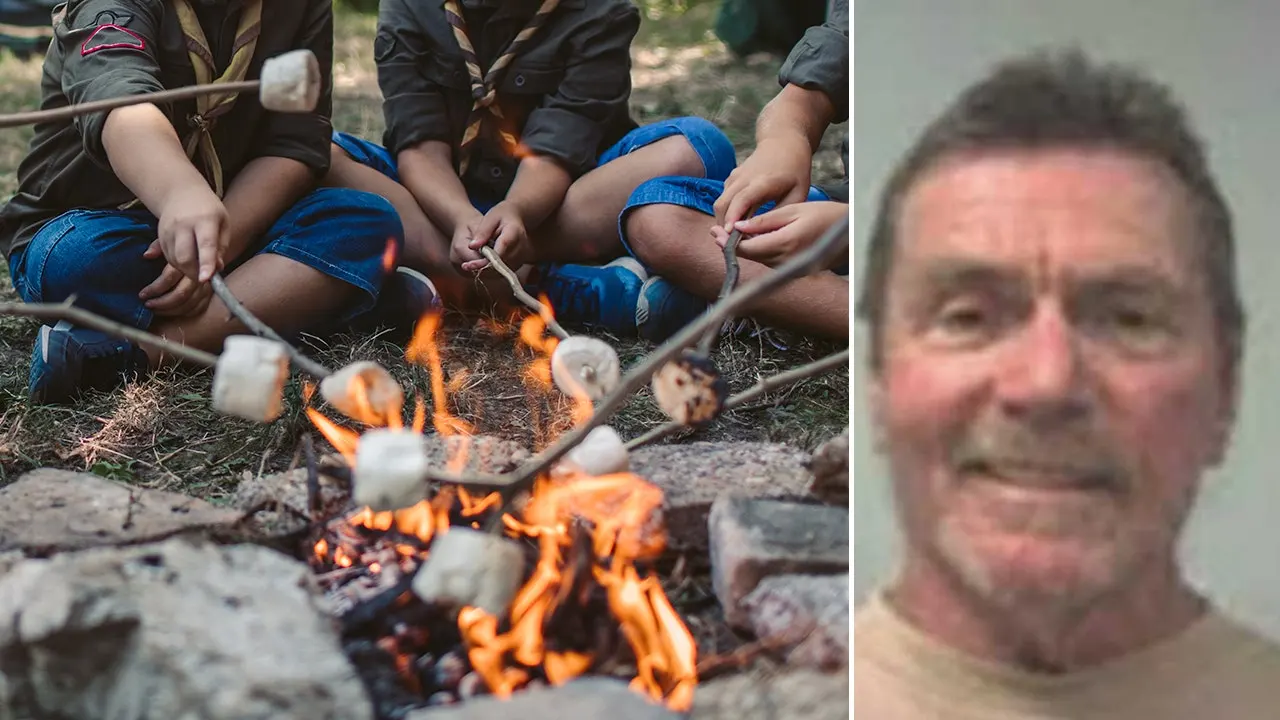
Nestled among the redwood trees and rolling fog of the Santa Cruz Mountains, there is a kind of quiet that most people only dream of. It is a place of winding dirt roads, makeshift mailboxes, and neighbors who look out for one another. Children ride bikes down gravel paths, families gather around fire pits on cool evenings, and the sounds of the forest replace the hum of the city. But for Santa Cruz County Sheriff Chris Clark, that quiet now carries a different kind of tension. State officials are considering a plan to move Michael Thomas Cheek, a 74-year-old convicted rapist, from a locked psychiatric facility into a taxpayer-funded rental home in this very community. The home is valued at more than $800,000, and it sits within a few miles of a Girl Scout camp and local schools. For the sheriff and the residents who call these mountains home, the proposal feels less like rehabilitation and more like a threat arriving at their doorstep.
The community in question is not the kind of place where people expect to become part of a statewide controversy. It is tight-knit, rural, and fiercely self-reliant. Neighbors know each other by name, and they know each other’s routines. When a new face appears, people notice. That is exactly why Sheriff Clark believes this location is so wrong for Cheek. In an interview with Fox News Digital, Clark described the deep unease that has settled over the area since the plan became known. He pointed out that the rugged terrain, while beautiful, is also unforgiving. The narrow roads are often slick with rain and pine needles. Emergency response times are naturally longer than in the flat, grid-like streets of the valley below. If Cheek were to commit another crime, Clark said, deputies would have to navigate a difficult landscape just to reach the scene. “The community for which he’s being considered to be released, it’s a really tight-knit community,” Clark said. “It’s not necessarily the easiest place for us to get to, you know, if and when something were to happen.” That simple admission carries a heavy weight: the people who would be living near Cheek might not be able to rely on the kind of rapid police response that most Americans take for granted.
One of the most troubling aspects of the proposal, according to Clark, is how Cheek would be supervised once he moves into the rental property. The plan likely involves electronic monitoring, a standard tool used to track convicted sex offenders after they are released from custody. But in the Santa Cruz Mountains, technology does not always work the way it does in urban areas. Clark explained that during the winter months, it is not uncommon for residents to lose power for hours or even days. Severe storms knock down trees, and the remote location means that utility crews are often slow to restore service. Without electricity, electronic monitoring systems can become useless. Cell phone connectivity is also extremely poor in many parts of the mountains, which raises another concern. If a neighbor sees something suspicious, or if a family fears that Cheek is lurking near a school bus stop, they might not be able to call for help. “When you talk about our mountain communities, it’s not uncommon that during the winter, you know, these folks lose power. The cell connectivity is extremely poor up there,” Clark said. “And so, when you think about monitoring him electronically, how effective are those systems if you have no electricity? And how about if people can’t call for help if they suspect Mr. Cheek is up to something when cell service is poor?” The sheriff’s questions are practical, but they speak to a deeper fear: that the technology designed to keep the public safe might fail at the exact moment it is needed most.
To understand why this case has stirred such outrage, one must look at the man at the center of it. In 1980, Michael Thomas Cheek was convicted of raping a young woman at gunpoint. That alone would be enough to mark him as a dangerous offender, but his crimes did not stop there. While awaiting trial or after his conviction, Cheek escaped from the Contra Costa County jail. During that escape, he raped a 15-year-old girl at gunpoint. The image of a teenage girl being abducted and assaulted by an escaped rapist is the kind of nightmare that stays with a community for decades. After he was captured and returned to custody, Cheek was ultimately classified as a sexually violent predator, a legal designation reserved for offenders who have been diagnosed with a mental condition that makes them likely to commit future acts of sexual violence. That classification is not given lightly. It requires a finding that the person poses a serious danger to society. For Cheek, it meant that even after his prison sentence was served, he would not be simply released into the world. Instead, he was committed to a locked psychiatric facility, where he could receive treatment while remaining isolated from the public. For many people, the fact that he was allowed to complete a sex offender treatment program in 2019 was a sign that the system was working. But for those who remember the violence of his crimes, it was simply the beginning of a long and frightening legal battle over where he would be sent next.
The state has tried at least twice before to place Cheek in Santa Cruz County, and both attempts failed. Now a third attempt is underway, and the community is bracing itself. Sheriff Clark made it clear that Cheek has no legitimate connection to the area. He is not from Santa Cruz County. He has no family there, no job prospects, no history of building a life in that community. The only tie he has to the county is the violence he committed there. As Clark put it, “Mr. Cheek has no tie to our county. He’s not from Santa Cruz County. And so his only tie here is that he frankly abducted somebody and raped them. And so he victimized people here. And so to me, it is completely unfair and shouldn’t be the case where a county that somebody’s victimized people is then burdened with the thought of having to house him here in one of the most expensive places frankly in the country to live, which we are.” The sheriff’s words cut to the heart of the matter. It is not just that the location is unsafe or that the terrain is difficult to police. It is that the community is being asked to carry a burden that belongs to no one in particular, and that the person being placed there is not a returning resident or a person with roots in the area. He is a man whose crimes left scars on the very county that is now being asked to host him. The fact that the rental home is valued at more than $800,000 only adds to the bitterness. Taxpayer money would be used to provide a comfortable, scenic residence for a man who once terrorized the region, while the families who live there worry about their children’s safety.
The legal fight over Cheek’s housing is set to reach a critical moment on October 30, when a superior court judge will hear arguments about the proposed placement. Until then, the people of the Santa Cruz Mountains are left in a kind of limbo, torn between their desire to be compassionate and their fear for their families. They wonder how a system that is supposed to protect them could allow a convicted serial rapist to live just a few miles from a Girl Scout camp. They wonder what it will mean for their children, their schools, and their sense of peace. Sheriff Clark is not alone in his opposition. The community has rallied around his concerns, and Fox News Digital has reached out to Cheek’s attorney for comment, though none was provided. The case raises profound questions about justice, punishment, and forgiveness. Society must decide how to handle offenders after they have served their time, and there is a genuine need for treatment and reintegration programs. But there is also a need for common sense, for vigilance, and for honesty about the limits of supervision in a remote mountain town. As the leaves begin to turn and the first winter storms approach the Santa Cruz Mountains, the people there are not just worried about the weather. They are worried about a man who may soon be living among them, and about whether the legal system that failed them once will do so again. The mountains have always been a place of refuge for those seeking peace. Now, some residents wonder if that peace is about to be shattered. The road ahead is uncertain, but one thing is clear: the community will be watching, waiting, and praying that the judge hears not just the arguments of lawyers, but the quiet, desperate voices of the families who call these hills home.