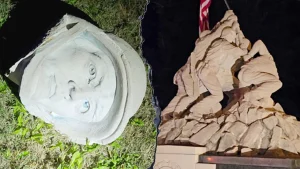



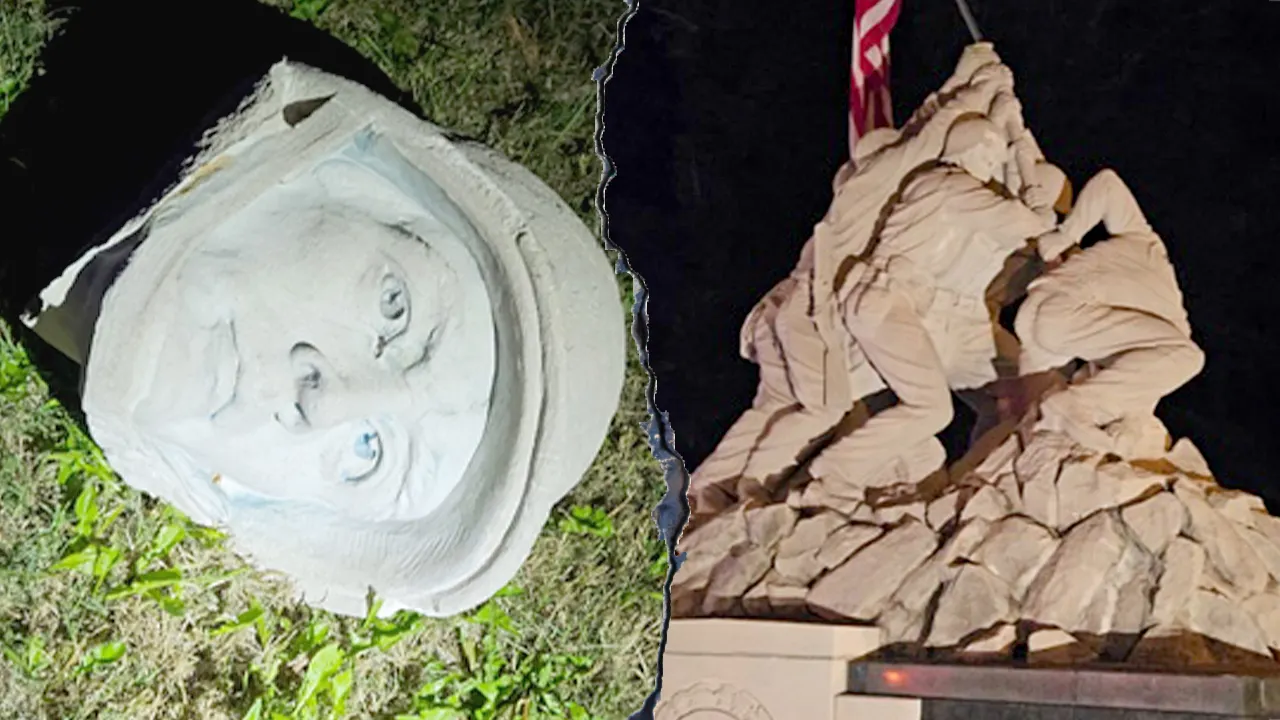
The October night had settled over the Virginia countryside with the kind of quiet that wraps itself around military installations at the edges of the capital region. Cars passed in brief intervals along the roads near Quantico, and floodlights carved pale pools of light across the entrance to Marine Corps Base Quantico—the storied home of Marine training and education, a name that carries generations of warfighting lore. The base, sprawled along the Potomac River, has trained officers for every conflict the United States has fought for more than a century. Then, at 10:13 p.m., the stillness shattered. Officers from the Prince William County Police Department responded to an urgent call and arrived at a limestone monument near the National Museum of the Marine Corps to find a scene that seemed torn from a nightmare: a young man swinging a sledgehammer with crushing, rhythmic force into a sculpted tableau of World War II heroism. Nearby, the modern glass-and-steel museum glowed softly in the dark, its silhouette echoing the very scene under attack. The man, later identified as Miguel Alonso Maldonado Soriano, 27, was subdued and handcuffed without further violence. But the destruction was already complete in its horror. The figure of one Marine—straining beneath the weight of the American flag being raised over Mount Suribachi—had been decapitated, its stone head toppled into the dark grass. Another figure was scarred with deep, violent gouges across his helmet and face. A third had the bayonet on his slung rifle shattered into fragments. The sledgehammer lay where it had fallen, its handle bent from the force of the blows, and the officers who made the arrest were visibly shaken by the mutilation of a sculpture they had passed a thousand times without thinking. The attack, which would cost hundreds of thousands of dollars to repair, left a wound on the American psyche that no sum could begin to heal. Maldonado Soriano was charged with felony destruction of property, trespass with intent to damage property, and felony injury to a monument. That night, a beloved monument to American courage had become a crime scene.
In the days that followed, federal sources began sketching out the biography of the man in custody—a biography that placed him squarely at the center of America’s most volatile debate. Maldonado Soriano was a Mexican national who had entered the United States illegally in December 1999, a small child at the time, barely old enough to hold his mother’s hand. He had grown up American in almost every sense—educated in American schools, immersed in American culture, without any real memory of the country of his birth. In 2014, during the Obama administration, he became a participant in the Deferred Action for Childhood Arrivals program, known as DACA, a policy that shielded certain young undocumented immigrants from deportation and permitted them to apply for work authorization, renewable every two years. DACA did not grant lawful status or a path to citizenship, but for hundreds of thousands of young people it offered a fragile, renewable foothold in the only country they considered home. The term “DACA recipient” itself has become a lightning rod in national politics, evoking both sympathy for innocent children of undocumented parents and frustration over the limits of presidential power to legislate by executive order. Maldonado Soriano’s DACA protections were maintained and extended by the Biden administration in 2024, but in August 2026—roughly two months before his arrest—his status was stripped when the Trump administration declined to renew it, returning him to the ranks of the undocumented. The loss would have left him suddenly, terrifyingly vulnerable to deportation. What drove him to the monument that night with a sledgehammer remains unexplained; no motive has been offered by investigators or his defense. But the White House immediately framed the incident as ammunition in the long political war over immigration. “This criminal illegal alien’s dream is over,” declared White House spokeswoman Taylor Rogers, who described the act as a desecration of the sacrifices of American service members, praised President Trump’s border policies, and accused Democrats of wanting to “flood our communities with dangerous criminal illegal aliens.”
The monument Maldonado Soriano is accused of vandalizing holds a place in the American imagination that few sculptures can claim. It is a 9-foot limestone carving by the artist Felix de Weldon, who was so moved by the sight of Joe Rosenthal’s Pulitzer Prize-winning photograph of the flag-raising on Iwo Jima that he devoted years of his art to transcending it in stone and bronze. De Weldon would go on to create the Marine Corps War Memorial in Arlington, an enormous bronze tableau of six men planting the American flag into a field of rough granite, one of the largest and most visited sculptures in the Washington area. The smaller Quantico statue functioned as a kind of architectural echo of that national icon, placed near the entrance of the Marine Corps’ heartland, adjacent to the National Museum of the Marine Corps, whose distinctive roofline recalls the flag-raising itself. The moment it depicts is seared into American consciousness: February 23, 1945, on the fifth day of the Battle of Iwo Jima, when six men—five Marines and one Navy corpsman—pushed a steel pipe into the volcanic soil of Mount Suribachi and raised the flag, their bodies bent against the wind in a collective act of defiance and hope. Three of those six men would be killed in the weeks that followed, a fact that deepens the image’s poignancy. The battle would rage for more than a month and claim nearly seven thousand American lives, with some twenty thousand wounded, making Iwo Jima one of the costliest engagements in Marine Corps history. The flag-raising photograph gave a war-weary nation a transcendent symbol of bravery; the Quantico statue gave Marines a sacred place to remember it. It was not built to be a major public monument; it was intended instead as a quiet, workday companion to the Marines who pass it daily—a reminder of those who came before them and of the standard they are expected to carry. That quiet intimacy made the assault all the more sickening: a violation not of a tourist attraction, but of the ceremonial rhythms of military life.
As pictures of the damaged sculpture spread across social media and news outlets, the shock was immediate and visceral. The Marine on the far right, his shoulders braced beneath the weight of the flagpole, had been decapitated—the head knocked cleanly from the torso, leaving behind a jagged gap that seemed almost unbearable to look at. The images were difficult for veterans to look at; some reportedly turned away from their screens. Another figure had been assaulted with such violence that the sledgehammer left deep troughs in the helmet and down his face, as though a claw had raked across his features. A third Marine had suffered severe damage to the bayonet attached to his rifle, the weapon slung across his back shattered into shards of limestone. Police estimated the total repair cost at several hundred thousand dollars, but conservators warned that recreating the missing head with any fidelity would be exceptionally difficult, requiring precise matching of the original limestone and close study of archival photographs. The statue had stood in that spot for decades, enduring wind, rain, and time, only to be undone in a matter of minutes by a man with a tool and a fury whose origins remain opaque. Beyond the physical wreckage lay the emotional shock. For generations, this monument has been a pilgrimage site: elderly veterans who survived Iwo Jima making one last journey, active-duty Marines stopping to salute, teachers bringing schoolchildren to explain what the flag means, and Gold Star families draping wreaths at its base in grief and gratitude. To the volunteers who maintain the memorial and the neighbors who tend its grounds, the damage read as personal. The attack on the statue was, to so many, an attack on the memory of the fallen and the living community that honors them—a desecration that turned an altar of American valor into a scene of violence. The sight of a headless Marine was not just an aesthetic outrage; it was a kind of second casualty, a new wound laid over the old ones of war.
The location, too, deepened the meaning of what had occurred. Marine Corps Base Quantico, established in 1917 during the First World War, is one of the most significant installations in the American military: a place where officers are trained, warfighting doctrine is refined, and the Corps’ elite units are prepared for deployments across the globe. It is also home to the FBI Academy and the DEA training center, making it a crossroads not only of the Marine Corps but of the nation’s defense and law enforcement communities, a community where the mission of the military is woven into the fabric of everyday life. Established at the outset of American involvement in World War I, the base has expanded through every major conflict since, from the banana wars to the global war on terror. The nickname “The Crossroads of the Marine Corps” speaks to its role as the point where every newly commissioned officer once passed through training on the way to the fleet, and where the institutional memory of Marines is concentrated. For decades, thousands of young officers have eaten at its mess halls, studied in its classrooms, and learned their first lessons about leading Marines. The monument stood at the threshold of this storied ground, near the museum that pays homage to the legacy of the Corps, within sight of the barracks and parade fields where each generation learns the virtues of courage, discipline, and sacrifice. In recognition of that legacy, the National Register of Historic Places in 2001 listed portions of the installation as the Quantico Marine Corps Base Historic District, encompassing 122 buildings, two landscapes, the damaged sculpture, and a water tower—a formal acknowledgment that this is ground worth protecting. That district status means the damaged statue, as part of it, is entitled to the strict standards of historic preservation—an exacting process that conservators will now undertake. For the men and women who wake at dawn to the sound of bugles and spend their days in training and service, the statue was a daily companion, worn familiar by weather and attention. Its violation was therefore an offense not merely against stone and history but against the living rhythm of the base—an intrusion that, in one brutal hour, turned the institution’s oldest and most cherished values into a headline.
Maldonado Soriano was being held without bond in the days after his arrest, and a court date had not yet been announced. He now faces potential penalties that could amount to years in prison under Virginia’s laws protecting monuments and historic property; Virginia law treats the destruction of memorials with particular seriousness, reflecting a long tradition of safeguarding the commonwealth’s historical legacy. It remains to be seen how the legal process will handle the intersection of immigration status, the collapse of DACA protections, and a crime whose motive is still unexplained. But for the American public, the deeper significance of this crime lies not in the man but in what he failed to destroy. The image of the Iwo Jima flag-raising is far larger than any single sculpture: it exists in the Pulitzer Prize-winning photograph that hangs in schools and veterans halls, in the massive bronze memorial in Arlington where presidents lay wreaths, in the memories of the families of those who fought, and in the very concept of American valor as it has been transmitted from generation to generation. That photograph, which inspired bond drives and shaped the American memory of the Pacific war, was described by historians as one of the most reproduced images in journalism. The Marines at Quantico will continue their daily routines, passing the shrouded remains of the damaged statue as they report to duty. Conservators will take meticulous measurements, search archives, and perhaps carve a new head from matching stone, reattaching it to a body that survived its attacker. But the true restoration is the one that takes place in the national heart—the reaffirmation that such places are worth guarding, that the cost of freedom is never buried in a museum, and that valor, while memorialized in stone, lives finally in the character of a free people. When the court date finally arrives and the legal machinery grinds forward, this case will be remembered not as a war over borders, but as the moment a flag-wounded nation chose, once again, to raise its standard.