

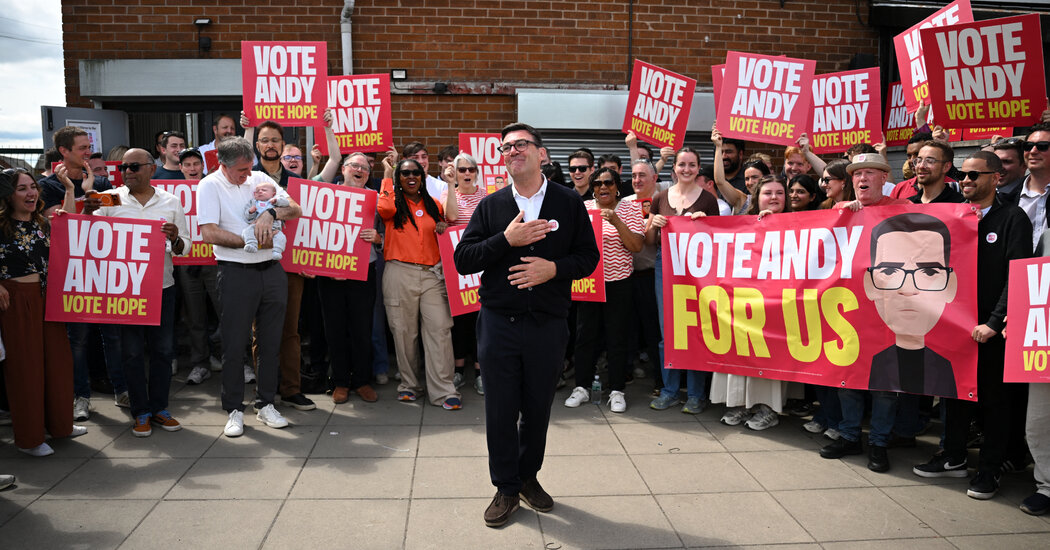
In the quiet, pre-dawn hours of a brisk Friday morning in northern England, a pivotal moment unfolded that could redefine the trajectory of British politics for a generation. Andy Burnham, the high-profile Mayor of Greater Manchester, stood before a weary but electrified crowd of supporters, election officials, and journalists as the final votes were tallied in the Makerfield parliamentary special election. When the returning officer finally stepped to the podium, the announcement confirmed what many had suspected but few dared to state with absolute certainty: Burnham had secured a resounding victory, capturing 24,937 votes—an impressive 55 percent majority of the ballots cast. For Burnham, a seasoned and charismatic politician who has long championed the interests of the north against what he views as a distant, London-centric elite, this win was far more than a local triumph. It was a calculated, triumphant return to Westminster, positioning him squarely on the path to challenge Keir Starmer for the leadership of the Labour Party and, ultimately, the keys to 10 Downing Street. The atmosphere in the counting hall was thick with a mixture of relief, exhaustion, and palpable anticipation, as those in attendance realized they were witnessing the opening salvo of a profound internal struggle for the soul and direction of the nation’s governing party.
As the flashbulbs of press cameras illuminated the stage, a beaming Burnham took to the microphone to deliver a victory speech that was less a standard thank-you and more a fiery, urgent manifesto aimed directly at the party leadership in London. Describing his decisive victory as a “loud cry for change” rising directly from the hearts of everyday working people, Burnham did not mince his words when addressing the current state of national governance under Prime Minister Keir Starmer. “I do say to my own party, this is a final chance to change,” Burnham warned, his voice carrying the weight of a man who has spent years listening to the grievances of communities that feel forgotten by the political establishment. “We must hear it, we must act upon it, and we must get it right. There will be no second chance, but it is a chance now from this result tonight to build a new politics based on unity and hope.” This passionate appeal resonated deeply with a British public that has grown increasingly disillusioned with standard political rhetoric, presenting Burnham not just as a policy-maker, but as an empathetic, authentic advocate willing to speak uncomfortable truths to those in power. By framing the election as a critical fork in the road, he illuminated the deep-seated anxiety shared by many in the Labour ranks who fear that without a radical shift in approach, the party risks squandering its historic mandate.
To truly understand the weight of Burnham’s victory, one must look at the unique character of Makerfield itself, a constituency woven from a rich tapestry of former coal mining villages, quiet residential neighborhoods, and historic market towns. Here, the legacy of heavy industry still lingers in the architecture and the collective memory of the residents, who have weathered decades of economic restructuring, austerity, and social neglect. For generations, these communities were the undisputed bedrock of the Labour movement, yet in recent years, they have become battlegrounds where economic anxiety and a sense of cultural abandonment have made voters receptive to alternative political voices. By choosing Burnham so decisively, the people of Makerfield were not simply returning to the Labour fold; they were endorsing a specific brand of compassionate, hands-on leadership that Burnham cultivated during his tenure as mayor, where he famously fought for better public transport, tackled homelessness, and stood up to Westminster’s pandemic-era restrictions. His victory represents a powerful human connection re-established between a political leader and a community that has desperately sought a champion who understands the daily struggles of making ends meet, keeping local businesses afloat, and maintaining a sense of community pride in an rapidly changing world.
This human connection proved to be the decisive shield against a formidable challenge from the populist right, represented by Nigel Farage’s Reform U.K. party, which had hoped to capitalize on local discontent to secure a breakthrough seat in Parliament. The Reform candidate, Rob Kenyon, put forward a spirited campaign that successfully tapped into persistent frustrations over immigration, the cost of living, and a general distrust of mainstream politicians, earning a second-place finish with 15,696 votes, or roughly 34 percent of the total vote share. While this result was a marked improvement over his party’s performance in the general election two years prior, it ultimately fell short of the seismic upset Reform U.K. had predicted, illustrating the limits of populist anger when confronted with a credible, progressive alternative. Kenyon’s campaign was also somewhat undermined from his own right flank by the presence of a candidate from Restore Britain, a far-right faction that criticized Farage and his allies for not being radical enough. The Restore Britain candidate drew away 3,111 votes—nearly 7 percent of the electorate—revealing a fracture within the right-wing populist movement that ultimately worked in Burnham’s favor, though even a combined right-wing vote would have still fallen short of Burnham’s commanding lead, solidifying his mandate as a candidate who can successfully bridge political divides.
But Burnham’s eyes are clearly set on a much larger horizon, as his victory speech made clear that his mission is also a defense of democratic values against what he sees as a rising tide of intolerance and division. Addressing the crowd, he warned that his political crusade was about steering the United Kingdom “away from the path that takes us to a divided, dark politics of the kind we see in the United States.” This stark comparison strikes a chord with many British voters who watch American political polarization with deep unease, fearing that the same vitriol, social fragmentation, and erosion of public trust could take root in their own communities. By advocating for a politics of “unity and hope,” Burnham positioned himself as an antidote to this divisive trend, arguing that the best way to defeat right-wing populism is not through technocratic indifference or managerial caution, but through bold, compassionate policies that directly improve people’s lives. For his supporters, this philosophical stance is what makes Burnham such a compelling alternative to Starmer, offering a vision of social democratic patriotism that celebrates local identity, rebuilds public infrastructure, and restores a sense of collective purpose and dignity to the British working class.
Now securely back in the House of Commons, Burnham is poised to begin the delicate and potentially explosive process of challenging Keir Starmer, whose approval ratings have plummeted to historic lows since he assumed office nearly two years ago. Starmer, who has struggled to cultivate a warm, personal connection with the electorate and has faced criticism for a perceived lack of clear vision, now finds himself in an incredibly precarious position as the party’s historical factions begin to mobilize. While the Prime Minister has insisted that he will fight to retain his leadership and fulfill his term, the rumblings of discontent within his own backbenches have grown into a steady roar, with several prominent Labour lawmakers publicly suggesting that Starmer should step aside for the good of both the party and the nation should Burnham mount a formal bid. How and when Burnham will choose to strike remains one of the most closely watched questions in British politics, but by winning Makerfield so decisively, he has proved that his political instincts are sharp, his base is energized, and his message is precisely what a fatigued public is longing to hear. Ultimately, this election was not just a local contest in a northern mining district; it was the prologue to a high-stakes drama that will determine who leads the United Kingdom into its uncertain future, guided by a renewed hope that politics can once again be a force for genuine, human-centered change.