

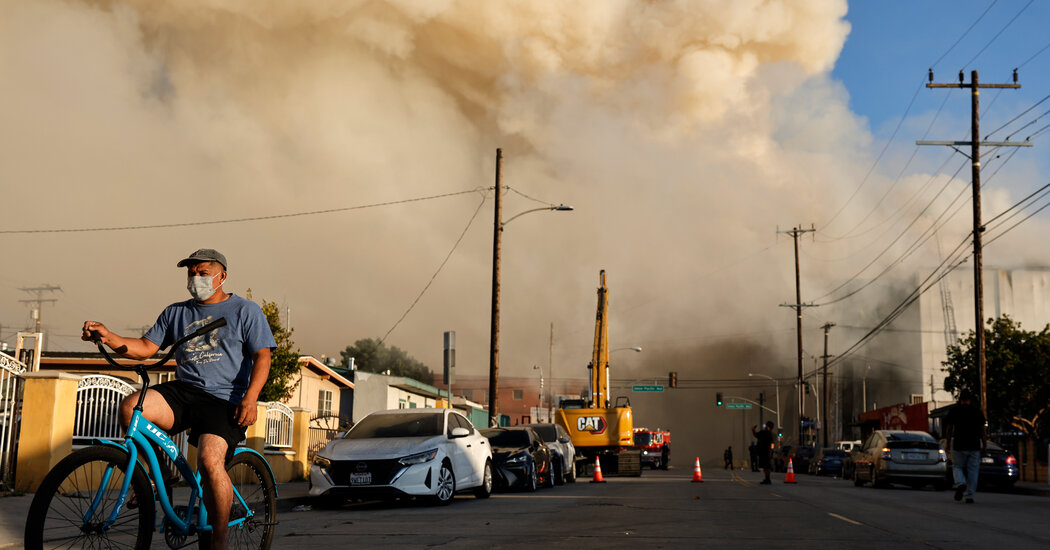
For five long, grueling days, a thick and oppressive blanket of gray smoke has hung stubbornly over the Los Angeles basin, transforming the vibrant Southern California skyline into a hazy, shadow-filled landscape. The fire, which broke out on a seemingly ordinary Wednesday afternoon at a massive cold-storage warehouse in the historic, culturally rich neighborhood of Boyle Heights, has refused to die, smoldering deep within the bowels of the facility and releasing a continuous stream of toxic particulates into the atmosphere. For the residents of Boyle Heights—a close-knit, predominantly working-class community known for its lively street life, colorful murals, and historic plazas—daily life has been abruptly put on hold. The comforting, familiar aromas of street vendors selling fresh churros and regional delicacies have been completely overwhelmed by the harsh, chemical stench of burning insulation, melting plastics, and vaporized industrial packaging. This atmospheric siege has slowly expanded far geopolitical boundaries, carrying fine ash and soot on the coastal winds into central Los Angeles, sweeping across the San Gabriel Valley, and threatening to degrade the air quality as far east as Riverside and Orange Counties. On Sunday, the South Coast Air Quality Management District felt compelled to extend its emergency health warnings, declaring that air particulate levels had surged to “very unhealthy” heights in several heavily populated areas. For vulnerable populations, including young children playing in local parks and elderly residents walking to Sunday services, the simple act of breathing has become a hazard, forcing families to seal their windows, shut down their outdoor activities, and dust off high-grade N-95 or P-100 respirators to guard their lungs against an invisible, airborne threat.
The extraordinary length and intensity of this disaster can be traced back to the highly specialized, ironic nature of the building itself: a colossal, modern icebox that essentially functioned as a giant, insulated thermos. Fighting a fire inside a 500,000-square-foot cold-storage warehouse owned by Lineage Logistics presents a logistical and physical nightmare that few municipal fire departments are ever fully prepared to confront. Built to withstand the scorching Southern California heat and keep millions of pounds of food frozen solid, the structure was engineered with incredibly thick concrete exterior walls lined with highly dense, insulated panels. When the blaze ignited deep within this fortress-like interior, the very insulation designed to keep the cold in acted as a highly efficient shield, trapping intense heat and toxic smoke while preventing water from reaching the seat of the flames. Firefighters from the Los Angeles Fire Department found themselves in a grueling, slow-motion battle, unable to simply vent the roof or smash through windows as they would in a conventional structure. To make matters infinitely more perilous, the facility housed millions of gallons of frozen food products alongside massive refrigeration networks charged with highly volatile and toxic anhydrous ammonia. This chemical element, vital for large-scale refrigeration but extremely dangerous to human health upon exposure, forced hazardous materials teams to work in carefully coordinated, high-stress rotations, desperately trying to bleed off and isolate the chemical threat while battling a subterranean furnace that seemed completely impervious to their initial efforts.
However, after days of tactical frustration and indirect cooling attempts that yielded only nominal progress, the tide finally began to turn on Saturday night, bringing a collective sigh of relief to the exhausted emergency crews on the front lines. The intense, deep-seated heat of the fire eventually did what the firefighters’ heavy tools could not, slowly compromising the structural integrity of the warehouse’s thick exterior walls. As the concrete and metal envelope began to weaken and warp, LAFD commanders seized the opportunity to transition from a defensive, holding posture to an aggressive, direct offensive. Utilizing massive, heavy excavators and specialized demolition machinery, crews began systematically clawing giant breaches into the outer walls, tearing away the insulated skin of the building to expose the glowing, orange heart of the fire that had remained hidden for nearly a week. Captain Jacob Raabe, an LAFD spokesman whose steady, reassuring updates have been a lifeline of information for the anxious local community, explained the critical nature of this breakthrough with practical candor. He remarked that prior to breaching the walls, continuously dumping millions of gallons of water onto the roof was akin to spraying the lid of a boiling pot; it lowered the external temperature slightly but did nothing to extinguish the violent reaction occurring underneath. With the walls finally pried open on Sunday, firefighters could finally position high-output deluge guns and master streams directly into the interior, turning the tide of the battle and allowing Captain Raabe to confidently predict a rapid, noticeable reduction in the choking smoke that has plagued the region for half a week.
The sheer, staggering scale of the logistics involved in this incident serves as a stark reminder of the massive, hidden infrastructure required to sustain a modern global metropolis like Los Angeles. The devastated warehouse, a sprawling commercial behemoth spanning nearly half a million square feet, served as a crucial hub in the regional food supply chain, holding an astonishing 85 million pounds of frozen food products at the time of the outbreak. Owned by Michigan-based Lineage Logistics, one of the world’s largest temperature-controlled supply chain and logistics providers, the facility represented the silent, mechanical heart of the city’s culinary pipeline, a place where vast quantities of frozen vegetables, meats, transport meals, and seafood were consolidated before being distributed to countless grocery stores, restaurants, and schools across the Southwest. The loss of this single node is a significant corporate and logistical blow, but the suspected cause of the catastrophe carries a particularly painful irony for a city striving toward a green energy future. Preliminary statements from a Lineage spokeswoman indicated that the fire is believed to have ignited while private contractors, working on behalf of the third-party owner of the warehouse’s extensive rooftop solar array, were conducting routine testing. This green-energy initiative, meant to harness the abundant California sunshine to sustainably power the massive cooling systems below, instead triggered a multi-day environmental crisis, prompting swift governmental intervention as Mayor Karen Bass and Governor Gavin Newsom both declared local and state emergencies to ensure that unlimited municipal resources and funding could be funneled into the monumental containment and recovery operations.
Yet, even as chemical smoke billowed across the horizon and local health officials warned of hazardous air quality, the sprawling, culturally diverse metropolis of Los Angeles put on a remarkable display of civic compartmentalization and resilience. Just a few miles to the north of the smoldering ruins in Boyle Heights, the legendary, sun-drenched grandstands of Dodger Stadium were packed to capacity on Sunday afternoon, with tens of thousands of passionate baseball fans cheering on the Los Angeles Dodgers as they played a high-stakes game against the Baltimore Orioles, seemingly unfazed by the faint, smoky odor carrying over the outfield. Across the city in Inglewood, an even more massive international crowd converged on the state-of-the-art SoFi Stadium to witness a thrilling World Cup soccer match between Belgium and Iran, filling the air with chants, songs, and a vibrant carnival atmosphere that flatly refused to be dampened by the regional air quality advisories. This surreal contrast—between an active, toxic industrial emergency on one side of town and joyful, world-class sporting spectacles on the other—captures the unique, stubborn character of Angelenos. Having spent decades adapting to the unpredictable rhythms of wildfires, earthquakes, seasonal mudslides, and legendary traffic congestion, the people of Southern California have developed a profound ability to keep moving forward, refusing to let an industrial crisis paralyze their city or diminish their shared passion for community, sports, and normal life.
As the firefighters’ high-pressure hoses continue to douse the final hot spots and the wind begins to disperse the remaining plumes of particulates toward the Inland Empire, the immediate, dramatic phase of the Boyle Heights warehouse fire is drawing to a close, but the long, arduous journey toward healing and recovery is only just beginning. For the residents of Boyle Heights, a community that has historically borne a disproportionate burden of industrial pollution due to its proximity to major freeways and manufacturing corridors, this incident has reignited urgent, deeply felt conversations regarding environmental justice and urban planning. The localized cleanup effort will be an unprecedented undertaking, requiring weeks of careful environmental monitoring as authorities grapple with the disposal of millions of gallons of contaminated runoff water, scorched plastics, and the putrid, decaying remains of millions of pounds of spoiled food. Yet, amidst the soot, the scarred concrete, and the lingering smell of damp charcoal, there is an undeniable, powerful sense of solidarity and relief warming the neighborhood. The clearing blue skies do not just symbolize the end of a respiratory hazard; they represent a hard-fought victory for the courageous men and women of the LAFD, a testament to the resilience of a historic neighborhood that refused to be choked out, and a poignant reminder of the enduring, unbreakable spirit that defines the people of Los Angeles.