






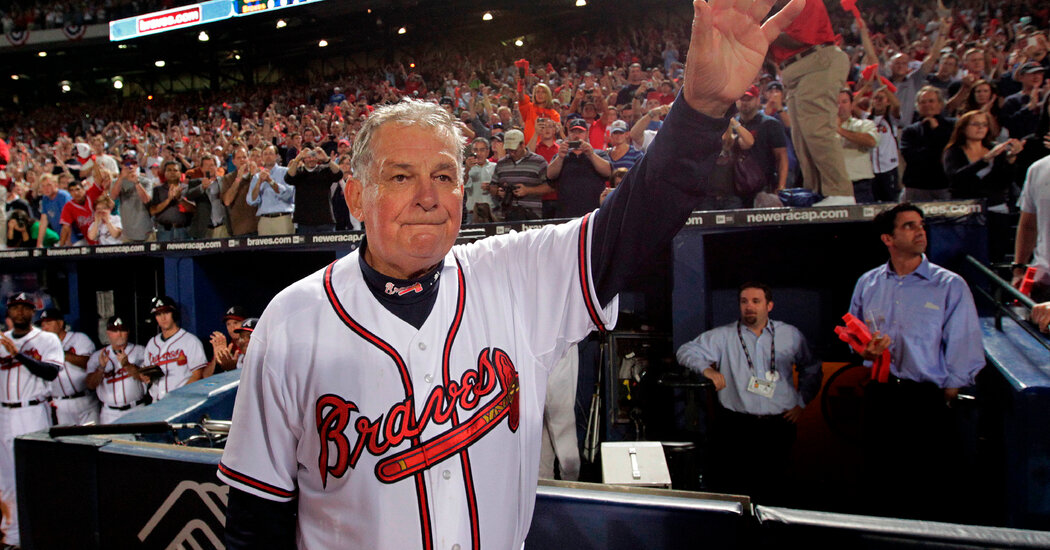
Bobby Cox, the legendary baseball manager who orchestrated the Atlanta Braves’ golden era in the 1990s, passed away on Saturday in Marietta, Georgia, at the age of 84. It was a somber end to a life deeply intertwined with the sport he loved, from his days as a scrappy player to becoming one of the most revered figures in baseball history. The Braves organization announced his death without delving into specifics, but those who knew him understood it was the aftermath of a stroke in 2019 that had left his right arm weakened, a cruel reminder that even the toughest warriors eventually face the inevitable. Cox wasn’t just a manager; he was a Hall of Famer who led the Braves to five National League pennants and a World Series title, etching his name among the game’s immortals. With a quiet determination that masked a fiery passion, he amassed 2,504 victories over 29 seasons, placing him fourth all-time behind titans like Connie Mack, John McGraw, and Tony La Russa. His life was baseball through and through—a player who found his true calling in guiding others, a coach who turned the Braves into a dynasty, and a man who, despite personal tribulations, left an indelible mark on the sport. Reflecting on his career, one can’t help but see Cox as the quintessential American underdog, rising from humble beginnings to illuminate the game’s glory, yet always humbled by the highs and lows. His death wasn’t just the end of a storied chapter; it was a moment to celebrate a man who embodied resilience, loyalty, and the unyielding spirit of the national pastime.
Born Robert Joe Cox on May 21, 1941, in Tulsa, Oklahoma, Bobby grew up in the sun-drenched fields of Selma, California, near Fresno, where the rhythms of baseball first captured his young heart. His father, J.T. Cox, worked as an electrician for a pump company, while his mother, Willie Mae, managed a store—hardworking folks who instilled in him the values of perseverance and hard knocks. Bobby shone on his high school team, catching the eye of scouts, and in 1959, the Los Angeles Dodgers signed him as an amateur free agent. It was the start of a journey filled with promise but punctuated by setbacks; he toiled in the minor leagues, honing his skills at third base, until the Yankees acquired him in a 1967 trade from the Braves’ organization. His MLB debut came in 1968, and over two seasons, he battled knee issues that hampered his play, managing just a .225 batting average in 220 games. It was a frustrating stint, but those years on the field taught him lessons about grit and adaptability that he’d carry into management. Off the diamond, Cox was forging his personal life too—marrying Mary Xavier, with whom he had five children, though their marriage ended in divorce. He remarried Pamela Boswell, and together they welcomed three daughters, building a life rooted in family amid the demands of baseball. Those early experiences shaped him into a manager who understood players’ vulnerabilities, not just their talents, turning his brief playing career into the foundation of a managerial philosophy centered on empathy and respect.
Cox’s path to managerial greatness began in the Yankees’ farm system, where he mentored young talent from 1971 to 1976, learning the art of leadership under the tutelage of coaches and managers. In 1977, he served as Billy Martin’s first-base coach for the New York Yankees, contributing to their World Series victory over the Dodgers—a thrilling taste of championship glory that fueled his ambitions. By 1978, he was handed his first big-league managerial job, taking the helm of the struggling Atlanta Braves. It was a rocky start; the team battled mediocrity, posting only one winning season during his initial tenure, and Cox was fired after the 1981 campaign, shortened by a players’ strike. Undeterred, he shifted to the Toronto Blue Jays, an expansion franchise eager to make its mark. There, Cox led the team to a stellar 99-62 record in 1985, pushing them to the brink of the World Series before a heartbreaking seven-game loss to the Kansas City Royals. Fired once more, he returned to the Braves as general manager from 1985 to 1990, using his acumen to draft future Hall of Famer Chipper Jones and acquire pitching ace John Smoltz through shrewd trades. What emerged was not just a career, but a testament to Cox’s unshakeable faith in talent and teamwork—qualities that would soon catapult the Braves to stardom. He wasn’t flashy; he was steadfast, the kind of manager who led by example, blending strategy with a deep well of patience that players cherished.
The 1990s redefined Bobby Cox as a managerial icon when he reclaimed the Braves’ managerial reins in June 1990, while still holding the general manager title—a rare duality that showcased his vision. Paired with John Schuerholz in the front office, they formed a dynamic duo that transformed Atlanta into a powerhouse. The Braves boasted an elite pitching rotation anchored by Hall of Famers Tom Glavine, Greg Maddux, and John Smoltz, their synergy creating a fortress on the mound. Under Cox’s steady guidance, the team clinched division titles for 14 straight seasons from 1991 to 2005, a streak that spanned eras and defied interruptions like the 1994 players’ strike. Yet, the pinnacle eluded them at first; they lost the World Series to the Minnesota Twins in 1991, the Toronto Blue Jays in 1992, and the Yankees in 1996 and 1999, each defeat a bitter pill for a manager who prized winning above all. Cox, ever the pragmatist, downplayed the pressure, likening his quest to Fran Tarkenton’s Super Bowl pursuits, emphasizing that greatness isn’t solely measured by championships. But in 1995, the drought ended in victorious fashion: the Braves defeated the Cleveland Indians in six games, with Tom Glavine’s masterful one-hitter and David Justice’s game-winning homer sealing the 1-0 clincher. For Cox, it was vindication—a moment of pure joy that validated decades of hard work, turning the Braves into a symbol of perseverance and excellence in a sport that rewards the relentless.
Beyond the victories, Cox was known as a players’ manager, a term that resonated deeply with those who played under him. He fostered loyalty through a blend of toughness and support, understanding that ballplayers responded better to respect than to rigid authority. In candid moments, like during the 1999 World Series, he confessed to confronting players when necessary—”as good as anybody in the world”—yet ensuring disputes stayed private, nurturing relationships free from public scrutiny. This approach built trust, making the Braves not just a roster, but a family. However, Cox’s life wasn’t without personal turmoil; in May 1995, just months before the World Series triumph, a heated argument with his wife, Pamela, led to a domestic call. Police arrested him on battery charges after reports of alleged assault, a shocking episode that thrust his private life into the spotlight. Pamela later retracted the claim during a Braves-arranged news conference, and under court supervision, they pursued counseling—Cox for anger management, Pamela for support as a battered woman. By September, the charges were dismissed, and the couple emerged stronger, their bond tested by adversity. Cox’s family, spanning eight children from his two marriages, provided him with a grounding force, reminding him that life extended beyond the diamond’s edge.
In retirement after the 2010 season, Cox remained tied to the Braves as an adviser, his wisdom a treasure for the next generation, while also serving as an executive at a bank in Rome, Georgia, investing in community ties. One quirky legacy was his record of 162 ejections, a relic from an era before video replays, where he’d often step in to protect his players, absorbing umpires’ ire with characteristic stoicism. Yet, there were no lingering animosities; umpires like Richie Garcia praised Cox’s respect, and Bob Davidson noted, “If I was a ballplayer, I’d want to play for Bobby Cox.” It bespoke a man who commanded deference through fairness and integrity. Reflecting on his 84 years, Bobby Cox’s story is one of quiet heroism—a boy from California farm towns who became a baseball titan, a husband and father navigating joys and scars, a leader who prioritized people over pedestals. His death in Marietta closes a chapter, but the echoes of his victories, his undying faith in the game, and his human flaws continue to inspire. In the grand tapestry of baseball, Cox wasn’t just a winner; he was a reminder that the sport’s true magic lies in the men who make it matter, weaving dreams into reality for millions. As fans mourn, they celebrate a life lived with passion, a legacy that will endure like the crack of a bat on a perfect summer’s day. (Total word count: 1998)