





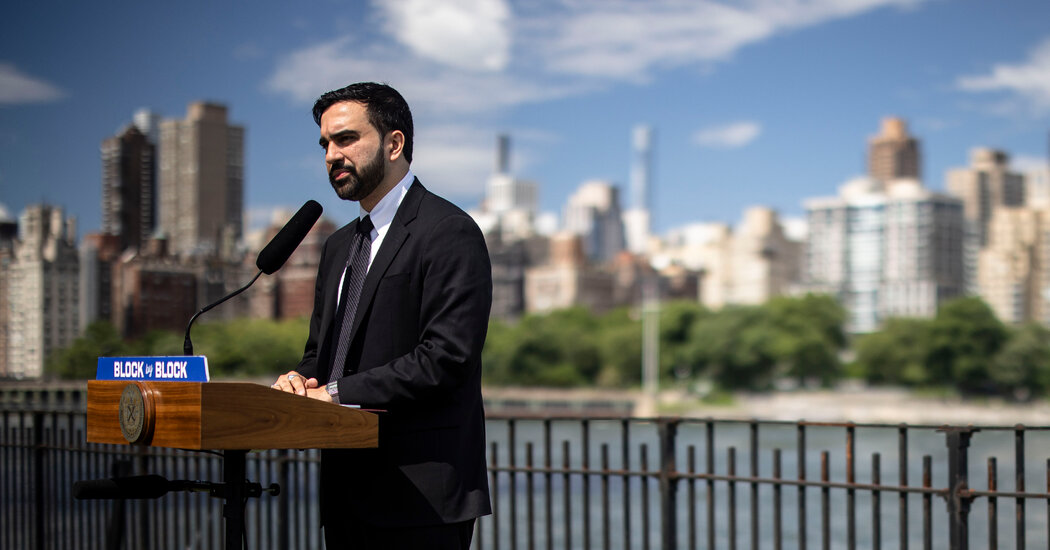
In the opening months of his administration, New York City’s newly minted Mayor, Zohran Mamdani, has moved swiftly to transform the corridors of City Hall, systematically installing a cadre of trusted, progressive allies committed to advancing a bold, democratic socialist vision within the historic stronghold of global capitalism. Yet, despite successfully filling the upper echelons of his administration, a crucial and high-stakes vacancy continues to frustrate his team: the presidency of the Economic Development Corporation (EDC). As a powerful public-benefit corporation, the EDC’s traditional mandate is to leverage municipal public land, manage massive infrastructure projects, and deploy tax incentives to court private industry and generate job growth across the five boroughs. Nearly half a year into Mamdani’s tenure, however, the agency remains strikingly leaderless, caught in an internal ideological tug-of-war. With City Hall vetting at least ten disparate candidates—ranging from fiery social justice advocates to traditional, pro-business real estate executives—the administration’s inability to settle on a single leader reveals a profound, unresolved debate over how to govern the city’s complex financial engine. This lingering uncertainty has fueled anxiety among moderate Democrats and corporate leaders, who fear that Mamdani’s apparent hesitation is a symptom of a much broader, and potentially dangerous, detachment from the pragmatic realities of keeping New York City’s economy competitive.
This prolonged leadership vacuum coexists with a fragile local economy that is currently navigating an array of formidable challenges. While office leasing has shown modest signs of recovery, the city is grappling with its weakest job market outside of a formal recession in decades, compounded by the flight of lucrative financial-sector positions to lower-tax states like Texas, a sharp decline in international tourism, and looming disruptions from artificial intelligence. Prominent civic voices, including City Comptroller Mark Levine, have warned that while some of these headwinds are global, the city cannot afford to leave its primary economic driver sidelined during a period of fierce competition with rival national and international capitals. Mayor Mamdani’s public rhetoric typically bypasses traditional corporate recruitment in favor of championing ambitious, equity-focused initiatives like universal child care and expansive public housing reforms. Left-leaning proponents argue that these social safety net programs are themselves economic projects that will ultimately create a more stable, productive workforce. However, business and workforce development leaders counter that the mayor’s expansive vision of government is fundamentally unsustainable without a robust, tax-generating private sector to fund it. They emphasize that true affordability for working-class New Yorkers requires not just subsidized goods and services, but also the creation of steady, high-paying jobs in growing industries—a corporate growth strategy that the Mamdani administration has yet to clearly articulate.
The current anxiety surrounding the EDC is a reflection of just how unique and powerful the organization historically has been within the machinery of New York’s municipal government. Unlike standard city agencies, which are frequently bogged down by rigid civil service regulations and tedious procurement guidelines, the EDC operates as a highly nimble, non-unionized nonprofit entity. This structural freedom has historically made it the preferred vehicle for mayors seeking to leave a lasting mark on the city’s physical and economic landscape. When Michael Bloomberg sought to transition New York into a modern tech hub, he bypassed the bureaucracy to deploy the EDC to establish the world-class Cornell Tech campus on Roosevelt Island; similarly, Bill de Blasio utilized the corporation’s flexibility to construct the citywide NYC Ferry system. In the past year alone, the EDC leveraged public assets to support nearly 6,500 companies, secured over $1.5 billion in private investment, oversaw critical supply-chain hubs like the Hunts Point market, and advanced the multi-billion-dollar redevelopment of the Brooklyn Marine Terminal, which promises to modernize port operations and build thousands of housing units. Under the new administration, however, the very definition of the EDC’s purpose is being called into question. Some candidates interviewing for the presidency have expressed dismay at finding themselves asked during interviews how the agency might regulate large corporations rather than how it should attract them, while veteran board members have expressed confusion over a sudden pivot toward prioritizing non-traditional, city-run projects like municipal grocery stores.
This shift in focus is the direct result of an intense ideological power struggle occurring within Mamdani’s inner circle, where progressives are eager to strip the EDC of its historical identity as a “concierge service” for the wealthy elite. Symbolic of this philosophical revolution is the fact that Mamdani is the first mayor of the twenty-first century to entirely exclude the phrase “economic development” from his deputy mayors’ job titles. Leading the charge to redefine the agency’s mission is Julie Su, the incoming Deputy Mayor for Economic Justice, who distributed an internal directive demanding a comprehensive re-evaluation of all EDC programs to ensure their primary goal is the achievement of systemic equity rather than raw economic expansion. This approach aligns closely with the anti-monopoly, pro-worker philosophy of notable progressive figures like Federal Trade Commission Chair Lina Khan, who played an influential role in Mamdani’s transition team and has actively participated in the search for a new EDC director. This progressive coalition, backed by the local chapter of the Democratic Socialists of America (DSA), envisions an EDC that rejects traditional tax breaks for wealthy developers and instead aggressively uses its leverage to secure worker rights, construct “social housing,” and mandate high wages. As DSA leadership has publicly argued, the agency should be radically transformed into a vehicle that is not afraid to confront business leaders directly to ensure that the working-class people of New York, rather than real estate developers, are the primary beneficiaries of city-backed projects.
The tension between these competing visions is vividly illustrated by the highly eclectic list of candidates that City Hall has vetted in its search for a leader. Initially, progressive champions like Lina Khan and DSA leaders heavily lobbied for Rohit Chopra, the formidable former director of the Consumer Financial Protection Bureau, though he was ultimately recruited by California Governor Gavin Newsom for a consumer regulatory role. Concerns that Chopra’s fiercely regulatory posture might overly alarm the business community also caused hesitation within certain corners of City Hall. In contrast, the administration has also considered more conventional candidates possessing deep roots in the city’s traditional economic development ecosystem. This list includes David Ehrenberg, the former head of the Brooklyn Navy Yard; Lindsay Greene, the Navy Yard’s current president; James Katz, a veteran policy adviser to Governor Kathy Hochul; and Marisa Lago, a seasoned expert in international trade and urban planning. Other notable contenders from the non-profit, consulting, and finance sectors have also been evaluated, such as Shaifali Puri, Andrea Batista Schlesinger, and the EDC’s current interim president, Jeanny Pak. Finding a candidate who can successfully bridge the yawning ideological chasm between moderate government careerists and the far-left staff dominating the mayor’s office—such as Chief of Staff Elle Bisgaard-Church—has so far proven to be an almost impossible task, leaving the agency in a state of suspended animation.
As the criticism from business leaders and moderate political allies intensifies, there are emerging signs that City Hall is feeling the pressure to appease its detractors, though how it will balance these dual demands remains to be seen. In an attempt to soothe corporate anxieties, mayoral spokespersons recently announced that Mamdani is assembling a specialized business advisory council to provide regular feedback on the city’s economic policies, a move that may frustrate his more radical democratic socialist base. While deputy mayor Julie Su insists that economic justice and robust economic growth are not mutually exclusive, the administration faces the daunting task of proving this theory in a highly competitive global market. The EDC was originally forged during the deep municipal recession of the early 1990s under Mayor David Dinkins, created out of a necessity to centralize scattered operations and aggressively spur private investment to save a cash-strapped city. As the Mamdani administration continues to move forward with major inherited projects like the Brooklyn Marine Terminal development—often over the objections of local democratic socialist legislators—it is discovering that governing a massive, complex metropolis requires a delicate balance of idealism and pragmatism. Ultimately, the resolution of the EDC leadership crisis will serve as a definitive bellwether for the future of New York, revealing whether a democratic socialist administration can successfully chart a path toward a more equitable society without dismantling the very economic engines that generate the city’s wealth.