






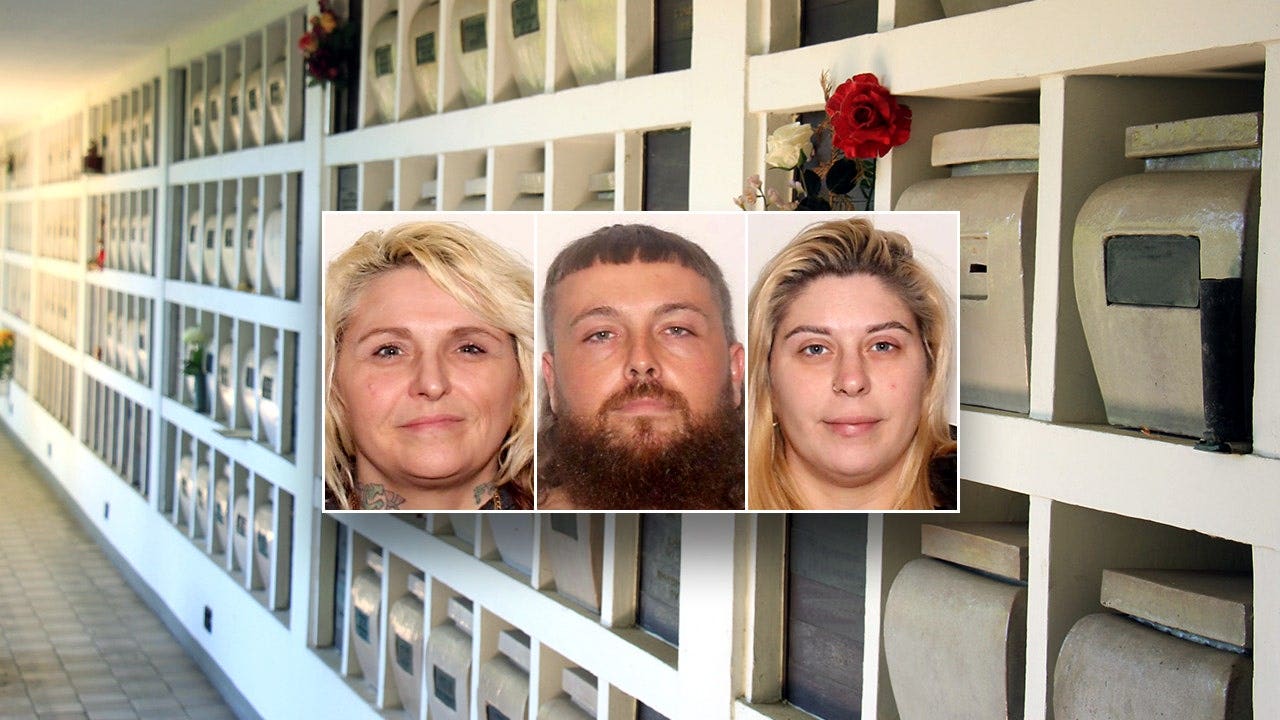
In a case that has sent a chill through families across the country, three people from Indiana have been arrested in connection with a bizarre and deeply unsettling spree of thefts from cemetery niches holding cremated remains. Authorities describe theendants as grave robbers who allegedly traveled across the eastern half of the United States, breaking into mausoleum niches and stealing not just valuables but irreplaceable keepsakes left with the dead. The Orange County Sheriff’s Office in Florida, which has identified at least twenty cases within its own jurisdiction alone, believes the true number of victims may be far higher because many grieving families have no idea that the final resting place of their loved ones has been violated. “What a horrible person you are if you decide to steal from the dead,” a sheriff’s office spokesman said in an emotional video appeal, urging anyone who might have been affected to come forward. The investigation began after cemeteries reported disturbingly methodical thefts, and surveillance footage soon revealed a chilling pattern: three individuals slipping into mausoleums, prying open glass-front niches, and calmly walking out with items that should have remained untouched forever.
The accused are Drake Lee Milam, thirty-three, Angela Garrett, fifty-two, and Porsche Bancroft, thirty-two, according to court records. The relationships among them add a strange layer to an already disturbing story: Bancroft is identified as Milam’s girlfriend and Garrett’s daughter. Milam and Garrett were arrested in Indiana within days, while Bancroft voluntarily turned herself in at the Seminole County Jail in Florida. Bancroft’s arraignment is scheduled for September twenty-second in Sanford, Florida, with a trial date set for February eighth. Milam and Garrett are expected to be extradited to Florida to face charges, though their court documents were not immediately accessible, a representative with the Seminole County Clerk of Court confirmed. All three face a laundry list of charges, including injuring or removing a tomb or monument, disturbing the contents of a grave or tomb, and grand theft over twenty thousand dollars. The charges reflect the severity with which law enforcement views these acts—not merely property crimes, but violations of sacred space and public trust.
The geographic scope of the alleged scheme is staggering. According to the Orange County Sheriff’s Office, surveillance footage from countless mausoleums shows the trio operating across a vast swath of the nation. “They’ve been everywhere from Oklahoma City to Minnesota to Texas here in Florida,”a spokesman said. “They visited Georgia, Iowa, North Carolina, even so far northeast as to Buffalo, New York.” The list doesn’t end there; investigators also believe the travelers passed through Illinois and New Jersey during their alleged cross-country grave-robbing campaign. The method was consistent: they targeted glass-front niches, often in cemetery mausoleums, where funeral homes and families display the urns containing cremated remains alongside personal mementos. The thieves would apparently break open these enclosures, remove whatever caught their eye, and walk out as if they had done nothing more than browse a shop. The boldness of the crime is perhaps what disturbs authorities most. These are not abandoned graves in forgotten corners; these are carefully maintained, publicly accessible spaces where families come to mourn. The detective work has been painstaking, with investigators piecing together surveillance clips from dozens of cemeteries to track the trio’s movements, and now they areasking the public for help identifying even more victims. “If you have a family member resting at a cemetery, take a moment to check their niche and make sure theirs items you placed with them are still there,”the sheriff’s office pleaded on social media.
The emotional toll of this case cannot be overstated, and the inventory of stolen items reveals why. This was not a random act of vandalism; it was a targeted theft of human memory. In one incident, a husband discovered his late wife’s niche had been violated, and the thieves had taken his-and-hers gold wedding rings, along with her Class of 1992 ring from Miami Southridge Senior High School—a silver ring with a blue stone that he had lovingly placed beside her ashes. In another, a wife reported that a ring given to her late husband for his twenty-fifth anniversary of working for The Walt Disney Co. had been stolen from his final resting place. A father found that his daughter’s 1972 class ring, bearing a blue stone, had been ripped from her niche. One widow tearfully told police that a twenty-two-inch gold chain with a gold anchor, which her husband had specifically wished to be interred with, was gone. Families reported missing gold wedding bands, gold earrings, gold bracelets, and diamond solitaires. Perhaps most poignantly, the wife of Charles Taaffe, former offensive coordinator for the University of Central Florida football team, discovered that his two gold championship rings had been stolen from where his remains were interred. These are not anonymous valuables; each piece represented a lifetime of love, sacrifice, and remembrance. As the sheriff’s office spokesman said, “Imagine losing your wife or husband and placing theirs wedding ring, and yours, in the niche—only to have them stolen by thieves looking for an easy payday.” The dollar amount recovered in Florida alone is estimated at thirty-five thousand dollars, spread across Orange, Seminole, and Hillsborough counties. But as authorities are quick to point out, “the dollar amount is not what’s important.”
The investigation has become a national call to action. Detectives across multiple states are now working together to identify more victims, knowing that many families may never realize what happened until they visit a grave on a birthday or anniversary only to find an empty niche. The Orange County Sheriff’s Office has urged everyone nationwide to check theirs loved ones’ burial sites, especially those in mausoleums with glass-front niches, to ensure that treasured items are still intact. They have also asked anyone with information about the case—or anyone who believes they may have been victimized—to contact Central Florida Crimeline at eight hundred four two three TIPS. The response from law enforcement reflects a broader recognition that crimes against the dead are crimes against the living, and that the wounds they inflict can last far longer than any loss of property. “Having a loved one’s final resting place disturbed and cherished family heirlooms taken is deeply painful, and we recognize that no arrest can undo what these families have experienced,”a sheriff’s office spokesperson said in an email. It is a sentiment that cuts to the heart of why this case feels so different from your average theft. There is something primal and sacred about how we honor the dead, and when that sanctity is shattered, it reverberates through every person who has ever laid someone they love to rest. The defendants, meanwhile, have not yet offered public statements. Bancroft said her attorney would provide one, but no statement was received before publication; Garrett and Milam did not respond. Their arrests have brought a measure of justice, but investigators know the work is far from over. The full extent of their travels, their motives, and whether they acted alone remains under investigation.
At its core, this story is about the fragile line between remembrance and desecration. Every ring, every class emblem, every championship trophy placed in a niche is a silent conversation between the living and the dead—a way of saying, “You are not forgotten.” To steal those objects is not simply a crime of greed; it is an attempt to erase that conversation, to monetize grief itself. The families affected have described feeling violated twice: once by death and once by theft. Yet amid the outrage, there is also hope: hope that by sharing this story, other victims might be identified; hope that advances in surveillance and interstate cooperation will bring more perpetrators to justice; and hope that communities will band together to watch over these sacred spaces. As the sheriff’s office concluded in its appeal, “This will not stand. Not in Florida.” And now, thanks to the dogged work of investigators and the courage of families willing to speak out, it will not stand anywhere else either. The case serves as a somber reminder to us all: if you have loved ones interred in a cemetery, take a moment to check on them. Look through the glass. Make sure the treasures you left behind are still there. Because for the families victimized by this trio, the pain of losing a loved one has been compounded by an unimaginable betrayal—and only by speaking out can they hope to reclaim some small measure of peace.