



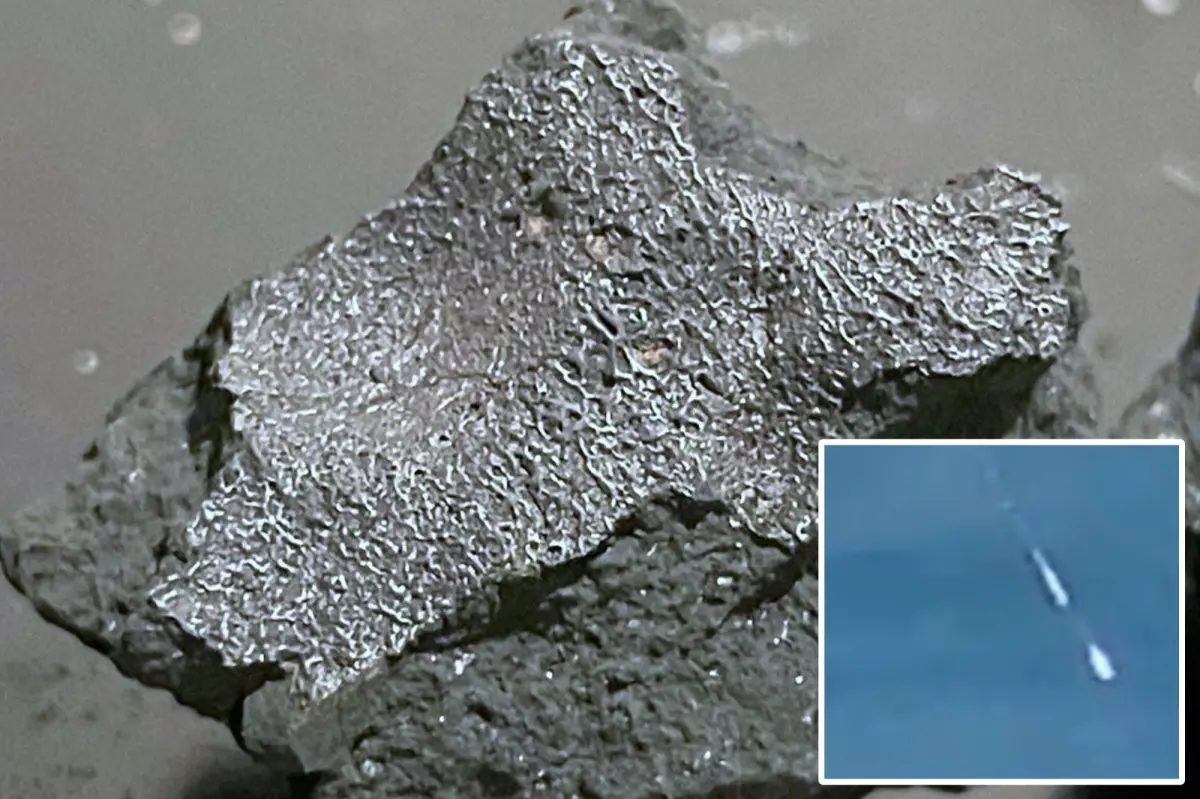
On the warm, unsuspecting afternoon of July 16, 2024, the peaceful summer routine of Hillsborough, New Jersey, was suddenly fractured by a spectacular intrusion from outer space. A two-pound fragment of an ancient, carbon-rich asteroid entered the Earth’s protective atmosphere at a breathtaking velocity of approximately 32,000 miles per hour. As it collided with the dense air of our planet, the intense friction vaporized its outer crust, creating a brilliant, blazing fireball that streaked across the daytime sky, passing directly in front of the iconic silhouette of the Statue of Liberty. Over sixty astonished eyewitnesses across five states—New York, New Jersey, Connecticut, Rhode Island, and Pennsylvania—recalled looking up in sheer disbelief as the celestial traveler illuminated the sky. The extreme kinetic energy of the rock’s rapid descent generated a powerful sonic boom and shockwave that rippled across the region, shaking windows in their frames and causing sixteen startled residents in New York and New Jersey to feel the physical tremor beneath their feet. Under the immense pressure of atmospheric drag, the fragile, clay-like structure of the incoming rock succumbed to the strain, shattering into a wide, tumbling cloud of tiny black pebbles. This trail of cosmic debris rained down over a long, dramatic path stretching from the urban landscapes of Staten Island into the deep suburban pockets of New Jersey. While the vast majority of these falling fragments were lost to the dense canopies, rivers, and lawns of the tri-state area, the largest and most scientifically vital piece of this ancient cosmic wanderer was destined for a much more dramatic, direct, and intimate confrontation with humanity in a quiet suburban neighborhood.
For the owner of the Hillsborough home, this grand cosmic event manifested not as a distant streak of light in the sky, but as a sudden, terrifying explosion that echoed through the hallways of their house. The peaceful quiet of the afternoon was shattered by a deafening, thunderous crash that vibrated through the very foundation of the home. Racing upstairs to investigate the source of the violent noise, the homeowner opened the door to the master bedroom and was met with a surreal and chaotic scene. A clean, jagged hole had been punched directly through the drywall of the ceiling, exposing the structural beams above, and the bed, pillows, and carpet below were covered in a scattering of dark, charcoal-like soot, drywall dust, and mysterious black stone fragments. Drifting throughout the room was a thick, highly unusual, and pungent smell of sulfur—a deep, ancient, and unmistakably primordial odor characteristic of the vacuum of space. While many people in such a startling situation might have swept up the debris or thrown it away as mere household waste, the homeowner possessed a remarkable presence of mind and an intuitive sense of curiosity. Recognizing that these strange, warm, soot-covered rocks had fallen directly from the heavens, they acted quickly and carefully to preserve the site. Using clean, improvised tools, the homeowner gathered the fragile black fragments and immediately sealed them inside clean glass jars. This swift, critical act of preservation prevented the sample from being contaminated by household dust, humidity, human skin oils, or Earthly gases, ensuring that the space rock remained in a pristine state for scientific study, turning a major household headache into a pristine cosmic treasure.
When the pristine samples were delivered to the scientific community, the reaction among geologists and planetary researchers was nothing short of euphoric. Analysis of the dark, fragile fragments revealed that the space rock—officially named “Hillsborough” in honor of the bedroom it claimed—was a highly rare and chemically primitive specimen classified as a CM1/2 carbonaceous chondrite. This classification represents one of the most exciting discoveries in modern meteoritics, marking only the second time in recorded history that a meteorite of this extremely fragile and delicate class has been successfully observed falling to Earth and subsequently recovered intact. Carbonaceous chondrites are essentially geological time capsules from the very birth of our solar system, holding a physical record of the raw chemical ingredients that existed over 4.5 billion years ago, long before the Earth had fully coalesced from the swirling primordial disk of gas and dust surrounding the young Sun. Because these rocks are dominated by carbon and soft, clay-like hydrated minerals, they are incredibly fragile; the vast majority of them crumble into fine dust and burn up entirely during their high-speed re-entry through Earth’s atmosphere. The survival of the Hillsborough meteorite, and its subsequent rescue from the soft surface of a master bedroom mattress which cushioned its final impact, bypassed the typical weathering processes that degrade most space rocks, providing cosmochemists with an incredibly rare, unaltered glimpse into the raw materials that formed our planetary neighborhood.
The true scientific revelation of the Hillsborough meteorite lay deep within its interior chemistry, where researchers uncovered a stunning, unprecedented record of ancient liquid water. Advanced laboratory scanning and chemical analyses revealed that the parent asteroid from which Hillsborough originally broke away was once host to a dynamic, flowing liquid brine—a highly concentrated, mineral-rich saltwater solution that actively circulated through the rock’s porous network of cracks and pathways billions of years ago. As this ancient alien water slowly evaporated under the faint warmth of the solar system’s youth, it left behind a highly dense and intricate pattern of concentrated salt deposits locked within the silicate minerals. While planetary scientists have encountered water-altered meteorites in the past, they had never before observed this specific, intense pattern of high-concentration salt formation within a CM-type carbonaceous chondrite. This suggests that the meteorite did not merely contain trace amounts of moisture, but instead originated from an active, hydrologically complex zone of its parent asteroid. In this zone, liquid water was abundant enough to pool, flow, and undergo repeated cycles of evaporation, providing scientists with an entirely new framework for understanding the behavior, distribution, and ultimate fate of water on the primitive rocky bodies that served as the building blocks for the terrestrial planets.
This ancient, warm, and highly concentrated salty environment acted as a highly effective celestial laboratory, incubating the chemical reactions necessary to synthesize the very building blocks of life. Upon extracting and analyzing the organic matter preserved within the meteorite’s matrix, cosmochemists from prestigious research institutions, including the SETI Institute, discovered an incredibly diverse and rich inventory of complex prebiotic molecules, including numerous amino acids similar to those found in other CM-type chondrites. Dr. Queenie Chan, a lead cosmochemist involved in analyzing the meteorite, emphasized that these findings provide strong support for the theory of panspermia—the idea that primitive carbonaceous chondrites acted as cosmic delivery vessels, bombarding the early, barren Earth with the organic substances necessary to spark biological life. Among the most fascinating discoveries were organometallic compounds, which are complex molecules that feature direct chemical bonds between carbon atoms and metals. In the modern biosphere of our planet, these unique organometallic structures are the absolute foundation of all advanced biological activity; they form the iron-based core of hemoglobin, which allows our blood to carry life-sustaining oxygen, and they lie at the heart of magnesium-based chlorophyll, which plants use to convert sunlight into energy. Finding these precise, pre-biological chemical architectures within a 4.5-billion-year-old rock suggests that the chemical machinery of life was already fully developed in deep space, waiting to find a hospitable planetary home.
Today, the profound legacy of that disruptive July afternoon in New Jersey reaches far beyond the patched ceiling of a suburban home. The carefully preserved fragments of the Hillsborough meteorite have been officially welcomed into the permanent, prestigious collections of the American Museum of Natural History in New York City. Here, preserved in specialized environmental chambers, they will remain safeguarded for generations to come, waiting for future scientists to examine them with even more advanced technologies that have yet to be conceived. This remarkable event serves as a beautiful, humbling reminder of the thin, porous boundary that separates our quiet, everyday lives from the grand and untamed forces of the cosmos. A simple master bedroom, interrupted by a rock older than the Earth itself, became the ultimate intersection of the cosmic and the domestic. The Hillsborough meteorite stands as a testament to our profound connection to the universe, reminding us that we are not isolated observers of a cold, distant void, but are deeply woven into its fabric. The very water that fills our vast oceans, the mineral salts that run through our tears, and the organic molecules that construct the DNA in our cells were once forged in the interstellar medium and carried through the darkness of space, occasionally making their presence known by crashing through our ceilings and into our collective understanding of existence.