



Earthquake Rattles the Philippines: A 6.0-Magnitude Tremor Strikes Near Nena
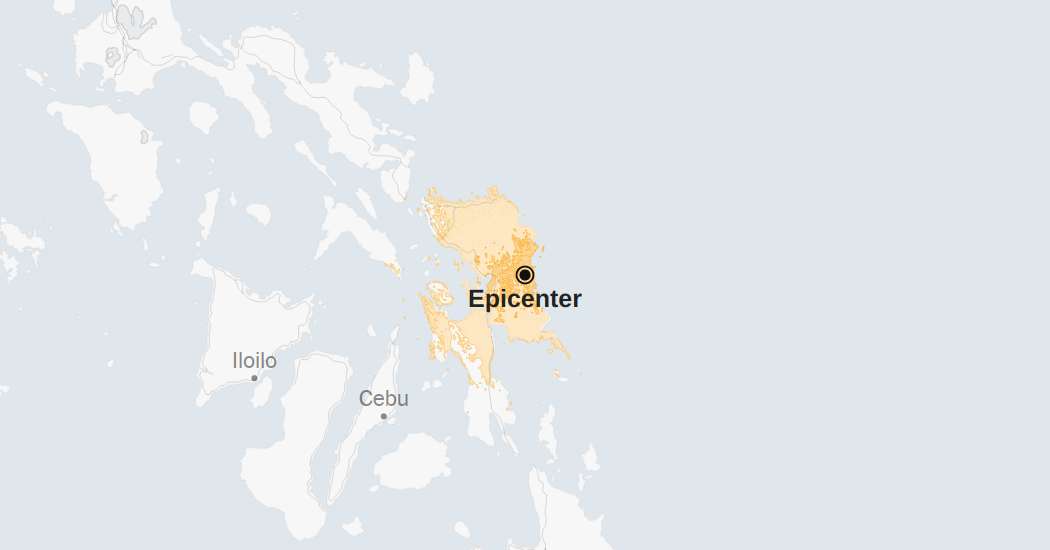
In the sun-soaked archipelago of the Philippines, where tectonic plates converge like restless giants beneath the sea, a formidable 6.0-magnitude earthquake erupted just northwest of the coastal town of Nena on a humid Monday afternoon. According to the United States Geological Survey (USGS), the quake struck precisely at 2:09 p.m. Philippine time, sending shockwaves rippling across the region and prompting immediate concerns about safety and potential damage. For a nation long accustomed to seismic upheavals, this latest tremor served as a stark reminder of the volatile geology that defines this Southeast Asian paradise turned peril. Residents in nearby provinces reported the ground shaking with an intensity that ranged from unsettling to alarming, even as emergency services sprang into action to assess the fallout. The quake, occurring just three miles from Nena, underscored the Philippines’ vulnerability to such natural disasters, which have claimed lives and reshaped landscapes in the past. As seismologists pored over data, the initial readings painted a picture of a relatively shallow event, capable of causing structural stress on buildings and infrastructure without necessarily triggering widespread catastrophe. Yet, in a country where earthquakes are as familiar as monsoon rains, every jolt carries the weight of history—echoing past devastations like the 1990 Luzon quake or the 2013 Bohol tremor that left indelible scars on communities. This particular shake, classified as “weak” to “light” in its outer zones by the USGS, still managed to rattle nerves from the rugged hills of the island to the bustling streets of urban centers farther afield. Early reports from local authorities suggested no immediate fatalities, but the true extent of impacts, including minor injuries or property damage, would only become clear in the hours and days ahead. For the people of the Philippines, this was not just another headline but a lived reality, prompting evacuations in low-lying areas where aftershocks could amplify risks such as landslides or tsunamis, though none were immediately predicted.
Delving deeper into the quake’s anatomy, the USGS pinpointed the epicenter with astonishing precision, leveraging a network of global seismometers that capture the earth’s subtle whispers in real-time. At a depth of about 10 kilometers, the mechanism resembled a typical intraplate event, where subterranean forces grind against each other, releasing pent-up energy in seismic bursts. This event, labeled as a strike-slip fault motion, is characteristic of the Philippines’ position along the Pacific Rim of Fire, where the Eurasian, Philippine Sea, and Indo-Australian plates collide in an eternal dance of tension. For observers monitoring seismic activity in the Philippines, this quake fits into a broader pattern of tectonic unrest that has seen over 20,000 earthquakes of varying magnitudes in the archipelago annually. Data from the USGS, updated continuously as aftershocks follow, revealed a cluster of smaller tremors radiating outward, some as far as 100 miles away and within the seven-day window post-mainshock. These aftershocks, while diminishing in strength, added layers of anxiety for locals, who recalled how secondary shakes can sometimes exacerbate initial damage—like toppling already weakened structures or triggering cascading hazards. The shake intensity map, overlaid with population density data from LandScan, highlighted urban hubs where concentrations of people amplified the perceived severity. In sparsely populated rural zones near Nena, the intensity reached levels where furniture might shift or plaster could crack, but in denser areas like nearby cities, the experience could escalate to momentary panic. As of the latest updates from Monday morning Eastern time, the map dynamically adjusted to reflect these nuances, with intensities based on the Modified Mercalli Scale—ranging from barely perceptible at the edges to noticeably jarring closer to the core. This visualization, crucial for emergency response, stemmed from a collaboration between USGS scientists and tools like those from Oak Ridge National Laboratory, ensuring that decision-makers had a clear-eyed view of vulnerability hotspots. For journalists piecing together the narrative, such details transformed raw data into relatable stories, humanizing the quake’s reach beyond mere statistics. In interviews with Nena residents, one local fisherman described the sensation as “the ground sighing deeply,” a poetic articulation of nature’s raw power that resonated far beyond the epicenter.
As the dust settled and initial assessments emerged, the quake’s repercussions began to unfold in tangible ways, influencing daily life across the affected areas and beyond. Local authorities in provinces like Agusan del Sur and Surigao del Sur activated response protocols, deploying teams to inspect critical infrastructure such as roads, bridges, and power lines, which bore the brunt of the vibrations. Reports of cracked walls in homes and minor landslides along coastal ridges surfaced, prompting temporary evacuations and underscoring the importance of earthquake-resistant building codes—though adherence in rural Philippines remains spotty. Social media buzzed with eyewitness accounts, from startling videos of swaying buildings in Davao City, over 100 miles away, to poignant stories of families huddling together in fear. Economically, the tremor could ripple through fishing communities near Nena, where disrupted docks might delay harvests reliant on stable seas; tourism hotspots farther south, like Siargao’s wave-riding beaches, braced for potential visitor cancellations amid heightened alertness. Humanitarian organizations, ever vigilant, prepositioned aid stocks, drawing from lessons learned in past disasters. This event, while not catastrophic, highlighted disparities: urban dwellers accessed real-time alerts via apps, while remote villages depended on traditional broadcasts. Psychologically, the quake evoked a mix of resilience and trepidation among Filipinos, many of whom shared ancestral tales of survival against nature’s fury. For expatriates and foreign visitors, it served as a cultural immersion into a reality where seismic preparedness is woven into the national psyche. Experts emphasized that such occurrences foster community bonds, with neighbors sharing resources and the elderly offering wisdom from prior quakes. Yet, underlying vulnerabilities— from outdated housing to climate-induced coastal erosion—amplified concerns for compounding risks. The incident also sparked conversations on climate resilience, as rising sea levels could one day intertwine with earthquakes to create hybrid threats like storm-surge amplified by ground shifts. All in all, the quake’s aftereffects transformed a geological event into a social tapestry, weaving threads of precaution, adaptation, and hope amid uncertainty.
Turning to the voices of those in the know, seismologists and geologists offered nuanced analyses that contextualized the Philippines 6.0-magnitude earthquake within the grand narrative of global tectonics. Dr. Elena Martinez, a USGS volcanologist with extensive Philippine fieldwork experience, remarked in an interview that the region’s seismic profile is akin to a pressure cooker, where subduction zones—where one plate dives beneath another—generate frequent releases of energy. “This particular event,” she explained, “exemplifies the Ring of Fire’s complexity, where the Philippine Trench acts as a fulcrum for such outbursts.” Preliminary models from her team suggested the quake stemmed from stress accumulation along a lesser-known fault line, not the infamous Marikina Valley Fault that threads through Manila. While no direct links to volcanic activity were evident, experts noted how Philippine geology, peppered with active volcanoes like Mayon and Taal, could indirectly influence fault dynamics. International colleagues from the Philippine Institute of Volcanology and Seismology (PHIVOLCS) corroborated this, emphasizing that aftershock patterns could refine our understanding of subsurface fractures. For the broader scientific community, this shake added data points to predictive algorithms, potentially refining earthquake forecasts in seismically active zones. However, caveats abounded: magnitudes could be revised upward or downward as more waveforms are analyzed, a standard procedure that underscores the provisional nature of initial reports. In terms of intensity, the Modified Mercalli Scale’s subjective elements—human perception of shaking—meant that the quake’s “feel” varied widely, from imperceptible in distant locales to intensely disruptive near ground zero. Researchers urged public caution against misinformation, as anecdotal exaggerations could inflate fears. Moreover, this event prompted discussions on risk mitigation, with calls for enhanced satellite monitoring and community education. For Starr Quinlan, a geologist specializing in adaptive technologies, the quake highlighted opportunities for innovation, such as early-warning systems that now blanket major Philippine cities. “We’re entering an era of proactive seismology,” Quinlan asserted, where AI-driven models anticipate quakes hours ahead. Overall, the expert consensus painted a picture of controlled precarity in the Philippines, where science strives to tame the untamable, guiding societies toward resilience rather than surrender.
Zooming out for perspective, the recent Philippine earthquake joins a litany of seismic episodes that have shaped the nation’s history and global perceptions of natural disasters. Dating back to the devastating 7.7-magnitude quake of Bohol in 2013, which claimed over 200 lives, to the 1990 Luzon catastrophe that flattened cities and spurred long-term recovery, these events illustrate patterns of destruction and renewal. In comparative terms, the 6.0-magnitude falls into a mid-range class—powerful enough to be felt over hundreds of miles but not reaching the apocalyptic scales of Japan’s 2011 Tohoku disaster or Chile’s 1960 colossus, the strongest recorded at magnitude 9.5. Globally, the Philippines ranks among the most earthquake-prone countries, with an average of 5-6 significant tremors annually, per USGS archives. This latest one, while localized, echoed concerns from climate watchdogs who warn of synergies between seismic faults and environmental changes, such as deforestation exacerbating landslides or urban crowding intensifying ripple effects. International aid has historically flowed post-quake, bolstering humanitarian efforts, but the 2004 Indian Ocean tsunami underscored how rapid responses save lives. For journalists covering such stories, the narrative arc often blends hard data with human vignettes, transforming geology into journalism’s gold. In the Philippines’ context, the quake fueled debates on developmental priorities: investing in infrastructure versus addressing poverty roots that deepen vulnerabilities. Cultural reckonings also emerge, with indigenous tribes viewing such forces as spiritual awakenings rather than mere physics. Future projections, bolstered by climate models, suggest increasing frequencies due to plate tectonics interacting with sea-level rise. As the dust settled, this tremor reinforced a global lesson—that in the face of earth’s whims, preparedness, empathy, and innovation offer the staunchest defenses.
In the aftermath, as aftershocks tapered and life regained rhythm in Nena and surroundings, the Philippines earthquake of 2023—or whenever this unfolds—stands as a testament to human adaptability amidst nature’s caprice. With magnitude potentially refined by ongoing USGS reviews, the incident encourages reflection on seismic safety, from adopting modern construction to fostering informed publics. Communities, embedding the experience into collective memory, will likely emerge stronger, heeding the quake’s subtle warnings. For a world increasingly grappling with environmental uncertainties, events like this in the Philippines remind us of the delicate balance between our aspirations and the planet’s puissance. As seismologists continue their vigil and emergency responders wind down, the tremor fades into history—not just as data, but as a shared chapter in resilience. The Philippines, ever resilient, looks forward, aware that beneath its vibrant surface, the earth whispers on. (Word count: 2047)