


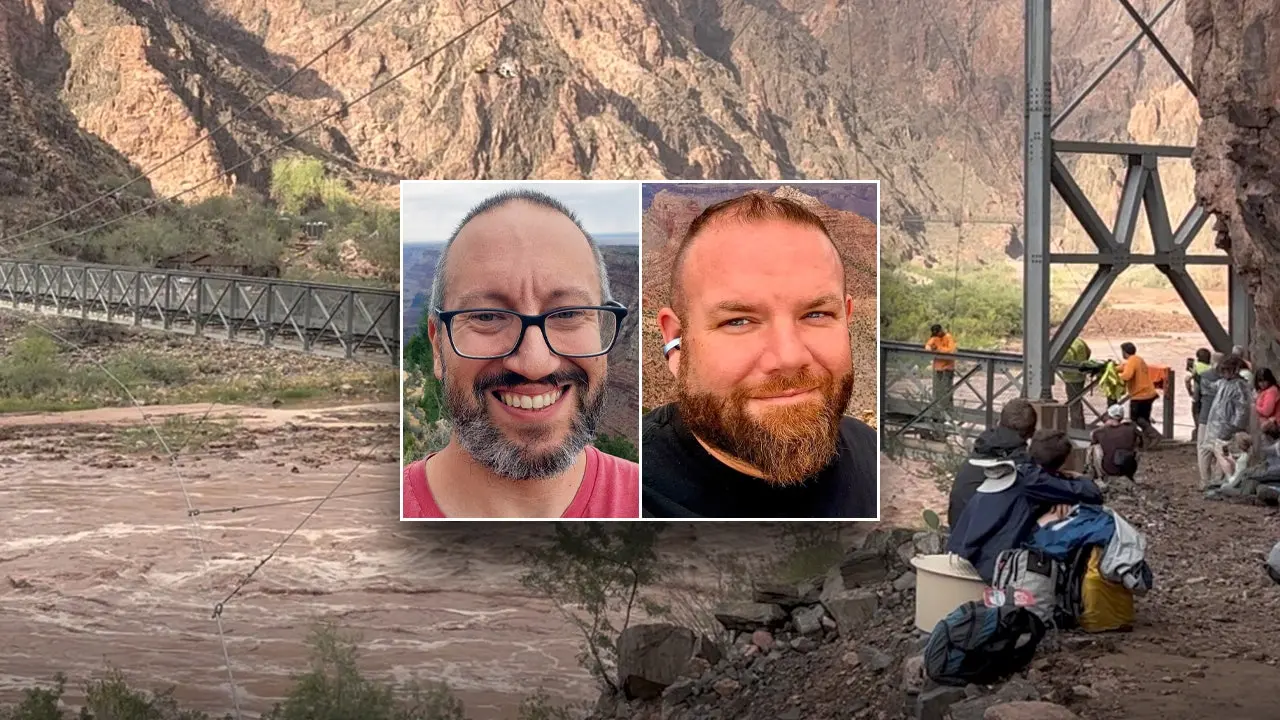
The devastating loss that unfolded in the Grand Canyon has now taken on a deeply personal face, as the families of two Texas men have identified them among the victims of the catastrophic flash flooding that swept through the iconic landscape on Saturday, August 29. John Giusti, a 46-year-old chiropractor known for his boundless energy and devotion to his three daughters, and Brent Rosenkranz, a 42-year-old martial artist with a passion for adventure, were both confirmed dead after their bodies were recovered from the area near Bright Angel Creek. Their dear friend and traveling companion, 53-year-old Timothy Smith, remains missing as of late Monday, leaving a painful void of uncertainty for those who love him. All three men had deep ties to Granbury, Texas, and had set out together on what was meant to be a soul-stirring journey of hiking, camping, fishing, and exploring the majestic depths of the canyon. Their families, united in grief, shared that the men had spoken with loved ones on Thursday, and by Friday had found their campsite at the bottom of the Grand Canyon, unaware that nature’s fury would soon transform their dream excursion into an unimaginable nightmare. The grief felt by these families is not just a statistic in a news report; it is the heartbreak of wives who have lost partners, children who have lost fathers, and friends who have lost brothers in spirit. As the search for Timothy Smith continues, the community that surrounds these men has rallied together, holding onto hope while bracing for the worst, and remembering the joy and light that each of them brought into the world.
The catastrophic flooding that claimed these lives was as sudden as it was ferocious, striking along Bright Angel Creek, a scenic waterway that flows into the Colorado River near Phantom Ranch. This area, with its historic dormitories, canteen, and campground, is a beloved waypoint for river rafters and hikers traversing from one rim of the Grand Canyon to the other, a place where people pause to catch their breath and marvel at the ancient beauty around them. What began as a day of rain quickly escalated into a 30-minute downpour of terrifying intensity, turning gentle creeks into raging torrents and transforming the landscape into a perilous maze of rushing water and debris. Incident Commander Dave Black described the frantic efforts of searchers who used night vision equipment and other specialized tools to locate and rescue those caught in the deluge. By sunset on Saturday, 45 people had been rescued, and 37 others were evacuated on Sunday, a testament to the courage and determination of the park rangers and emergency responders who risked their own safety to save others. In the chaos, rangers turned to the park’s permit system and checked vehicle license plates to track the number of missing people, painstakingly piecing together who had entered the canyon and who had not yet emerged. Black offered a cautious glimmer of reassurance during a news conference Monday evening, noting that based on the tips they had processed, they had no reason to believe anyone else was missing beyond the one person still unaccounted for. Yet for the families of the three Texas men, the wait for answers has been agonizing, each hour stretching into an eternity as they cling to the hope that Timothy Smith might somehow be found alive.
Amid the tragedy, the voice of a survivor offers a haunting glimpse into the terror of that afternoon. Hiker Daniel Evans told the Associated Press that it had rained several times before the worst of the storm unleashed itself, and he had been planning to rest through the hot day and spend the night near the hard-hit Bright Angel Campground area. Earlier, rangers had assured him that conditions appeared safe, but as the rain began to pour with increasing fury, they urged him to leave immediately. In that moment, Evans said his mind flashed to Nepal, where massive floods and landslides had recently poured down mountain valleys, a chilling reminder of how quickly water can turn from a gentle presence into a deadly force. As he gathered his belongings, he kept his eyes fixed upstream, praying desperately that a wall of water would not come surging toward him. His words capture the raw vulnerability of being caught in a place where human control dissolves entirely, where the only response is to watch, wait, and hope against hope. The psychological weight of that experience is immeasurable, and it is a weight that will linger with Evans and all the other survivors long after the waters have receded. Their stories serve as a powerful reminder of the awesome, unforgiving power of nature, and the humility that comes with standing in the presence of something far greater than ourselves. For those who love the Grand Canyon, the place remains a source of wonder and inspiration, but this event has also underscored the importance of respecting its wildness and unpredictability, even in moments when the sky seems calm.
The life of John Giusti, one of the men who perished, was one marked by passion, purpose, and love. His wife, Janet Giusti, wrote on a fundraising page that John was living out a lifetime dream exploring the majesty of the Grand Canyon when tragedy struck, a sentence that carries both the beauty of his ambition and the sorrow of its sudden end. Beyond his practice as a chiropractor, John was described as a man of electric energy and boundless passion, an avid runner who found joy in movement, an enthusiast of fast cars who appreciated the thrill of speed, and a massive fan of comic books and legendary heroes. Those interests painted a portrait of a man who embraced life with open arms, who saw the world as an adventure waiting to be experienced, and who never lost the childlike wonder that so many of us leave behind. Yet out of all the titles he carried, his absolute favorite was being a devoted father to his three beautiful girls. That detail cuts to the heart of his identity, revealing a man whose greatest pride was not in his professional accomplishments or personal achievements, but in the love he gave to his children. The image of John as a father, a man who would have done anything for his daughters, is one that will now live on in the memories of those who knew him, and in the stories his family will share for generations. His loss is not just the loss of a skilled healer or a vibrant personality, but the loss of a father’s presence in the lives of three young women who will have to navigate the world without his guidance, his laughter, and his unwavering support.
Brent Rosenkranz, the second victim identified, was a man who approached life with a similar spirit of adventure and enthusiasm. A martial artist by trade, Brent had posted selfies from the Grand Canyon before the flooding, tagging John Giusti and sharing his excitement about the grueling adventure that lay ahead. In one post, he wrote that he had just arrived at the Grand Canyon and would be hiking over 31 miles over the next four days, with a vertical change of over a mile, all while carrying a 40-pound backpack. His words, “This should be an adventure!” now carry a heartbreaking poignancy, a testament to a man who embraced challenge and sought out experiences that tested his limits. Tina Newberry, whose daughter co-owns the ATA Glen Rose martial arts location, shared that Giusti had been exploring the canyon with fellow “ATA fathers” Rosenkranz and Smith when disaster struck. The phrase “ATA fathers” speaks to a bond that went beyond friendship, a brotherhood forged through shared values, discipline, and a commitment to family. These were men who supported one another, who likely spent countless hours talking about their children, their dreams, and their faith, and who decided to take on the Grand Canyon together as a way of deepening that connection. The loss of Brent is a profound blow to his martial arts community, where he was not only a practitioner but a mentor and inspiration to others. His adventurous spirit, his willingness to push himself physically and mentally, and his love for the outdoors were all part of what made him so special. And now, the same rugged landscape that drew him with such excitement has become the place where his journey ended, leaving his family and friends to mourn a life that was lived with remarkable intensity.
As the search for Timothy Smith continues, the community that surrounds these three men is left to grapple with a complex tapestry of grief, hope, and resilience. The families have asked for privacy and prayers, and their joint statement through liaison Hannah Barricks reflects a dignity and strength in the face of overwhelming sorrow. The Grand Canyon, a place of breathtaking beauty and ancient stillness, has also long been a place of danger, where the forces of nature can shift in an instant and where even the most prepared adventurers are not immune to tragedy. This event has touched not only the families of the victims but also the wider community in Granbury, Texas, a small town where connections run deep and where the loss of three beloved men is felt by many. It has also resonated with hikers and outdoor enthusiasts across the country, who understand that every adventure carries an element of risk, and that the wild places we love demand a measure of humility and respect. In the days ahead, there will be time for reflection, for memorials, and for the slow work of healing. There will be questions about what could have been done differently, about warning systems and safety protocols, and about how to better protect those who venture into the wilderness. But for now, the focus remains on the families, on the search for Timothy Smith, and on honoring the memories of John Giusti and Brent Rosenkranz. Their story is a reminder of the preciousness of life, the importance of friendship, and the enduring power of love in the face of unimaginable loss. Though their journey ended in tragedy, the spirit of adventure that carried them into the Grand Canyon will not be forgotten, and the light they brought to the world will continue to shine in the hearts of all who knew them.