



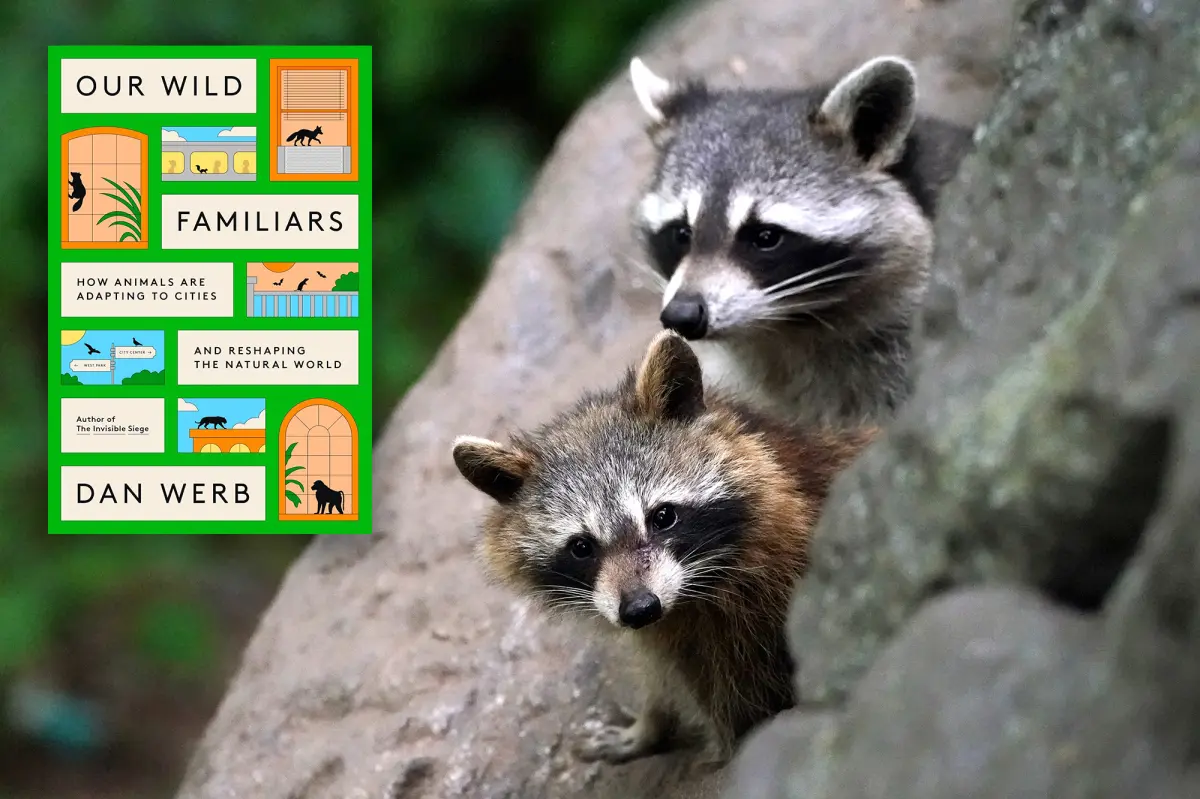
On a random July morning in 2015, a dead raccoon on a Toronto sidewalk sparked an unexpectedly heartfelt public wake. Passersby name-tagged the deceased creature “Conrad,” placing a single red rose, a sympathy card, and eventually a circle of burning vigil candles around his furry corpse. In his captivating new book, Our Wild Familiars, author and scientist Dan Werb uses this bizarre yet touching moment of collective empathy to introduce us to the fascinating world of synanthropes—wild creatures that have actively chosen to live “together with man.” Far from being ecological dead zones, our bustling cities have transformed into vibrant, accidental sanctuaries where animals are not just surviving, but actively rewriting their own evolutionary destinies in the shadows of our skyscrapers.
This urban evolutionary leap is perhaps most visible in our ongoing, comedic chess match with city raccoons. When Toronto authorities spent millions on complex, rotating-lock garbage bins designed to be completely “raccoon-proof,” they severely underestimated their furry neighbors. Lacking opposable thumbs, one genius raccoon still figured out how to unlock the mechanism within months, quickly teaching the trick to others through a cognitive process biologists call “reversal learning”—the unique mental agility to discard old habits and invent new problem-solving strategies on the fly. Werb points out that the relentless challenges of urban navigation are putting raccoon intelligence on a fast-tracked evolutionary trajectory, leaving scientists highly anticipating what these nocturnal innovators might master next.
While some city dwellers view urban wildlife as pests to be conquered, visionary thinkers are redesigning human architecture to foster peaceful, shared spaces. When architect Joyce Hwang moved to Buffalo, New York, she was horrified to find that the local remedy for unexpected indoor bats was a tennis racket. Rather than accepting this hostile dynamic, Hwang began designing beautiful, functional public art structures like “Bat Cloud” and “Bat Tower,” which double as elegant sanctuary spaces for local bat populations. Her work beautifully illustrates Werb’s philosophy that the true antidote to our instinctual fear of nature is intimacy, proving that modern cities can be reimagined to actively boost biodiversity while enhancing the visual landscape for human residents.
This relentless drive to adapt extends deep beneath the waves, into some of the most degraded artificial environments on Earth. In the murky waters surrounding Seattle, marine ecologist Eliza Heery discovered that a seafloor littered with rusted vans, discarded appliances, handguns, and industrial heavy metals has surprisingly become a bustling, thriving ecosystem. Most astonishingly, the highly intelligent Giant Pacific Octopus has claimed this underwater junkyard as its home, thriving in greater numbers here than in pristine coastal habitats further out to sea. This unexpected marine sanctuary serves as a powerful testament to the sheer resilience of nature, showing that life will stubbornly carve out a home even in the toxic ruins of human neglect.
Of course, sharing our immediate living spaces with wild animals becomes infinitely more complicated when the neighbor in question occupies the top of the food chain. This harsh reality was brought to light in February 2023, when a wild leopard wandered into a busy courthouse in Ghaziabad, India, injuring several people during a terrifying four-hour standoff. As human developments continuously carve deeper into ancient wilderness, dangerous encounters with apex predators are shifting from rare anomalies to predictably frequent crises. As Werb dryly notes, while it is relatively easy to share a neighborhood with thousands of mischievous trash pandas, peacefully coexisting with a stray, highly territorial hundred-pound big cat presents a far more urgent safety and conservation challenge.
Ultimately, Werb argues that the secret to successful interspecies coexistence lies in changing predictable human patterns rather than trying to violently suppress animal instincts. Generations of poisoning rats in New York City, for example, only succeeded in breeding super-rats resistant to rodenticides; however, a simple shift to securing trash in plastic bins immediately slashed local rat sightings by sixty percent. By adjusting our own behaviors, securing our waste, and designing our cities with nature in mind, we can transition from fighting a losing war against the wild to coexisting in harmony with it. Our concrete jungles are not artificial barriers keeping nature out—they are evolving ecosystems where humans and wild beasts are writing a shared future together.