


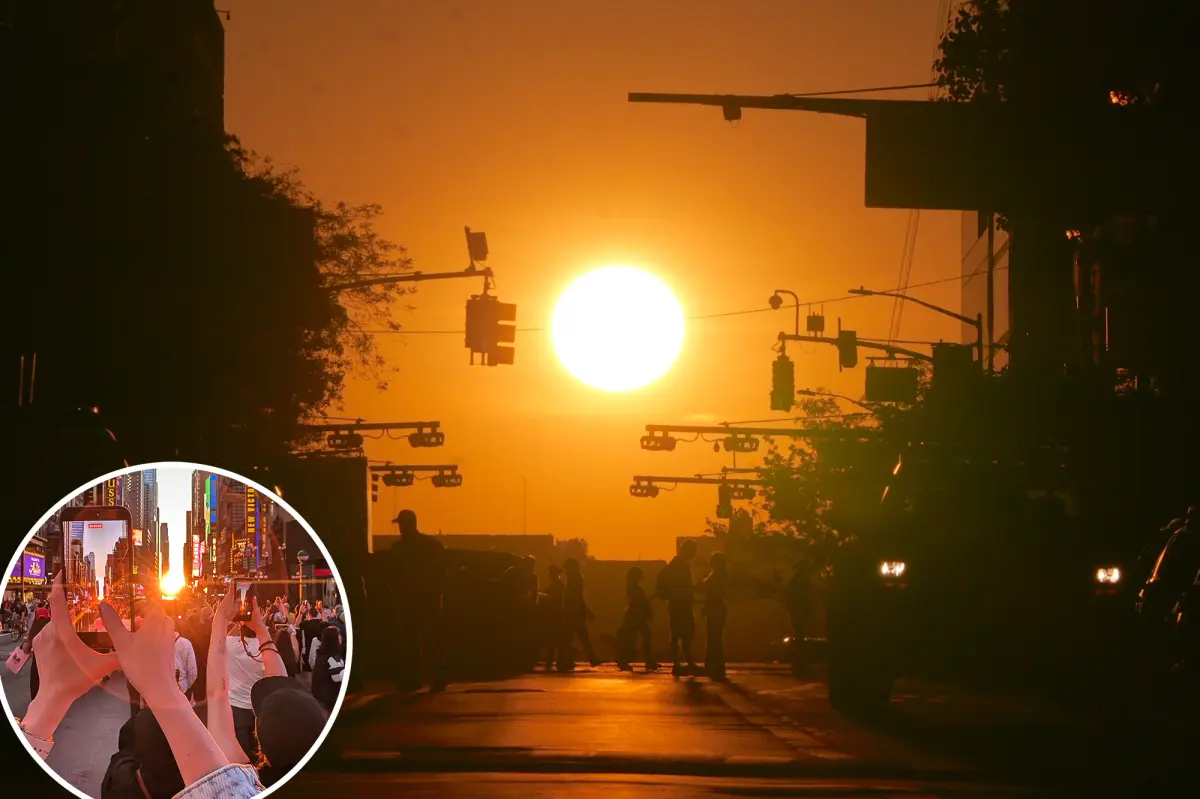
Grab your smartphones and head down to the bustling streets of New York, because the year’s final Manhattanhenge is officially here. This spectacular, coincidental phenomenon—where the setting sun aligns in perfect symmetry with Manhattan’s rectangular street grid—is taking place this weekend, Saturday, July 11 through Sunday, July 12. Though the beauty of this natural event is that you do not have to work very hard to find a great view, not all east-west corridors are created equal. While meteorologists suggest a few passing clouds may occasionally drift through the sky, there is no rain in the forecast around the sunset time of 8:28 p.m., promising clear, dramatic views for casual observers and avid photographers alike.
To celebrate the occasion, the American Museum of Natural History is hosting an exciting, free block party on Saturday from 3:00 p.m. to 10:00 p.m. along West 79th Street, between Amsterdam and Columbus avenues. The event features indoor World Cup viewing, while the street outside comes alive with chess matches, double-dutch jump rope, and classic board games. The prime viewing window is expected around 8:20 p.m., just as the renowned Williamsburg Salsa Orchestra begins to play a vibrant soundtrack to the sunset. For those curious about the science behind the spectacle, the museum is also hosting an educational lecture at 7:00 p.m., where experts will dive deep into the cosmic mechanics that make this urban phenomenon possible.
The term “Manhattanhenge” was famously coined by astrophysicist Neil deGrasse Tyson, who drew inspiration from the prehistoric Stonehenge monument in England, where the sun aligns with ancient stones during the solstices. Tyson calculated the precise grid of Manhattan, measuring the specific azimuth—the horizontal angle along the horizon—and altitude where the sun would align directly with the streets. To put the grand scale of this alignment into perspective, if you point your finger straight down the middle of 42nd Street on these specific dates, you are pointing along a direct line that extends 93 million miles through space, pointing directly to the heart of our solar system’s star.
While we are taught in school that the sun always rises in the east and sets in the west, this perfect cardinal alignment actually only occurs twice a year on the spring and autumn equinoxes. Because the Earth is tilted on its axis and constantly orbiting the sun, the sunset point shifts along the horizon every day. If Manhattan’s street grid were perfectly aligned with the geographic north-south line, Manhattanhenge would happen on the equinoxes. However, because the city’s grid is rotated about 30 degrees east of geographic north, the alignment is shifted on our calendar to late May and mid-July.
Manhattan is uniquely suited for this visual masterpiece due to its uniform rectangular grid and its wide-open western horizon looking across the Hudson River toward New Jersey. The sheer height of the skyscrapers creates a grand, vertical brick-and-glass canyon that frames the brilliant orb of the sun as it sinks. To catch the best views, you should position yourself as far east as possible while maintaining a clear line of sight to New Jersey. The most popular cross streets for prime viewing include 14th, 23rd, 34th, 42nd, and 57th streets, while elevated spots like the Tudor City Overpass and Hunter’s Point South Park in Queens offer breathtaking, panoramic perspectives.
To pinpoint the exact moments for the event, astrophysicist Jackie Fahorty of the American Museum of Natural History calculates the sun’s coordinates from 42nd Street and Fifth Avenue. This location allows her to distinguish between the “full sun” Manhattanhenge, where the bottom edge of the sun kisses the grid before dipping below the horizon, and the “half sun” version, where the sun is sliced perfectly in half. While May features the half sun first, the July event reverses the order, showcasing the full sun on Saturday and the half sun on Sunday. Ultimately, as Neil deGrasse Tyson reminds us, Manhattanhenge is a beautiful excuse for busy New Yorkers to temporarily stop rushing, look up, and appreciate our connection to the grand cosmos.