





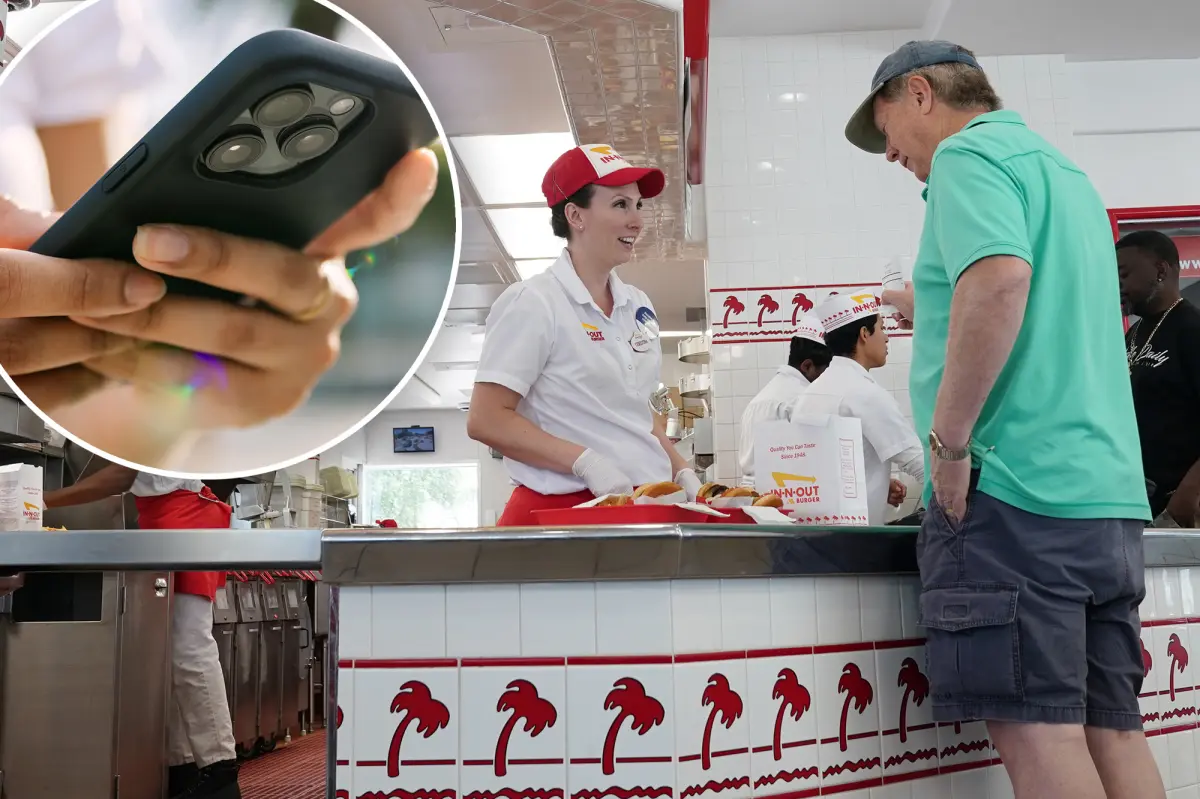
There is a moment, familiar to anyone who has ever lived in or visited California, when the idea of an In-N-Out Double-Double stops being a casual thought and transforms into a low-grade emergency. You are suddenly aware of the exact architecture of the burger: two hand-formed beef patties griddled just enough to yield, two slices of melted American cheese, the cool crunch of hand-leafed lettuce, a tomato that actually tastes like something, and that soft, impossibly wholesome bun, toasted on both sides until it is sweet and buttery. You can almost feel the weight of it in the palm of your hand, wrapped in a paper sleeve that slowly turns translucent with juice. But the path to that moment is rarely convenient. In-N-Out is famous for many things—fresh ingredients, fanatical loyalty, business hours that politely end before the night gets ugly—but above all, it is famous for refusing to modernize the ordering process in any meaningful way. There is no app. There is no advance ordering. There is no third-party delivery. The chain has even gone to court to prevent companies such as DoorDash from swooping in and turning its cult burgers into delivery fare. The only sanctioned way to satisfy the craving is to put on clothes, drive to the nearest red-and-white beacon, stand in line, and wait—and if the parking lot is packed, the wait can be long enough to threaten the very will to live. For Californians who are recovering from surgery, juggling children, trapped in back-to-back meetings, or simply too sleepy to face a crowded drive-thru, that is not good enough. So they have found another way. A secret, unglamorous, and completely unauthorized market of couriers now offers to bring In-N-Out directly to your door. It operates through classified ads, private messages, and cash-app payments. It has no official name, no formal rules, and no guarantee of success. But it exists, and it is growing, one craving at a time.
The secret side of the In-N-Out economy was recently dragged into broad daylight by L.A. Material, a local outlet with a healthy appetite for the absurd and the hidden. Its reporters combed through Facebook Marketplace and discovered close to a dozen independent couriers advertising unauthorized door-to-door runs. The service area is startling: it covers Hollywood, Orange County, and even distant Santa Barbara, meaning there is a verifiable pipeline of burger smugglers moving up and down the California coast. The advertisements are a beautiful, messy collage of desperation and creativity. Some appear to have been designed with artificial intelligence, offering images of burgers that could never exist in reality: iceberg lettuce with the structural integrity of a telephone, patties hovering in space, buns with suspiciously perfect air holes. Others are more straightforward, featuring real photographs of a Double-Double glistening in the sun or a bag of fries slumped next to a drink cup. The financial side of the business is equally unregulated. On Airtasker, which is like a wildly informal marketplace for odd jobs, there is a dedicated page for In-N-Out delivery in California, something the company itself would never sanction. One customer in Santa Clara paid a hundred dollars for the delivery of two Animal Style cheeseburgers and two orders of Animal Style fries, a price that must have seemed perfectly reasonable at the moment the order was placed. Another customer in Los Angeles paid forty dollars to have In-N-Out brought to their home after surgery, because the medications made driving unwise and the pain made fast food a necessity. The runners generally ask for the cost of the meal plus a fee, agreed on in advance, but the terms are open to negotiation. Some demand a deposit as soon as the conversation begins. Others insist on payment only after the bag has changed hands. It is the wild west of fast food, with all the charm and danger that implies.
To understand why this black market bothers some people and delights others, you first have to understand the institution it is trying to dodge. In-N-Out was founded in 1948 by Harry and Esther Snyder in Baldwin Park, just east of Los Angeles, and it remains one of the last great family-owned fast-food empires in America. The menu has barely changed since the beginning, except for a few secret off-menu items that loyalists have invented over the years. The restaurants are not franchised. The meat is fresh, never frozen. The fries are cut at each location from raw potatoes, which is why they take a little longer and why they are so glorious in the first minute and so sad thereafter. The company does not advertise on billboards, does not chase trends, and does not care about overnight retailers. Lynsi Snyder, the billionaire granddaughter of the founders and the current CEO, has spent her life guarding these traditions. She has made it clear that she considers the human interaction at the counter to be as important as the food on the tray. In 2015, the company sued DoorDash to prevent unauthorized couriers from delivering its food, arguing that the practice damaged the brand’s freshness and quality. At a Pepperdine University event, Snyder said that what makes In-N-Out special is not just the burger but the service, the smile, the moment of exchange. She warned that delivery gimmicks would ultimately destroy the hospitality that customers have come to expect. From her point of view, the drive-thru line is not an inconvenience; it is a ritual. The wait is a kind of tribute. The fact that the burger is handed to you by a person, not dropped off by an algorithm, is part of the picture. In-N-Out sells more than lettuce and beef. It sells the feeling of being cared for, and that feeling has a strict expiration date.
The people who have stepped into the unofficial delivery business are not corporate saboteurs. Most are simply neighbors who like the food and understand that hunger can make people do strange, generous, and occasionally profitable things. Jesse Osorio, a thirty-year-old HVAC technician from Hollywood, is almost the perfect representative of this underground economy. He told L.A. Material that he loves In-N-Out, eats it all the time, and one day realized there might be other people who want the same thing but cannot jump in a car and chase it. So he started offering his services. His business model is honest and simple: the customer pays for the food, and Osorio charges a flat fee of $20 per delivery, or $30 for larger orders. He does about twenty runs a week, which means he is spending a significant portion of his spare time in the warm, greasy embrace of the In-N-Out drive-thru. For him, the work is not just about money. It is a way to bring pleasure to other people, to deliver a small dose of Southern California sunshine to someone who might be stuck at home, or sick, or working a double shift. He has seen the relief in his customers’ eyes when the bag arrives. He has watched old men tear up over animal-style fries. He is probably not going to get rich, but he is participating in something that feels more human than a standard delivery app. The other couriers who compete with Osorio on Facebook Marketplace have a range of skills and styles. Some are reasonably professional and even send updates as they wait in the drive-thru line. Others are chaotic, posting the same blurry photo in five different groups, using capital letters in strange places, and signing off with emojis that do not quite make sense. It doesn’t matter. In a market where the item for sale is both delicious and forbidden, the seller does not need to be polished. They just need to arrive.
Of course, no black market would be complete without its share of fraud, and the In-N-Out delivery underground is no exception. The same platforms that make it easy for a legitimate side-hustler to post an ad also make it easy for a completely fictional person to take your money and vanish. There is no buyer protection, no review system that can be trusted, no way to know if the stranger on the other side of the screen is a real human being with a car and a hunger for work, or someone sitting in a bedroom with a burner phone and a talent for disappearing. L.A. Material decided to test the market firsthand, and the result was a lesson in the dangers of unregulated commerce. The reporters got in touch with a seller, negotiated a fee for a delivery, and were asked to send a $25 deposit in advance over Zelle. It seemed like a small risk, a reasonable request. Maybe the runner just wanted partial compensation for the time and gas that would be spent. So the money was sent. The runner, it turned out, was not a runner at all. The messages stopped. The seller disappeared from the platform and blocked the hungry journalists. The $25 was gone. No burger, no refund, no apology. For anyone who decides to venture into this ecosystem, the story is a warning. Even an honest delivery can end in disappointment, because In-N-Out’s food is designed to be eaten immediately, not driven across town in a passenger seat. The fries, as beautiful as they are in the restaurant, become flaccid and sad by the time they reach a front porch. The shake melts into a puddle of vanilla-colored memories. The burger itself may survive, but it will not be the transcendent thing it was when it left the counter. That is the fundamental tension: every unofficial delivery is both a small miracle and a quiet betrayal of the product that inspired it.
This underground burger market is not going to destroy In-N-Out. If anything, it is proof that the chain has reached a level of cultural status that borders on mythology. A company only becomes worth sneaking around for when its products are so beloved that people are willing to break the company’s own rules to get them. That is not a failure; it is a measure of success. But it is also a strange and very modern standoff. In-N-Out believes, with what seems to be genuine sincerity, that the experience of showing up and waiting is part of the gift. The people who hire unofficial runners believe the opposite: that the burger is the gift, and the waiting is an unnecessary obstacle between them and their joy. The couriers, stuck in the middle, are simply trying to earn a few dollars by making the world more convenient, one delivery at a time. They are not asking for permission. They are not waiting for the chain to change its mind. They are doing what Californians have always done when the rules do not fit their desires: they find a workaround. Some customers will continue to line up in the parking lot, because that is where comfort lives. Others will send a stranger $25 in advance and learn that the ancient bargain of trusting people can still sting. But for every scam, there will be ten successful deliveries, bags of warm food arriving at apartment doors like contraband and Christmas presents at once. Nobody is getting arrested for this. There is no task force. The phenomenon is small enough to be a curiosity and persistent enough to be a pattern. As long as the chain stays true to its old-fashioned philosophy, there will be people waiting in line—and as long as there are people waiting in line, there will be someone else willing to cut in ahead of them for a price. The unofficial, unregulated, deeply weird trade in In-N-Out delivery is a love letter written in greaseproof paper, a small act of rebellion against the inconvenient fact that good things require effort.