


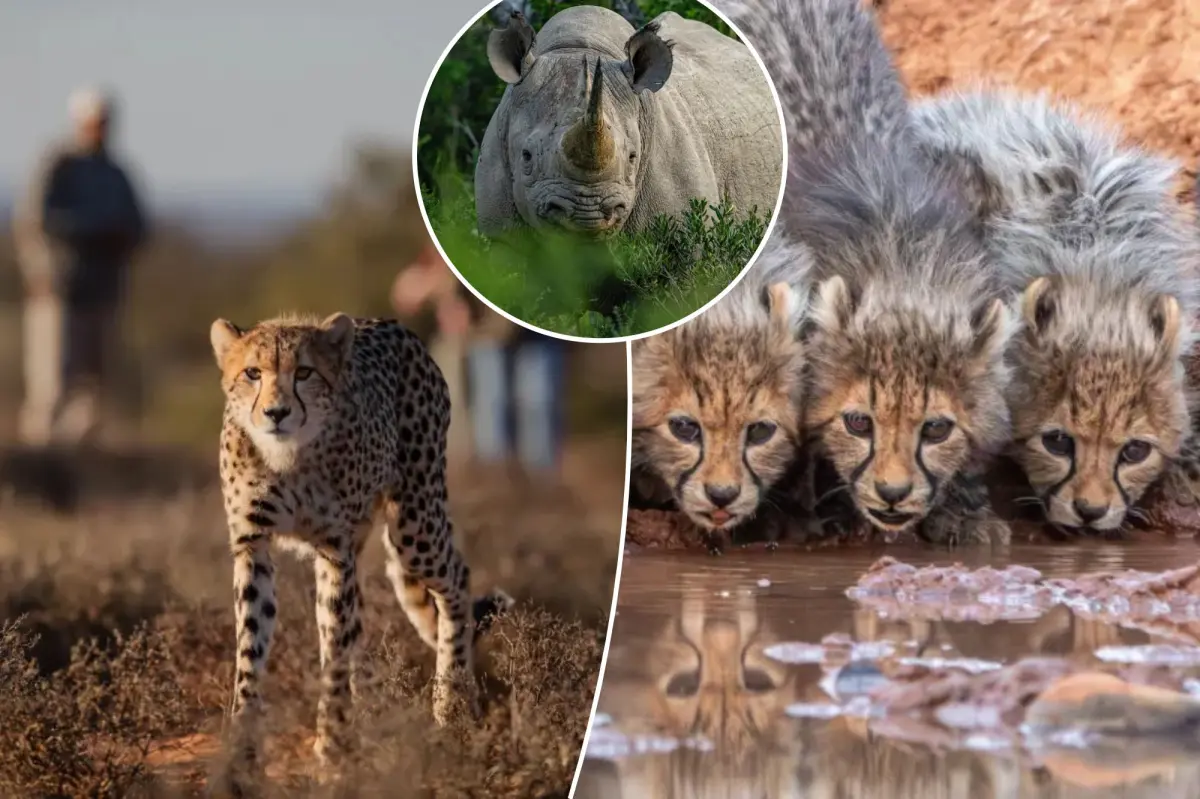
Before I went to Samara Karoo Reserve, I thought I knew what made a safari sundowner perfect. There is a familiar ritual to it: the engine cuts, the guide pulls out a cooler, and you sit beneath an acacia while the sky turns to apricot and charcoal. A gin and tonic seems essential. But during my first evening in this wild stretch of South Africa’s Eastern Cape, I discovered that the true recipe had nothing to do with alcohol. It was golden light, blissful silence, and a wild cheetah lounging twenty feet away as if the whole landscape were her living room—which, in a sense, it was. Her name was Mbali, and despite her regal posture, she was the busiest kind of mother. Her six mischievous cubs were still draped in their final baby fluff, including the odd silver-gray fringe along their spines that makes young cheetahs resemble fierce honey badgers and fools predators into leaving them alone. As the sun dropped behind the Karoo ridges, I crouched low to watch Mbali groom and nuzzle her little ones. It was impossible not to hold my breath. The cubs tumbled over one another, pawing at their mother’s tail, while Mbali calmly cleaned their faces and watched the horizon. What amazed me most was how unbothered the whole family was by our presence. We were standing on foot, not hidden in a vehicle, and yet she allowed me to share her evening as though I were part of the scenery. I have been lucky enough to experience many wildlife encounters, but that quiet confidence—a wild mother trusting me with a glimpse of her secret world—felt like the rarest gift.
That trust did not arrive overnight. It was built, patiently and deliberately, over generations of cheetahs at Samara—and it began with Mbali’s great-grandmother, a legendary female named Sibella. Sibella’s early life was marked by cruelty. She suffered a brutal hunting attack at human hands, was rescued and rehabilitated by the De Wildt Cheetah & Wildlife Trust, and in 2004 was released into the reserve. At that moment, she became the first cheetah in South Africa’s Great Karoo in nearly 130 years; unregulated farming and hunting had wiped out the species across this vast arid region, and the land had been silent for over a century. But there was something extraordinary about Sibella. Despite the trauma she had endured, she did not run from people. She allowed Samara’s guides to approach her on foot, to spend hours in her company, even to observe her cubs. The reserve’s founder and director, Sarah Tompkins, still shakes her head at the mystery: “Scientists can’t explain it. Given her previous abuse, Sibella should have been terrified. But she allowed human beings into her space and to view her cubs.” That inexplicable gift became a living inheritance. Every subsequent generation has been raised in an environment where humans are calm, predictable, and respectful, and so they have learned, as cats do, that people on foot are part of the landscape rather than a threat. This is not taming; the cheetahs remain entirely wild, hunting for themselves and raising their young without intervention. It is habituation, a carefully managed process that has made Samara one of the best places in Africa to photograph cheetahs—and one of the few where you can leave the vehicle entirely. Guests can book the Cheetah Trail, a three-night slackpacking experience that follows the cats’ movements across the reserve. The stakes are urgent: fewer than 7,000 adult cheetahs remain in the wild, scattered across shrinking habitats. To meet Mbali and her cubs is to understand why those numbers matter, and why rewilding places like Samara offers hope.
This hunger to walk among wild animals is part of a larger shift in the safari world. Travelers are increasingly eager to step off the game vehicle and into the landscape. Tamsyn Fricker, co-founder of Travel Artistry Africa, has watched that desire grow: “Folks are keen to engage and learn about tracking and conservation. It’s about slowing down to really see and understand these creatures.” Walking forces you to slow down. You cannot barrel toward a sighting; you have to read the wind, listen for alarm calls, notice fresh tracks, and let the bush reveal itself on its own schedule. But not every walking safari is created equal, and Fricker is quick to offer a caution. If a property guarantees a specific sighting, or promises an “interaction” in which an animal walks alongside you, that is a red flag. A legitimate operator does not seek direct access to an animal, and will confirm guide credentials without hesitation—walking guides need extra training, a deeper understanding of animal behavior, and the ability to make calm decisions under pressure. At Samara, no one ever promised me Mbali. The guides made no guarantees, because nature does not work on demand and they never pretended otherwise. We walked slowly, stopping often, following signs I could barely see. When we finally found her, there was no sense of a performance. Mbali was simply living her life—grooming her cubs, watching the light fade, doing exactly what she would have done whether or not we were there. That is the difference between a real encounter and a manufactured one. Real walking safaris ask you to accept uncertainty, to be humble, and to understand that wildness is a gift, not an amenity.
For travelers eager to follow that trail further, South Africa’s Eastern Cape offers one of the most thrilling walks of all: rhino tracking. The region has become an epicenter of black rhino conservation, and nowhere is that more evident than at Kwandwe Private Game Reserve, a vast 74,000-acre expanse of rolling bushveld. Angus Sholto-Douglas, Kwandwe’s managing director, describes the area with justifiable pride: “The Eastern Cape [of South Africa] has become an epicenter of black rhino conservation.” During a recent visit, I tracked both black and white rhinos on foot, keeping a respectful distance as we moved through thick brush and open grassland. The two species could not be more different. White rhinos are gregarious grazers, often found in open plains, while black rhinos are shy, solitary browsers with a reputation for being more dangerous when startled. To walk in their presence is to feel the ground vibrate with their weight, to smell their earth-and-grass scent, and to understand how something so massive can disappear so completely into the landscape. I also joined Kwandwe’s specialized Rhino Conservation Safari, during which the reserve’s ecological team and veterinarians worked alongside me to gather vital data. The centerpiece of the day was fitting a young rhino with a state-of-the-art, solar-powered ankle collar—a device that will allow rangers to monitor the animal’s movements and protect it from poaching for years to come. The procedure was done with such precision and care that it felt like a glimpse into the future of conservation. It was also a reminder of how fragile this success remains. Rhinos are poached for their horns, and every minute of effort is a defense against greed. Walking with them, I understood that conservation is not abstract. It is practical, intimate, and urgent. And it begins with people willing to get close enough to care.
Then there are elephants, which may be the most moving of all creatures to meet on foot. In Zimbabwe’s Hwange National Park, home to one of Africa’s largest elephant populations, the person you want by your side is Calvet Nkomo. A head guide at African Bush Camps’ Somalisa Camp, Nkomo has more than thirty years of experience, and his knowledge is not merely encyclopedic—it is personal. He knows the individual animals that wander these paths, their family histories, their moods, their quirks. Elephants never forget, the saying goes, and neither does Nkomo. During one of our walks, he spotted a particularly placid bull ahead, grazing in a dry riverbed. Another guide might have pointed and moved on. Nkomo instead instructed me to duck down into the tall grass and wait. We knelt there, hidden, as he read the elephant’s body language—the slow rhythm of its trunk, the relaxed angle of its ears, the unhurried weight of its step. Then, at precisely the right moment, he signaled me to stand slowly. The bull looked up. For a long, suspended moment, we simply regarded one another: two species sharing the same ground by mutual choice. The elephant gave a soft rumble, considered us, and then resumed his business, granting us a few seconds of coexistence before melting into the mopane woodland. It was not a chase or a spectacle. It was a conversation conducted in quiet gestures, and it left me trembling. That is the artistry of a great walking guide—not to overpower the landscape, but to speak its language. On foot, you feel an elephant’s footsteps in the earth before you see it. You smell its warm, dusty presence. You realize that you are not an observer at all, but part of the same ancient story.
Perhaps the most profound walk of all leads into the misty bamboo and volcanic slopes of Rwanda’s Volcanoes National Park to meet mountain gorillas. Trekking with these great apes has become one of the most sought-after wildlife experiences in the world, and for good reason. “Looking into the eyes of a gorilla feels like gazing into a mirror of one’s soul,” said Inge Kotze, head of conservation at Singita, which runs the nearby Kwitonda Lodge. The trek itself is not easy. You climb through dense forest, mud, and altitude, following a trail broken by trackers who have been up since dawn. But when you finally reach the family, the exhaustion evaporates. A silverback might sit just a few meters away, chewing a stem of bamboo with an expression of ancient calm. Mothers groom their infants. Juveniles somersault through the undergrowth. The encounter feels less like observation than recognition, as if you are meeting relatives you never knew you had. The story behind that feeling is one of conservation’s greatest rebirths. In 1981, mountain gorillas had plummeted to just 242 individuals, a number so small that extinction seemed inevitable. Thanks to decades of coordinated protection—anti-poaching patrols, veterinary care, community involvement, and carefully managed tourism—the population has climbed to nearly 1,100. They are now the only great ape on Earth whose numbers are increasing. It is a triumphant reminder that human beings can be more than a threat; we can also be guardians. Every permit purchased, every respectful visitor, every guide who explains gorilla behavior helps secure their future. And that, I think, is the real lesson of a walking safari. It is not about checklisting animals or capturing the perfect photograph. It is about returning to the wild as a guest, not a spectator, and carrying home a deeper commitment to protect the places that still hold magic. At Samara, that commitment felt embodied by Mbali and her six cubs, a wild cheetah family that has learned to trust us—if we prove ourselves worthy. My sundowner had no gin, no tonic, no ice. It had golden light, blissful silence, and a mother cheetah at rest twenty feet away. It was the best drink I have ever had.