







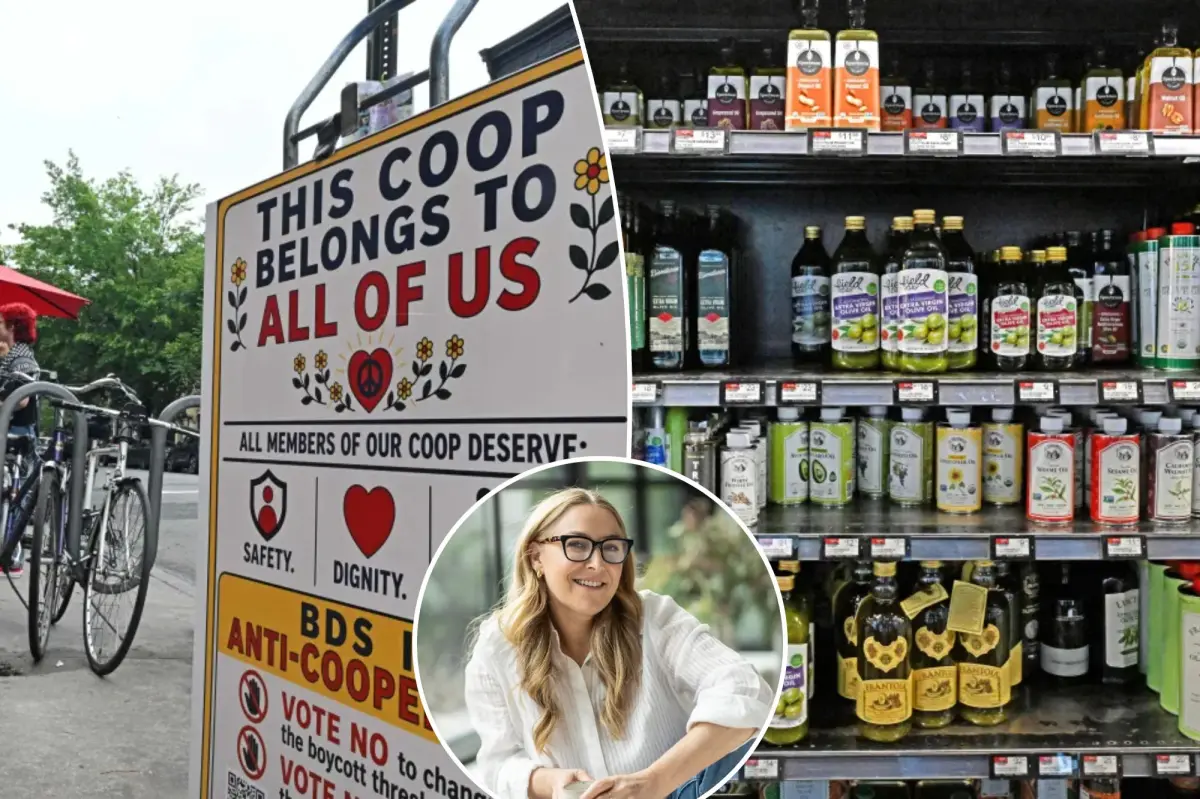
For decades, the Park Slope Food Coop on Union Street in Brooklyn has existed not just as a grocery store, but as a vibrant, highly democratic sanctuary for progressive values, where members trade their labor for affordable, ethically sourced food. Yet, this long-standing community hub recently became the battleground for one of the most polarizing and emotionally charged debates in its history, culminating in a highly anticipated vote on May 26 to boycott all products manufactured or sourced from Israel. Driven by passionate advocacy from supporters of the Boycott, Divestment, Sanctions (BDS) movement—who argued that economic isolation was a necessary, nonviolent response to the ongoing military conflict and humanitarian crisis in Gaza—more than 7,000 members participated in the massive, high-stakes vote. When the ballots were tallied, an overwhelming 67% majority had voted to approve the ban, translating into immediate action that saw target items vanish from the coop’s shelves by the following Wednesday morning. To those who championed the cause, the moment was celebrated as a historic victory of grassroots solidarity and ethical consumerism, demonstrating the power of ordinary citizens to stand against perceived state-sanctioned injustice. However, as the initial dust settled in the quiet aisles of the coop, the immediate, real-world consequences of this sweeping decree began to surface, revealing a painful rift between the lofty intentions of political activism and the tangled, highly complex web of global food production. Far from dealing a blow to state leaders or military institutions in the Middle East, the rapid implementation of the boycott began to ripple outward in unexpected, deeply personal ways, severing decades of trust, mutual effort, and shared values between the cooperative and the very diverse groups of independent business owners, small-scale farmers, and working-class laborers who rely on these shelves for their livelihoods.
The most striking and immediate irony of this blanket boycott emerged in the specific products that were swept up in the purge, many of which had spent years serving as symbols of cross-cultural cooperation and minority empowerment within the region. Chief among these was Al Arz, a critically acclaimed tahini brand formerly owned and built by Julia Zaher, an Israeli-Arab businesswoman who achieved extraordinary success in a highly competitive market, eventually selling her groundbreaking company for an impressive $50 million. To many, Zaher’s journey represented a shining example of how marginalized voices could break through socioeconomic barriers to build economic independence and leave a powerful, lasting legacy for future generations of Arab women in the Middle East. Yet, by implementing a monolithic ban based solely on geographic origin, the Park Slope Food Coop effectively wiped her legacy from their shelves, punishing the brand she spent a lifetime building in an attempt to target the state itself. Similarly, the coop’s ban resulted in the removal of Equal Exchange Olive Oil, a beloved staple that, far from representing state-backed aggression, is produced by a dedicated, values-driven non-profit organization co-managed and led by an integrated team of Arab and Jewish women. This unique collaborative initiative was founded specifically to foster dialogue, build economic bridges, and demonstrate that mutual respect and joint prosperity are possible even amid decades of political strife. By treating these nuanced, community-focused endeavors as simple extensions of a sovereign government, the boycott did not just ignore the complex social realities of the region; it actively dismantled the very projects of peaceful coexistence and economic integration that progressive consumer groups typically strive to support and celebrate.
For Rachel Simons, the Australian-born co-founder and CEO of the artisanal New York-based sesame and halva brand Seed + Mill, the news of the boycott’s passage fell like a devastating personal and professional blow. Simons, who co-founded her business in 2016 as a small, passionate food stall in Chelsea Market, had spent the last eight years building her company on a foundation of culinary appreciation, mutual respect, and high-quality craftsmanship, eventually securing a coveted place on the Park Slope Food Coop’s shelves around 2019. To a small, independent business like Seed + Mill, receiving regular, monthly orders from the coop was not merely a stable source of revenue; it was a deeply motivating validation from a retail partner whose cooperative principles, commitment to ethical sourcing, and community-centric philosophy perfectly mirrored her own business ethics. Simons, who is Jewish, has always been fiercely clear that Seed + Mill was never conceived as a political brand or an emblem of any single, exclusive national identity, but rather as an open celebration of sesame’s ancient, globally shared cultural history. The realization that her company had been officially categorized as an unacceptable entity overnight left her and her tight-knit team in a state of profound shock and mourning, severely damaging their team morale and leaving them feeling fundamentally misunderstood. She watched in frustration as years of collaborative, highly personal relationships were abruptly erased by a board-room decision that reduced her life’s work, her relationships with local growers, and her team’s dedication to a one-dimensional political label that ignored the diverse human network behind every jar of tahini they produced.
To truly understand the human cost of the Coop’s decision, one must look beyond the bustling streets of Brooklyn and the corporate offices of New York, and focus instead on the physical factory floor where Seed + Mill’s tahini is actually put into jars. The company’s primary co-packing facility is nested in Northern Israel and is proudly owned by an Arab Muslim Israeli family that has spent generations perfecting the art of food production. This local business is not some faceless corporate entity, but a vital economic heartbeat for the surrounding region, employing a rich and harmonious mixture of Arab, Jewish, Christian, and Druze workers who labor side-by-side every day in an environment defined by mutual dependency and shared success. According to Simons, there is absolutely zero evidence of an exclusionary or discriminatory system on this factory floor; instead, it exists as a rare, highly functional microcosm of daily coexistence, where individuals from vastly different ethnic, religious, and political backgrounds find common ground, support their families, and build collective prosperity through honest work. For these working-class employees, the global export market is not an abstract concept, but the primary mechanism that guarantees their job security, healthcare, and the well-being of their children in an otherwise unstable region. By cutting off access to cooperative markets like the Park Slope Food Coop, Western activists are directly threatening the financial security of these very diverse, ordinary workers, effectively penalizing an integrated, peaceful ecosystem that should be championed as a model for the future rather than being economically starved by a distant boycott.
In her emotional conversations following the vote, Simons expressed a deep and abiding frustration with what she describes as the “reductive” and oversimplified nature of modern socio-political consumer boycotts, arguing that they serve as blunt instruments that rarely, if ever, achieve their stated, idealistic goals. She points out that in our rush to take a stand on highly complex, centuries-old geopolitical conflicts, we have increasingly abandoned the vital art of direct communication, opting instead to communicate through absolute bans, corporate excommunications, and the flattening of individual human stories into easily digestible slogans. The tragic casualty of this trend is the loss of nuance, as consumer boycotts consistently fail to account for the incredibly intricate and diverse economic ecosystems that exist behind every single consumer product on a grocery shelf. When an organization like the Park Slope Food Coop decides to ban a brand like Seed + Mill, they are not sending a meaningful or painful message to the political elites running the government of Israel, who remain entirely unaffected by retail decisions in Brooklyn. Instead, this blunt instrument strikes down the small business owners, the local transport drivers, the packaging suppliers, and the multi-ethnic agricultural laborers who have built their entire lives around cooperative work and cross-border partnerships. Simons laments that by replacing actual community engagement and nuanced perspective with sweeping, absolute gestures, we are slowly closing the door on mutual understanding, isolating the moderate voices who are actively doing the hard, quiet work of daily peace-building, and leaving behind a fractured retail landscape where even food is weaponized to divide us.
Ultimately, the painful controversy unfolding at the Park Slope Food Coop serves as a sobering, powerful cautionary tale for the broader landscape of modern consumer activism, raising critical, urgent questions about the true efficacy and ethical implications of our purchasing decisions. While the desire of cooperative members to act against human suffering in Gaza is rooted in a deeply felt, highly understandable urge to do something in the face of tragedy, the actual execution of this boycott highlights the profound disconnect between distant moral posturing and the tangible realities of working-class lives on the ground. When we reduce complex, human-centric supply chains containing thousands of diverse workers to a simple, binary choice on a ballot, we risk destroying the very bridges of economic cooperation and daily co-existence that hold the key to long-term peace in troubled regions. True progress and lasting social justice are rarely built through isolation, exclusion, or the silencing of local, integrated voices; instead, they require us to lean into the discomfort of complexity, to seek out and support those rare spaces where different cultures work in harmony, and to refuse to let our collective empathy be flattened by polarizing slogans. As the empty shelves at the Union Street coop stand as silent monuments to a community divided, the stories of Rachel Simons, Julia Zaher, and the multi-ethnic workers of Northern Israel remind us that behind every label, there is a human face, a family to feed, and a fragile dream of shared peace that we must strive to protect rather than dismantle in our pursuit of simple answers.