





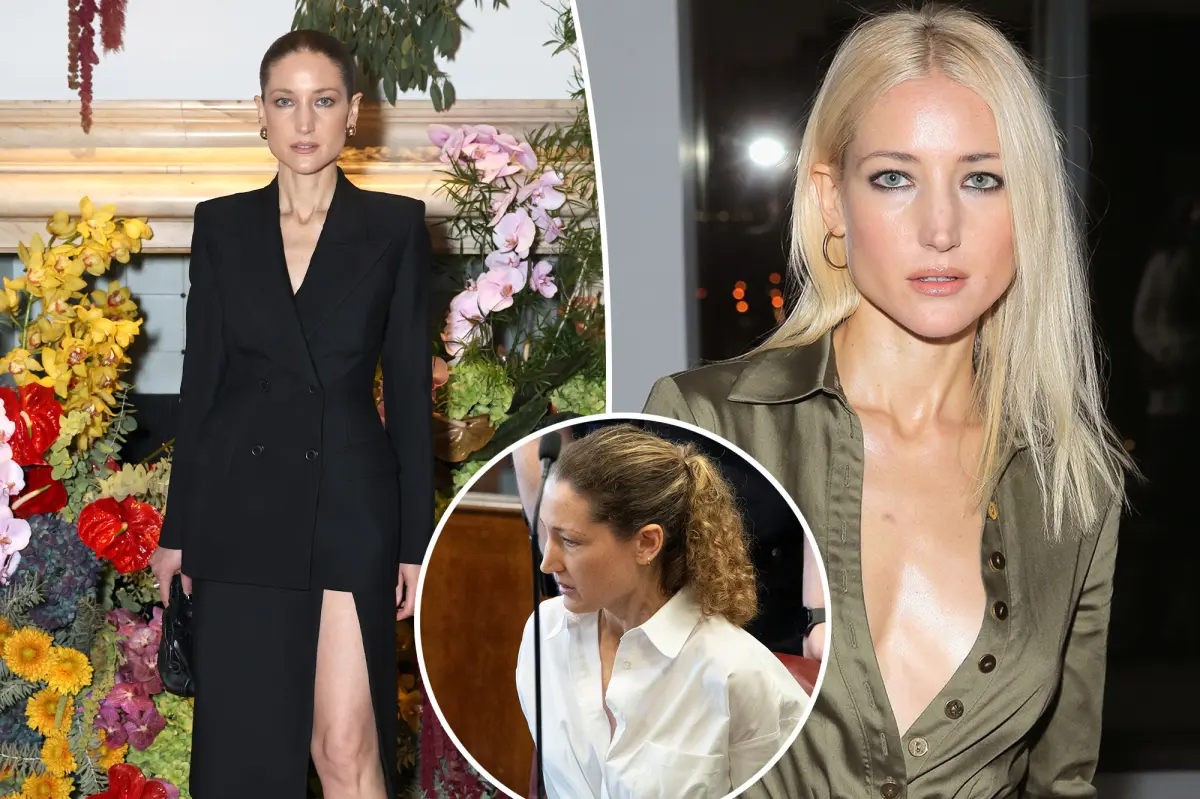
It should be illegal to look as good as Andrea Mary Marshall does on her carefully curated Instagram feed. Perhaps soon, it will be. On Wednesday, the 44-year-old fashion designer — who runs Salon 1884, a luxury brand that has dressed Julia Roberts, Katie Holmes, and Cynthia Erivo — arrived at New York County Criminal Court for a pre-trial hearing. The glamorous former model and longtime fixture of elite parties was not there for a collaboration or a magazine cover. She was there to face an ugly accusation. According to charges filed by District Attorney Alvin Bragg, Marshall bilked some of New York’s best garment workers out of $54,000 in just three years. She has pleaded not guilty to all charges. The image of Marshall walking into a criminal courtroom is a long way from the glossy world she has cultivated for decades: the Vogue profiles, the art openings, the celebrity clientele, the carefully styled selfies. She was once the Boston-born designer who added “Mary” to her name to sound more Catholic, as she confessed in a New York Times profile that was even more glowing than her skin. She dated Jefferson Hack, Kate Moss’s ex-husband. She was praised for both fashion and art. But now, the same impeccably curated life that made her a star is part of the backdrop for a very different story — one about unpaid workers, desperate texts, and a fall from grace that feels both shocking and, to some who know her, inevitable.
According to Bragg’s filing, Marshall’s behavior toward her employees was hardly Pope-like. She allegedly coerced former workers into laboring up to 100 hours a week, then gaslit them about payment. She allegedly withheld time cards to manipulate overtime hours and forced consecutive overnight shifts that left people exhausted and undercompensated. Many of the workers were immigrants, striving to feed their families, and their emotional pleas for money are now part of the public record. In one text, a garment worker wrote: “Good afternoon, miss. Please can you pay me something. I need to send it to Ecuador. It’s for my son. Please, I’m asking you. He’s sick.” Another read: “Miss Andrea, please can you pay me half. I really need to send money to Ecuador for my children. I really need it, miss, please help me.” In response to a third request, Marshall allegedly replied: “You are not allowed in my office. Give me your address and I will mail you a check.” According to the Department of Labor, that check never came. The charges against Marshall include Grand Larceny in the Second Degree, Scheme to Defraud in the First Degree, Failure to Secure Compensation, and Failure to Pay Wages in Accordance with Labor Law. Combined, they could carry between one and ten years in jail. The portrait painted by prosecutors is of an entitled socialite trying to pull a fast one on hardworking New Yorkers — a woman who continued to attend glamorous events and wear designer labels while her employees begged for money to care for sick children.
But Marshall’s lawyers, Anna Estevao and Justine Harris, say the case is far more complicated than the D.A.’s narrative suggests. “There is so much more to this story,” they told The Post exclusively. “Ms. Marshall is a solo female entrepreneur and artist who did her best under challenging circumstances. She paid all of her workers above minimum wage, more than she paid herself, in addition to buying them meals and Ubers home when they worked late. To the extent she experienced cash flow issues and fell behind in her obligations, she remains committed to paying her outstanding debts.” The defense also claims that Marshall herself is a victim of theft — not by her employees, but by “major fashion retailers not paying on time” for orders they had placed. In this telling, Marshall is a struggling business owner squeezed by a broken system, and the D.A. is trying to “make an example” of her with inflated criminal charges. “She’s getting screwed by a larger system,” says a former Prada fashion executive who now consults for smaller brands. “Retailers take all your clothes. They say they’ll pay and then they don’t. And if they declare bankruptcy, like Saks, then you don’t get paid. She’s basically broke even though she did everything right.” The narrative is almost tragically familiar in the fashion industry: designers pour their creativity and resources into collections, department stores delay payments or stiff them entirely, and the people at the bottom — the seamstresses, pattern cutters, and garment workers — are left waiting for wages while the designer takes the blame.
Yet some industry insiders and former employees are not convinced. Sources familiar with the deal between Salon 1884 and Neiman Marcus say that, in Marshall’s case, retail payment delays cannot explain her financial troubles. Salon 1884 was only carried at the luxury retailer until the spring of 2025 — nearly a year before its parent company, Saks Global, filed for Chapter 11 bankruptcy. There is a difference, they argue, between running out of money and allegedly manipulating an employee’s timesheet so you don’t have to pay them at all. And some former workers bristle at Marshall’s continued public appearances in high-end labels while claiming she can’t pay her debts. “The Cartier Love bracelet she’s still wearing is a terrible choice,” said one former staffer who is still owed funds. “Sell it and pay people.” Emma Gage, a downtown designer for the label Melke who shares a similar clientele and often works with the same pool of skilled immigrant laborers, told The Post she cannot understand how anyone could short their shirt-makers for years without knowing it was happening. Gage explained that one custom dress or suit costs about $1,000 in labor, including draping, fitting, pattern cutting, and garment construction. “If someone owes $54,000 and they’re making custom outfits, that’s 54 times they’ve done this behavior. That’s theft, plain and simple.” The math is blunt, and it cuts through the more sympathetic version of Marshall as a helpless artist caught in a web of late payments. Even if she was struggling, the argument goes, she had choices — and she made the wrong ones, over and over again.
At the same time, the broader fashion industry is not innocent. A luxury fashion executive with personal knowledge of Marshall’s business told The Post that “what she did was wrong,” but added that Marshall was doing over a million dollars in retail sales collectively while stores withheld payment. “They took all her clothes and withheld all her money. The stress over this has been eating her alive.” The executive described Marshall as “a pawn” in a high-stakes game of hot potato. “There’s no excuse to not pay your team. But if retailers like Neiman Marcus paid Andrea on time, she would not be in the position she’s in.” A CFDA-nominated New York designer, who is friendly with Marshall and could not be named because of their own pending case against a mega-retailer, echoed that sentiment. “We’re all living on promises,” they said. “I’m scared to know how much money I lost from that bankruptcy.” Their spouse’s successful business is the only reason they can currently make payroll. These voices highlight a systemic problem in luxury fashion: designers are expected to create beautiful things, but the business side is brutal, and the smallest players are often the most vulnerable. When department stores go bankrupt or simply refuse to pay, the burden trickles down — and too often, it lands on the shoulders of immigrant garment workers who have the least power to fight back. Marshall’s case, in that sense, is not just about one designer’s personal failures. It is about an industry that romanticizes creativity while starving the people who make it possible, and then lets individual artists take the fall for a system that was never designed to protect them.
Marshall’s trial is expected to begin in early 2027. Until then, she continues to court the fashion world’s approval, posting at 4 a.m. on Instagram the day after her court check-in: a close-up video of herself sewing at a metal table, doing a skilled gathering stitch on raw cotton, artfully arranging the fabric with her bare hands. On one wrist, she wore the Cartier Love bangle that her former colleagues mentioned. If it’s real, it retails for just under $8,000 — roughly 15 percent of what the D.A. alleges she owes. The video is cryptic, perhaps a message about the value and skill of her own handiwork, perhaps an attempt to remind the world that she is, above all, an artist. But the optics are hard to ignore. Six months ago, a well-known fashion consultant told The Post, Marshall asked her to work for the brand but said she would have to pay in clothes because she had no money. “She said she was having issues getting retailers to pay her for orders. I wish I could have helped — she’s super talented. But I can’t work for free.” Former employees, friends, and fellow designers describe Marshall as a brilliant but financially unsavvy woman who, in the words of one allegedly swindled former employee, “believed more money would appear… and when it didn’t, she froze. She just doesn’t know how to handle this.” Her lawyers insist she has been and will continue making “good faith efforts to comply with complicated regulations,” and that the D.A.’s highly public campaign to turn her into a convicted criminal is “massively unjust and unfair” given her attempts at reparations and past precedent treating such violations as civil matters. So is Andrea Mary Marshall a hapless fashion victim, or a common thief whose finger-pointing is obscured by a gleaming gel manicure? The answer probably lies somewhere in the gray space between the two: a talented, struggling woman who made terrible choices under crushing pressure, surrounded by an industry that celebrates her work but leaves her unpaid — and, in turn, left her own workers waiting for wages they had earned. The law will decide her fate. But for the garment workers who texted her about sick children and rent money, the wait has already been far too long.