





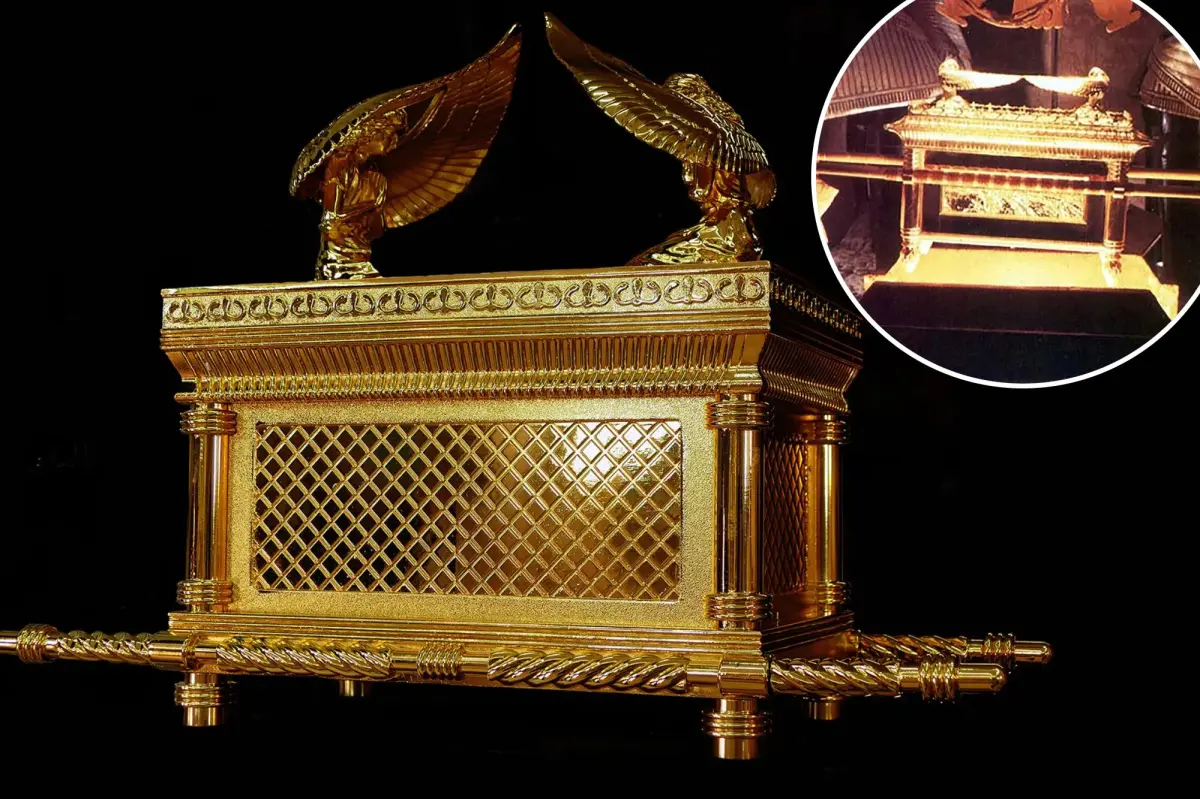
For over two and a half millennia, the ultimate fate of the Ark of the Covenant has captivated the human imagination. This legendary gilded chest, which biblical tradition says held the stone tablets of the Ten Commandments, vanished from historical records after the Babylonian empire sacked Jerusalem in 586 BC. While Hollywood depicted Indiana Jones dodging booby traps to find it, real-world archaeologist Dr. Chris McKinny, an associate professor at Tennessee’s Lipscomb University, is taking a far more scientific, hands-on path. Rather than grabbing a shovel and rushing blindly into Jerusalem, McKinny is championing a sophisticated, non-invasive approach to crack this ancient mystery. His quest is at the heart of the documentary series Legends of the Lost Ark, where he explores a compelling theory: the sacred artifact might still rest in a subterranean chamber deep beneath the City of David, just south of Jerusalem’s famous Temple Mount.
The chief obstacle to investigating this theory is the sheer complexity and political sensitivity of the site. The Temple Mount is an archaeological goldmine, with thousands of years of human history layered on top of itself. However, because it is actively managed by the Jerusalem Islamic Waqf and holds immense religious significance for Jews, Christians, and Muslims alike, traditional excavation is entirely out of the question. McKinny describes the Temple Mount as an archaeological “black hole.” While researchers have mapped and studied nearly every corner of ancient Jerusalem—making it one of the most thoroughly documented cities on earth alongside Rome and Athens—the Mount itself remains almost completely untouched. Our current archaeological knowledge of this critical site relies on a few scattered observations made over 150 years ago and whatever clues can be gleaned from discarded debris. To bypass these restrictions and glimpse what lies beneath, McKinny and his team are turning to cutting-edge technology.
The game-changer in this search comes in the form of cosmic-ray muon detectors, developed by physicist Erez Etzion and his team at Tel Aviv University. Muons are subatomic particles created when cosmic rays strike the Earth’s upper atmosphere. As these particles rain down, they easily pass through open air but are absorbed or deflected by solid stone and soil. By placing muon detectors near ancient structures, scientists can measure the density of the earth below. This acts as a highly advanced EKG for the ground, revealing hidden voids, forgotten aqueducts, and sealed chambers without disturbing a single stone. The technology has already proven its worth in a successful pilot run in the City of David, where a detector placed in one underground cavern successfully “saw” through solid rock to identify a known chamber on the other side, even picking up a tiny, previously undiscovered tunnel in the process. McKinny’s dream is to set up a network of these passive scanners along the retaining walls of the Temple Mount, creating a digital blueprint of the hidden world beneath.
While the prospect of scanning the earth is thrilling, it raises a natural question: could these high-tech sensors actually spot the gold-plated Ark itself? When McKinny asked Etzion if the technology could detect precious metals, the physicist explained that because muons are sensitive to extreme differences in density, a massive deposit of gold would indeed stand out. However, Etzion was quick to manage expectations. The muon system excels at capturing glaring contrasts, such as a massive empty hall surrounded by solid limestone. A relatively small wooden box covered in a thin veneer of gold leaf, buried under tons of heavy rock, would likely not register as a distinct shape. Furthermore, deploying these state-of-the-art scanners is highly expensive, with equipment costs reaching hundreds of thousands of dollars. Despite these financial hurdles, Etzion remains confident that as the technology is refined and becomes more portable, the detectors will eventually pay for themselves by revolutionizing how archaeological surveys are conducted worldwide.
Of course, the search for the Ark has plenty of detractors who believe the entire endeavor is a wild goose chase. Many scholars and theologians, such as Dr. Jeremiah Johnston, argue that the Ark was likely destroyed during the Babylonian invasion and no longer exists in any physical form. From a theological perspective, Johnston notes that for Christians, the spiritual significance of the Ark was entirely fulfilled through Jesus, making the physical chest irrelevant to modern faith. Renowned British scholar Tudor Parfitt is even more blunt, dismissing most Ark hunts as products of internet conspiracy theories rather than historical reality, stating flatly that the object simply does not exist anymore. Meanwhile, other archaeological teams are focusing their energy elsewhere, using traditional methods and technological tools to excavate ancient Shiloh—the Ark’s original home before it was brought to Jerusalem—hoping to find clues about the Tabernacle that once housed it.
For McKinny, however, the journey is about far more than just finding history’s most famous treasure. He views the Ark as a cultural touchstone that helps us understand the ancient mind, the development of biblical texts, and the enduring power of these historical narratives. He is realistic about the limitations of technology, acknowledging that even the most advanced sensors cannot replace the sweat and physical toll of traditional, hands-on archaeology. Yet, he remains profoundly optimistic that we are on the verge of uncovering incredible secrets buried deep beneath Jerusalem’s soil. As for what he would do if the muon detectors actually succeeded in locating the Ark of the Covenant? McKinny laughs and references the cinematic warnings of his childhood. Having watched Steven Spielberg’s classic film, he is absolutely certain of one thing: he will not be the one to open it.