


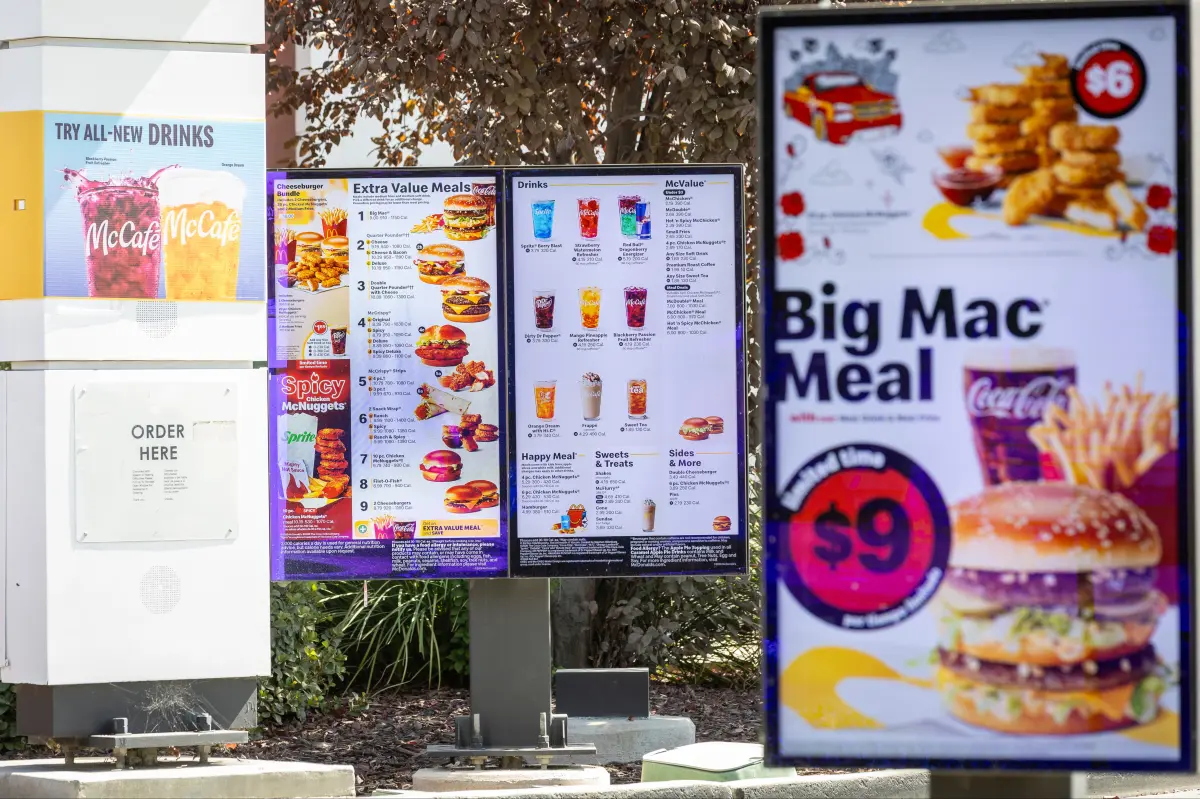
At first glance, ordering a Big Mac is a simple, almost automatic act: you walk in, you read the menu board, you hand over a few dollars, and you walk out with a warm bag. But behind that ordinary transaction, a high-stakes legal battle is now unfolding. McDonald’s has been sued in federal court in Chicago in a proposed nationwide class action that accuses the fast-food giant of illegally coordinating menu prices across its franchise and company-owned restaurants through an AI-powered pricing system. The lawsuit, filed on Friday, claims that McDonald’s violated US antitrust law by conspiring with its independent franchisees to fix prices using algorithms trained on nonpublic sales data. For the average customer, the allegations strike at something deeply personal: the trust that the price on the menu is the result of fair, independent, and competitive decisions—not a carefully calibrated machine designed to squeeze every last cent out of them. The plaintiff, an Illinois resident, is seeking to represent a class of potentially millions of McDonald’s customers across the country, meaning that if the case moves forward, it could touch nearly every person who has bought a meal at the Golden Arches in recent years. The suit paints a picture of a company that uses its massive scale and technological sophistication not just to improve efficiency, but to control the market in ways that allegedly harm consumers. It is a story about algorithms, french fries, and the quiet ways in which artificial intelligence is reshaping the everyday economy.
The complaint leans heavily on reporting from Reuters, which revealed last week that McDonald’s pricing engine relies on machine-learning algorithms to continuously analyze data from millions of daily transactions across its nearly 14,000 US restaurants. The idea is that the system can detect patterns in customer behavior, local demand, weather, traffic, and even the pricing moves of competitors, then recommend optimal price points for every menu item at every location. That sounds like a helpful tool for busy franchise owners, but the lawsuit sees something more sinister. It argues that because the same AI system is used across both corporate-owned and franchised locations, it creates an illegal channel for price coordination. Instead of each restaurant owner independently deciding what a cheeseburger should cost, the algorithm effectively aligns their decisions, potentially leading to uniform, artificially inflated prices that wouldn’t exist in a truly competitive market. The lawsuit repeats a fundamental principle of antitrust law: “Independent businesses must set their prices independently.” When a central authority collects sensitive pricing data from thousands of competitors and then feeds it through a shared recommendation engine, the line between independent decision-making and coordinated behavior can blur. The plaintiffs and their lawyers say that this is exactly what McDonald’s has done—using its trove of data not to empower local owners, but to orchestrate a quiet, algorithm-driven price-fixing scheme that leaves consumers paying more than they should.
For the people bringing the lawsuit, this is not an abstract debate about technology. It’s about real money taken out of real pockets, one meal at a time. Lark Turner, a lawyer for the plaintiff, put it bluntly in a statement, accusing McDonald’s of “leveraging its troves of data and its franchised system to nickel-and-dime consumers down to the last French fry.” That phrase captures the emotional core of the case: the feeling that corporations are using invisible algorithms to take advantage of ordinary people, especially at a time when food prices are already a source of daily stress for many families. The lawsuit suggests that the same AI system that helps McDonald’s decide where to place a new restaurant or how long to cook a batch of fries is also being used to test just how much customers are willing to pay before they flinch. The result, according to the complaint, is a landscape where prices are not set by neighborhood competition but by a centralized machine learning system that has access to far more information than any individual franchise owner could ever have. And because the franchise owners are independent business people, the lawsuit argues, they are supposed to be competitors in their own right—each trying to attract customers with better prices and better service. Instead, they are all playing from the same algorithmic playbook, which the plaintiffs say subverts the very idea of a free market. For the millions of customers who just want a cheap, fast meal, the alleged scheme means that the price they see on the digital menu board may have been quietly manipulated by a corporate algorithm, not shaped by the honest give-and-take of local commerce.
McDonald’s, for its part, has dismissed the lawsuit as speculative and uninformed. In a statement released on Monday, the company pushed back forcefully, saying, “AI does not set the price of a Big Mac or any other menu item.” It insisted that franchisees make their own pricing decisions, and that the use of pricing recommendation tools and analytics is widespread across industries. The company’s defense is likely to resonate with anyone who understands how retail pricing actually works: businesses of all kinds—from airlines to hotels to grocery stores—use data to adjust prices, and a recommendation is not the same as a command. McDonald’s points out that the final call on pricing belongs to individual franchisees, who know their own costs, their own local markets, and their own customers best. From that perspective, the AI system is nothing more than a sophisticated suggestion tool, not a puppet master pulling the strings of thousands of small business owners. The company also seems to be banking on the idea that consumers understand price changes are normal and responsive to supply, demand, and local conditions. Prices already vary from one McDonald’s to another, depending on rent, labor costs, and other factors. The question is whether a shared algorithm makes those variations less independent, or whether it simply helps franchise owners make smarter, more informed choices. That is the central factual dispute the court will have to untangle, but it is also a question that goes far beyond McDonald’s: in a world where nearly every major company uses AI to process data and guide decisions, where exactly should the line be drawn between legal optimization and illegal coordination?
This lawsuit does not exist in a vacuum. It is part of a growing wave of US class actions that accuse companies of using algorithms or artificial intelligence to illegally coordinate prices across entire industries. In recent years, plaintiffs have filed similar cases involving hotel rooms, apartment rentals, and other consumer purchases, arguing that software platforms have quietly replaced old-fashioned, smoke-filled-room price-fixing conspiracies with high-tech, machine-driven equivalents. The legal theory behind these cases is still evolving, but the basic argument is always the same: when competitors all rely on the same algorithm, trained on the same nonpublic data, they are no longer truly competing. Instead, they are participating in a kind of automated cartel, where the algorithm learns to avoid price wars and maximize collective profits at the expense of consumers. Defenders of these systems argue that algorithms are simply tools, that they don’t have intent, and that companies are free to use publicly available data to set their own prices. But critics say that the weapons may be new even if the war is old, and that antitrust laws written for the industrial age are now being tested by artificial intelligence. McDonald’s is just the most visible target so far. The company’s massive scale, its beloved brand, and the everyday nature of its products make the case easy for ordinary people to understand. Few consumers may care about the price of a hotel room in a distant city, but nearly everyone has an opinion about the cost of a Quarter Pounder. That is why this lawsuit could become a turning point in how courts think about AI pricing—and how companies use data to set prices without crossing the line into collusion.
For now, the case is underway, and the outcome is far from certain. McDonald’s has strong arguments on its side, including the fact that the use of pricing analytics is common and that franchisees have a legal right to make their own decisions. But the plaintiffs also have a compelling story, one that taps into growing public anxiety about artificial intelligence and corporate power. If the class is certified, the lawsuit could force McDonald’s to open its algorithmic black box and explain exactly how its pricing engine works, how much weight it gives to nonpublic transaction data, and whether franchisees ever felt pressured to follow its recommendations. The case could also raise uncomfortable questions for other fast-food chains and retailers that have quietly adopted similar technologies. Are those systems merely helping businesses respond to the market, or are they helping them fix prices? Could a recommendation tool that tells every franchisee to raise prices by twenty cents become a modern-day price-fixing conspiracy? These are the questions that courts, regulators, and businesses will have to grapple with in the coming years. For consumers, the stakes are simple: whether they can trust that the prices they see are the product of honest competition, not the output of an unseen algorithm working to maximize profit at their expense. The lawsuit against McDonald’s is more than a legal complaint; it is a reminder that the tools we use to make life easier can also be used in ways that challenge our assumptions about fairness and free enterprise. And until that challenge is resolved, every Big Mac you buy may come with a side of uncertainty—a small, lingering question about whether the price was set in a local restaurant, or in the cold, calculating heart of a machine.