


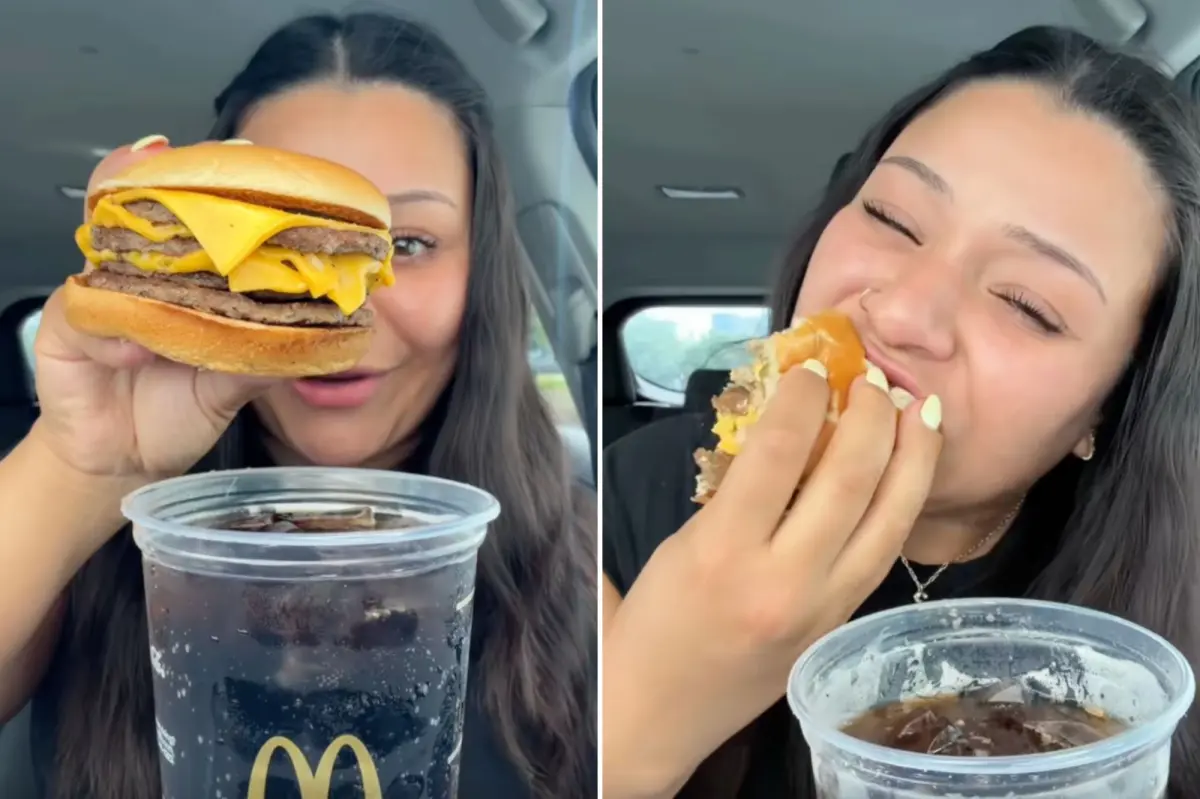
In an era where our social media feeds are constantly flooded with increasingly bizarre culinary creations, one might think we have reached the absolute limit of fast-food experimentation. From flamin’ hot dust sprinkled on sweet desserts to elaborate multi-layered sandwich towers, the internet has seen it all—or so we thought. Just when the collective consciousness of the digital world seemed settled, a viral TikTok video emerged to completely shatter our assumptions and thoroughly divide the global community of fast-food enthusiasts. Popular food content creator @theangelfoodie ignited a fiery online debate by posting a short, unassuming video of herself holding a classic, golden-brown McDonald’s triple cheeseburger. Instead of taking a standard bite, she calmly and deliberately plunged the entire burger directly into a cup of ice-cold, fizzy Coca-Cola, allowing the soft, baked bun to drink in the dark, carbonated liquid before taking a large, unhesitating bite. Accompanied by the simple, provocative caption, “Don’t knock it til you try it,” this single act of culinary defiance quickly racked up thousands of views, sparking an intense wave of fascination, curiosity, and sheer psychological distress across multiple social media platforms.
To understand why this brief clip provoked such an explosive reaction, one must look at the deeply visceral, physical reality of what this “hack” actually entails. Food is not merely about survival; it is an incredibly complex sensory experience dictated by temperature, texture, and flavor harmony. Dipping a freshly grilled, warm, and highly savory cheeseburger into a freezing-cold, sugary, carbonated soft drink completely upends the traditional rules of gastronomy. The immediate visual of the porous, yeasty bun acting like a sponge, absorbing the dark, syrupy soda, is enough to trigger an evolutionary aversion in many viewers who associate soggy bread with spoilage. The physical contrast is jarring: you have the hot, salty grease of the beef patties and the rich, melted processed cheese suddenly colliding with the icy, sharp, and effervescent sweetness of the cola. For the vast majority of onlookers, this chaotic amalgamation of textures—mushy, wet bread paired with dense meat and fizzy liquid—feels like a direct assault on the palate, while for a tiny, brave minority of culinary rebels, it represents a thrilling, taboo frontier of flavor contrast.
Naturally, the digital court of public opinion convened almost immediately, and the overwhelming verdict from fast-food traditionalists was one of absolute horror and betrayal. Comment sections became a digital battlefield of disbelief, with many users dramatically claiming that witnessing the act had genuinely “ruined” their day or night. The consensus among the outraged was that the creator had completely “lost the plot,” sacrificing a perfectly good, comforting meal for the sake of viral clout. Even seasoned fast-food employees found themselves unable to defend the creation, with one McDonald’s worker pleading in the comments, “I’m sorry, no,” while others flatly refused to be tricked into ruining both a perfectly good soda and a pristine cheeseburger. The collective shock was so profound that it even caught the attention of corporate social media managers, who often use these viral moments to humanize their brands. McDonald’s itself chimed in with a hilariously brief, existential comment that perfectly captured the public’s confusion: “Just why.” Not to be left out of the cultural conversation, rival chain Arby’s, famous for its own meat-heavy sandwiches, gently intervened by commenting, “let’s rethink this burger situation,” proving that some lines are simply not meant to be crossed, even in the highly competitive world of fast food.
The cultural ripple effect of the Coca-Cola-soaked burger did not stop at corporate bantering; it quickly made its way to pop culture royalty, further cementing its status as a certified internet phenomenon. Nicole “Snooki” Polizzi, the iconic star of MTV’s legendary reality series Jersey Shore, felt compelled to weigh in on the unfolding food drama. Known for her wild, uninhibited, and adventurous personality during her reality TV reign, Snooki’s opinion carried a unique weight for fans who know she is rarely one to shy away from unconventional choices. Yet, even the self-proclaimed party princess drew a hard line at this bizarre culinary pairing, writing, “I’m down for anything, but I don’t think this.” When someone who built a legacy on defying social norms and embracing chaotic fun decides that a food trend is too extreme, it highlights just how deeply unsettling the average person finds the idea of a wet, carbonated cheeseburger. Snooki’s reaction bridged the gap between everyday internet scroll-depth content and mainstream entertainment, transforming a quirky TikTok video into a broader cultural talking point about the limits of human taste and culinary decency.
Despite the heavy downpour of criticism and mock outrage, a surprisingly vocal and fiercely defensive faction of adventurous eaters emerged from the woodwork to champion the bizarre combination. These brave culinary contrarians argued that the flavor profile of the soda-dipped burger actually makes perfect scientific sense if you look past the initial shock of the presentation. They pointed out that the classic combination of eating a salty burger and immediately washing it down with a sweet, cold soda is something billions of people do every single day without a second thought; this hack simply cuts out the middleman by combining the two elements into a single, highly efficient bite. Proponents of the trend likened the experience to dipping hot, salty french fries into a cold, sweet milkshake—a widely accepted and beloved practice that similarly plays on the contrast of temperatures, textures, and the fundamental human love for sweet-and-salty flavor dynamics. As more daring individuals took the plunge at their local drive-thrus, comments like “It’s actually decent” and “Trying this today” began to sprinkle the comment sections, proving that curiosity often triumphs over disgust when it comes to the human palate.
Ultimately, this viral McDonald’s and Coca-Cola saga is indicative of a much larger, fascinating shift in our modern relationship with food, technology, and community. In the digital age, eating has been transformed from a private, nurturing ritual into a highly performative, collaborative public spectacle where the boundaries of taste are constantly pushed to capture our increasingly short attention spans. Whether this specific combination is viewed as an accidental stroke of culinary genius or an unholy, soggy abomination that should never be spoken of again, it highlights the incredible power of social media to unite millions of strangers in shared laughter, mock outrage, and genuine curiosity. As we move forward into an increasingly connected world, the boundary-pushing universe of TikTok fast-food hacks shows absolutely no signs of slowing down, reminding us that as long as we have access to a drive-thru, a camera, and a little bit of imagination, the next bizarre, internet-breaking flavor combination is always just one swipe away.