




Paragraph 1: The Serene Morning Shattered by a Savage Grasp
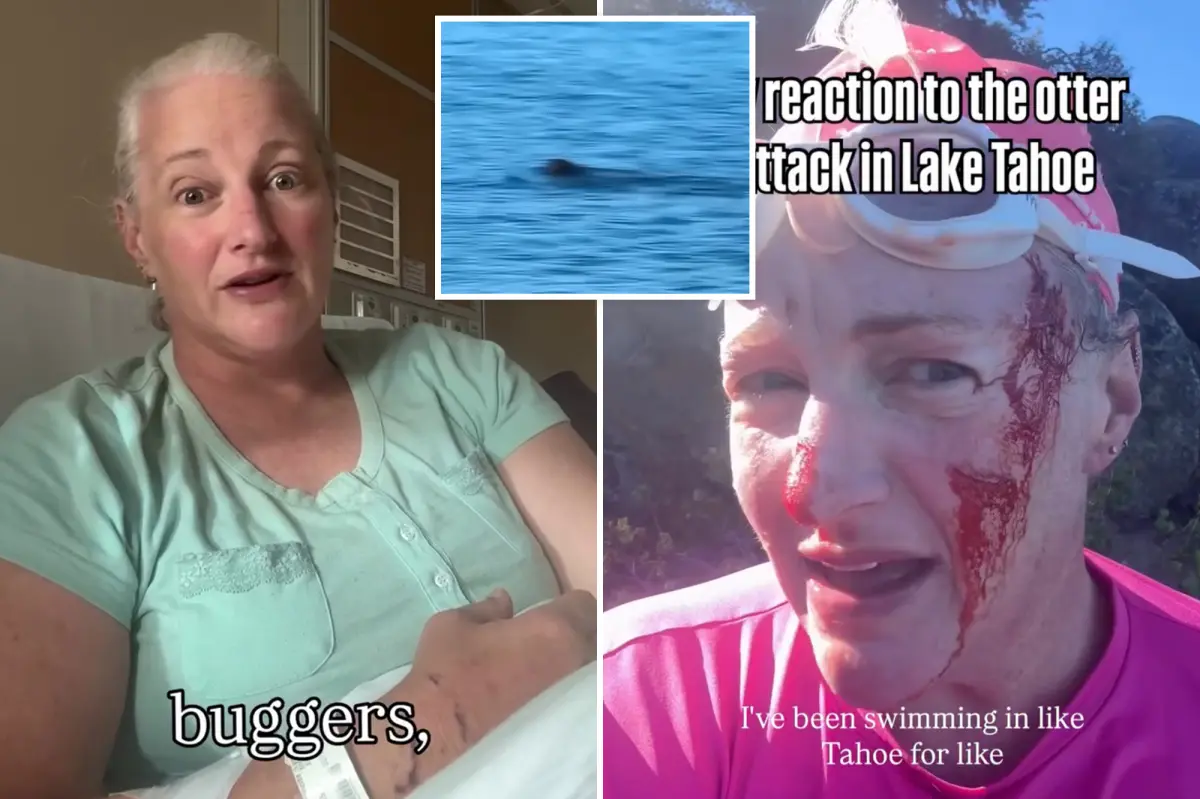
The water of Lake Tahoe had always been Lynnette Bellin’s sanctuary. At 51 years old, she had spent over twenty-five years carving her body through its glassy, pine-fringed expanse, treating the cold, clear water as an extension of her own soul. As a swim instructor, she knew the lake’s moods intimately—the way the morning mist clung to the surface, the silent, cathedral-like stillness that greeted her at 8 a.m. near Hidden Beach. It was in this sacred space of peace and ritual that her world violently inverted. On August 30, as she sliced through the water, a sudden, forceful grip clamped onto her leg, yanking her beneath the surface with startling, primal power. Her first instinct, a human, a playful prankster, a fellow early-morning swimmer in distress, dissolved into sheer, unadulterated terror as the sleek, brown form of a river otter materialized before her. The creature, far from the playful image depicted in nature documentaries, locked its eyes on her with a chilling, predatory focus. It was not startled; it was not defensive; it was attacking with a ruthless, calculated intensity. Bellin, her mind reeling from the impossible reality of the situation, saw the otter’s teeth and claws coming for her face and hands, and in that frozen moment, the tranquil sanctuary transformed into a dangerous battleground where her survival instinct kicked in with raw, desperate adrenaline. The serene morning was broken not by bird song or lapping waves, but by the frantic splashing of a woman fighting for her life against an animal she never imagined could pose such a threat. She tried to push it away, to reason with a creature governed by pure instinct, but the otter was relentless, a furry, sinewy engine of aggression that kept driving its sharp teeth into her skin and its claws raking across her legs and arms.
Paragraph 2: A Desperate Struggle Across Rocks and Through Tears
The attack, which Bellin swears lasted a dreadful five minutes, became a blur of pain and determination. Kicking and screaming, she managed to break free long enough to scramble toward a large boulder jutting out of the shallows. But the otter was not deterred; it climbed right up onto the rock after her, exhibiting a level of persistence that felt supernatural. It continued to bite and tear at her flesh, driving her higher up the granite outcrop. In a moment of sheer desperation, she tried to grab the animal and throw it, but it was like trying to hold smoke—it twisted, bit her hands, and lunged again for her face. The blood was dripping into her eyes, staining her goggles, coloring the clear water around the rock a horrifying red. Realizing she couldn’t stay on the boulder, she made a desperate leap for a larger, higher rock, scrambling over the sharp edges as the otter circled below, its behavior not that of a frightened animal but of a territorial predator ensuring its prey couldn’t return to the water. Trapped, bleeding, and exhausted, Bellin realized her only escape route was over the rocks, past the shoreline, and onto the paved bike trail above. With adrenaline masking the searing pain of her wounds, she climbed over the rugged terrain and scaled a fence, finally dragging her mangled body onto the path. She was a horrifying apparition—dripping blood, her face swollen and lacerated, her swimsuit torn. The few cyclists and walkers she passed recoiled in horror and confusion, and someone finally called for help. But true to her resilient nature, Bellin, after police, firefighters, and an ambulance arrived, ultimately drove herself to the emergency room, where doctors would labor over her injuries, stitching her up with 38 sutures and beginning the painful series of rabies shots that would puncture her abdomen, a stark, stinging reminder of the violent encounter.
Paragraph 3: The Hidden Threat Under the Skin
For a few days, it seemed as though the nightmare was over, filed away as a bizarre, terrifying story to tell at dinner parties. Lynnette, now recovering at home, tried to resume normal life. But an insidious, silent emergency was brewing under the surface of her visible wounds. One day, sitting at her computer, attempting to type, she realized her left hand was swollen, throbbing, and compromised. A wave of cold dread washed over her. Believing she might have broken bones in the brutal struggle, she drove herself to urgent care, half-expecting a simple cast. But the x-ray revealed nothing broken, which was a strange, unsettling relief. Yet, the medical staff, recognizing the danger of deep puncture wounds, admitted her to the hospital immediately. The next morning, she was wheeled into surgery. The surgeon meticulously opened her pinky finger, inspecting the intricate tissue and cartilage damaged by the otter’s teeth. What he found was a nasty, spreading infection, a hidden bacterial menace that had been festering in the deep tissue. Flushing it out with saline, he cleaned the wound as best he could, but the battle was not over. Bellin woke up attached to IV antibiotics, her arm a constellation of tubes and monitors, and a new, sobering reality set in: she couldn’t go home until an infectious disease doctor cleared her body for the hidden bacteria that otters, with their semi-aquatic lives and fish-heavy diets, harbor in their mouths. From her hospital bed, she stared at the two distinct bite marks on either side of her hand, realizing the true, invisible danger of the natural world. “Who knew those were dirty little buggers?” she mused to her Instagram followers, injecting her trademark dark humor into a situation that was frighteningly serious. The attack had not just stolen her peace of mind; it had breached her body’s defenses in ways she hadn’t anticipated, leaving her to fight a second, more subtle battle.
Paragraph 4: The Bitter Irony of the “Otter Lady”
The irony of Lynnette Bellin’s predicament is almost too cruel to comprehend. She is the proud owner of ISR Reno Tahoe, a specialized infant swimming resource program dedicated to teaching children, some as young as six months old, crucial water survival skills—how to roll onto their backs, float, and breathe efficiently in the water. Her entire professional identity is built on making children safe in the unpredictable, untamed world of lakes and pools. She has spent decades preaching that competence in the water is the ultimate life preserver. In her teaching bag, tucked among the kickboards and goggles, is a small, adorable toy otter, a playful mascot she uses to engage nervous young swimmers, a cute prop to distract them from their fears. Now, that cutesy representation of an aquatic mammal has been permanently tainted by a real-life horror story. The attack, which she has documented in a series of raw, viral videos on Instagram and TikTok, has transformed her into an internet sensation, a reluctant celebrity branded with the ironic moniker “The Otter Lady.” She posts from her hospital bed, her face still bruised and scabbed, her hand heavily bandaged, and she laughs at the absurdity of it all. The woman who taught dozens of children to trust the water now flinches at the thought of diving in. The lake that was her second home for 25 years—the place where she found peace, solitude, and physical balance—has become a location of trauma. She wonders if she will even use the toy otter again in her classes, a symbol of the trust in nature that has been irrevocably broken. This attack, statistically improbable with only 59 documented cases since 1875, chose her, and it dismantled the clean narrative she had built around her profession and her personal history with the wilderness, forcing her to reconcile her love for the lake with the terrifying reality of a creature that lives within it.
Paragraph 5: The Power of Second Nature and Unyielding Spirit
Despite the physical pain, the invasive medical procedures, and the psychological shock, Bellin’s spirit remains defiantly unbroken. She doesn’t wallow in her anger; instead, she channels her energy into a profound reflection on her survival. In a powerful social media post, she articulated what many would consider the key to her escape: “The water can be unpredictable and unforgiving. Being a competent swimmer is what saved me in this situation, as I didn’t have to think about my breath control or how to move in the water—it is second nature to me.” This statement is a testament to the power of training and muscle memory. While a panicked person might have wasted precious air fighting the water itself, Bellin’s body took over. Her diaphragm effortlessly controlled her breathing; her legs kicked with automatic precision, allowing her mind to focus entirely on the actual threat—the attacking otter. She didn’t have to think about staying afloat; she could think about how to pry those jaws off her leg, how to fight back. She credits the very program she teaches with saving her life, a full-circle validation of her life’s work. Her humor, too, is a fiery weapon of resilience. Laughing off the infection, joking about being the “Otter Lady,” and maintaining a visible, upbeat presence on social media, she is choosing to reclaim her narrative. She is showing her followers that she is not a victim, but a survivor—a 51-year-old woman who was brutally attacked and is now in a hospital bed, joking about the irony and fighting through occupational therapy to regain the use of her hand. It is a masterclass in human resilience, showing that while nature can be ruthless, the human spirit, when armed with preparation and a dark sense of humor, can be even more relentless.
Paragraph 6: Healing, Hope, and a Cautious Return to the Wild
As Lynnette Bellin waits for the infectious disease doctors to clear her to leave the hospital, her journey is far from over. The physical rehabilitation is arduous. Working with an occupational therapist, she performs painful, repetitive exercises to restore mobility and strength to her pinky finger and her hand, which are crucial for her work as an instructor. The IV antibiotics drip steadily, a constant reminder of the invisible war still raging within her body. The timeline for her release is uncertain, hinging on the medical team’s confidence that the infection is completely eradicated. But beyond the physical, there is the deeper work of healing the mental scars. She acknowledges the freezing fear that now accompanies the thought of re-entering the water at Lake Tahoe. Yet, there is a quiet determination in her voice, a resolve not to let a singular, freak incident with a wild animal define her or sever her connection to the watery place she loves. The rarity of such attacks—the fact that otters are typically shy, retreating creatures—provides some intellectual comfort, but it does little to erase the visceral trauma. Still, Bellin looks toward the future. She wants to return to teaching children, to pass on the life-saving skills that saved her own life. Perhaps she will retire the toy otter, replacing it with a new symbol of courage and survival. Her story, broadcast live from her hospital bed to thousands of followers, has transcended the realm of a mere local news story. It has become a human tale of facing a sudden, unimaginable threat, discovering the hidden strength within one’s own body, and adapting to a world where even the most beautiful sanctuaries hold untold dangers. As she prepares to step back into the world, armed with stitches, scars, and a profound new respect for the wild, Lynnette Bellin is not just recuperating; she is remaking herself—not as a victim of an otter, but as a testament to the unyielding, adaptive, and resilient human heart, determined to swim again.