





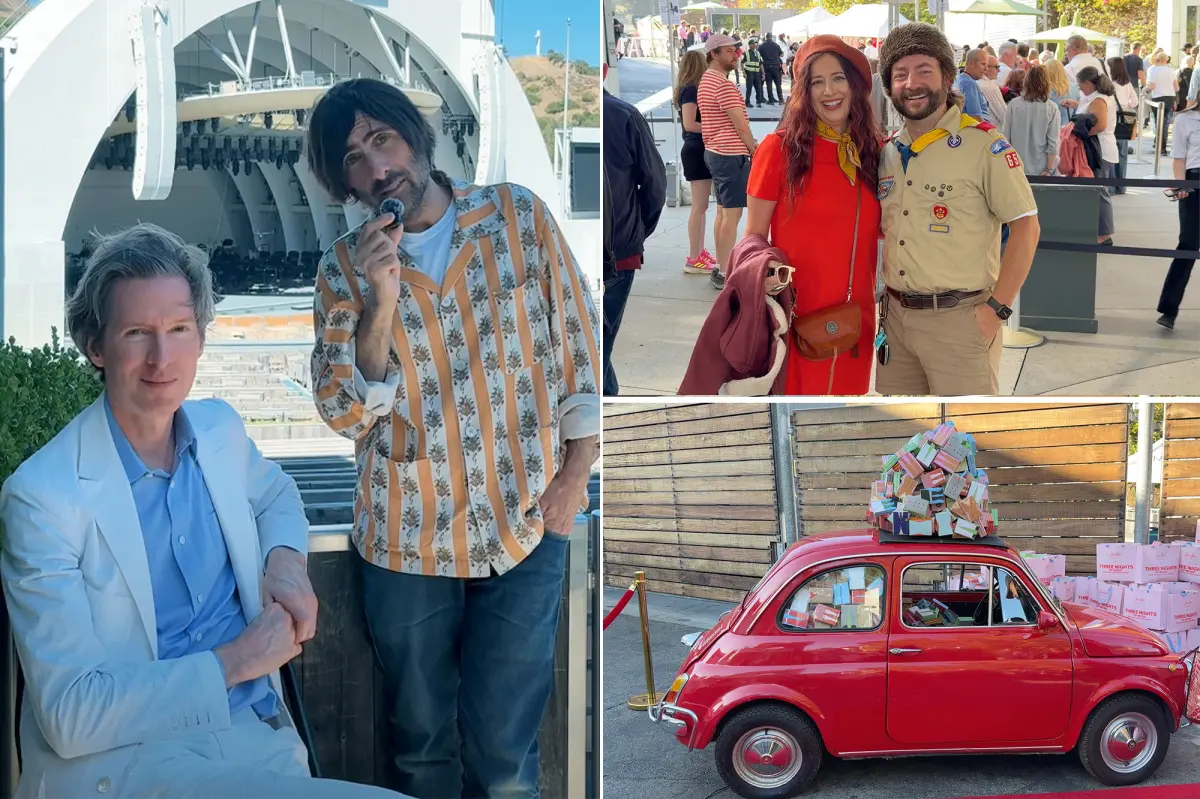
This past weekend, the historic Hollywood Bowl shed its usual California-cool persona and fully transformed into the delightfully symmetrical, vintage-hued, and whimsical world of legendary filmmaker Wes Anderson. Hosting a spectacular multi-artist tribute concert, the iconic open-air venue became a sanctuary for thousands of die-hard cinephiles. Showing up in true, passionate fan fashion, the audience looked like a walking scrapbook of Anderson’s cinematic history, with the crowd heavily dotted with homemade Margot Tenenbaum fur coats, meticulously ironed Khaki Scout uniforms from Moonrise Kingdom, and bright red Team Zissou beanies. It was a visual celebration of a director whose distinct aesthetic has defined a generation of indie cinema, turning a standard concert into an immersive, living archive of his beloved films.
Standing at the center of this whimsical universe was none other than Hollywood icon and frequent Anderson collaborator, Bill Murray. Stepping onto the stage to host the evening’s festivities with his signature deadpan charm, Murray immediately won over the crowd. Looking out at the sea of eccentric costumes and eager faces, he playfully quipped, “What are we doing here? I mean, someone’s got to ask that question,” eliciting a roar of laughter and thunderous applause from the adoring audience. Murray’s effortless stage presence set a perfectly casual, self-aware tone for an evening dedicated to celebrating artistic eccentricity, proving once again why he remains the ultimate real-life spirit animal of the Wes Anderson cinematic universe.
The night’s musical journey was guided by the soaring sounds of the Los Angeles Philharmonic, who provided a lush orchestrational backbone to some of the most memorable soundtracks in modern film history. Under the stars, the orchestra breathed rich new life into the needle-drops and original scores that have defined Anderson’s thirty-year career, spanning from the youthful rebellion of Rushmore to the nostalgic, coastal innocence of Moonrise Kingdom. Spanning three decades of curated musical brilliance, the setlist served as a poignant reminder of how deeply Anderson relies on music to craft the emotional landscapes of his films, proving that a perfect pop song or a delicate piece of classical music is just as central to his storytelling as his famous camera pans.
To bring these iconic cinematic moments to life, a stellar, star-studded lineup of contemporary indie royalty took to the stage, each sharing their own personal connection to Anderson’s worlds. The audience was treated to captivating performances by genre-blending icon Beck, indie-pop darling Jenny Lewis, and the soulful, soaring vocals of My Morning Jacket’s Jim James. Adding to the star power was Karen O, the magnetic frontwoman of the Yeah Yeah Yeahs, alongside actor and musician Jason Schwartzman—a fitting addition given his status as a key Anderson muse who has starred in seven of the director’s films. Together, this collective of creative powerhouses turned the tribute into a heartfelt love letter to the director’s enduring influence on both film and music.
In a night already overflowing with highlights, the emotional pinnacle arrived when Bill Murray introduced Wes Anderson himself to the stage. To the delight of the crowd, the notoriously private director welcomed legendary singer-songwriter Jackson Browne to perform “These Days.” The tender, melancholic song famously soundtracked one of the most iconic scenes in Anderson’s filmography: Margot Tenenbaum stepping off a green bus to greet her adoptive brother Richie in The Royal Tenenbaums. Hearing Browne perform the track live, framed by the cinematic grandeur of the Hollywood Bowl and backed by the LA Phil, created an unforgettable, goosebump-inducing moment where movie magic and real-world artistry beautifully collided.
The evening also featured a delightfully unexpected performance by legendary 1980s new wave pioneers Devo, further emphasizing the eclectic, boundary-pushing musical tastes that Anderson has championed throughout his career. As the final notes echoed through the Hollywood Hills, the event stood as a triumphant testament to the power of creative collaboration and the community built around Anderson’s singular artistic vision. It was a magical night where the surreal became real, leaving thousands of fans, musicians, and actors united in their shared love for a director who continues to teach us to see the beauty, symmetry, and humor in our own quirky lives.