


Paragraph 1
Lily Rabe has never been one to play it safe. Whether she is stepping into the shoes of a tormented writer on a Broadway stage or slipping into a whimsical Rodarte gown for a red carpet, her instinct is the same: she thrives when she is just a little bit off-balance. “I don’t ever like to stay in a comfort zone,” she says with a knowing smile. “That’s what keeps it all exciting.” At 44, she radiates a warm, grounded energy that feels almost contradictory for someone whose career has spanned ghosts, witches, Shakespearean heroines, and high-stakes family dramas. But that restlessness—that desire to keep moving—defines everything about her, from the characters she chooses to the clothes she wears. Her go-to designers for major events read like a poet’s mood board: Rodarte, Erdem (a total favorite, she insists), Honor, the dreamy romanticism of Bora Aksu, and Bode. For her everyday life, she confesses a deep and abiding “Mayle obsession.” It is a style vocabulary that speaks to her dual nature: the ethereal, slightly eccentric bohemian who lives inside a fiercely dedicated working actress. She speaks about her craft with an insatiable hunger, a need to keep creating, but she also notes a rare and welcome sense of peace these days. “I have a sort of insatiable appetite for work,” she says, resting back, “but right now, I’d say I do feel very sated.” It’s a beautiful paradox—being driven yet deeply fulfilled—and it captures where she is right now: a woman at the top of her game, looking back at a winding, fascinating road, and forward at a horizon brimming with possibility.
Paragraph 2
This autumn represents a remarkable convergence of everything Rabe loves most: the immediacy of live theater, the electricity of a stacked cast, and the emotional terrain of a modern American classic. Just weeks after wrapping her celebrated run as Paulina in The Winter’s Tale opposite Raúl Esparza at the Delacorte—her fifth production in the Public Theater’s beloved Shakespeare in the Park series—she is throwing herself into rehearsals for Other Desert Cities. The play, Jon Robin Baitz’s razor-sharp 2011 dramedy about a wealthy, politically conservative Palm Springs family ripping open its own wounds, finds Rabe playing Brooke Wyeth, a troubled writer whose memoir threatens to detonate a decade-old family secret. It officially opens on October 18 at the Hudson Theatre, and the production boasts what can only be described as a murderer’s row of acting talent: Julia Louis-Dreyfus and Ed Harris as her parents, Allison Janney as her acerbic aunt, and Joe Keery as her brother. The collective star power makes this the hottest ticket on the Mojave this fall, but for Rabe, it’s personal. She sat down for her first read-through with the cast on August 25, but it was an earlier photo shoot together that sealed the deal. “I’m in love with all of them,” she gushes, sounding genuinely star-struck despite being one of the most respected stage actresses of her generation. She’d worked with Harris before, but this marks her first collaborative acting experience with the rest of them. When she was asked to present the Best Play award alongside Louis-Dreyfus at the Tony Awards back in June, the chemistry was instant. “I’ll watch her in anything. I wish she were our president,” Rabe jokes, referencing the actress’s iconic turn on Veep, before adding with a laugh, “Although I’m glad she’s not, because I wouldn’t be able to do this play with her.” That playful reverence is mutual—and it’s that sense of collective devotion to the work that makes this production feel so special.
Paragraph 3
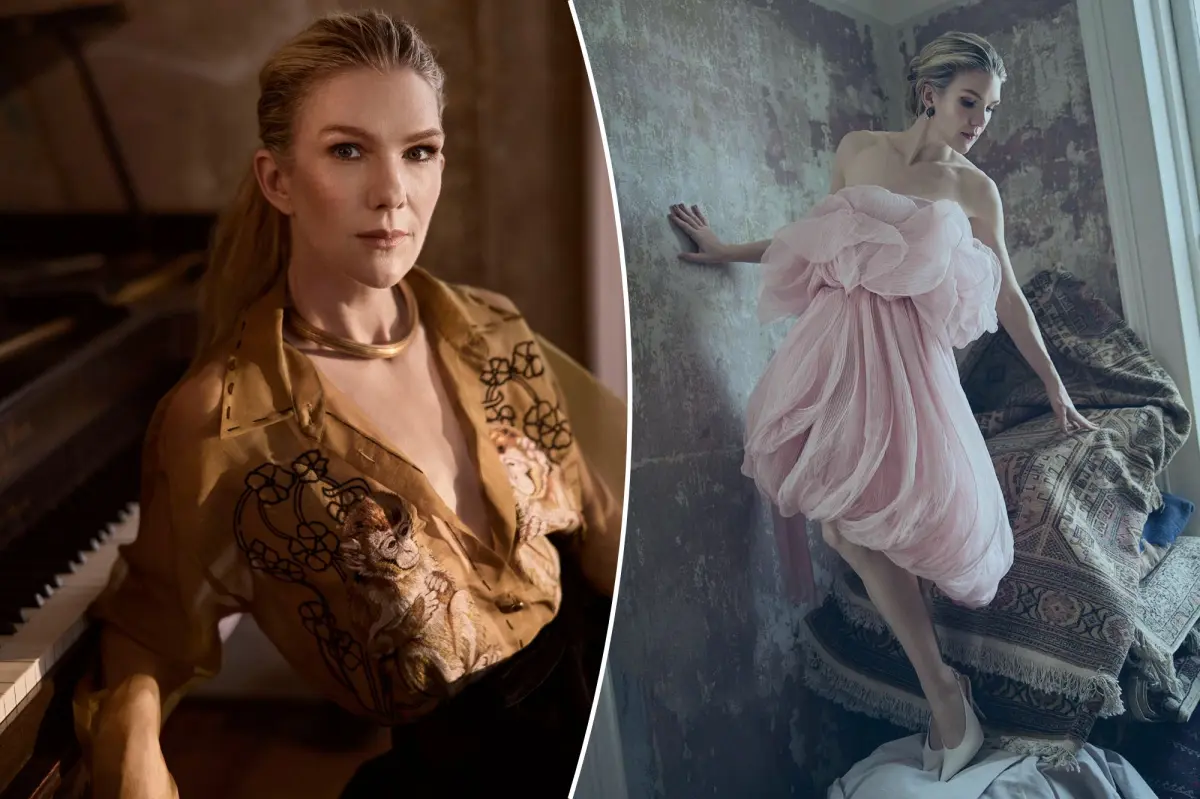
To understand Lily Rabe, one must understand the artistic DNA coursing through her veins. She is the daughter of two extraordinary talents: the late Jill Clayburgh, the Oscar-nominated actress who redefined cinematic womanhood in films like An Unmarried Woman, and David Rabe, the 86-year-old Tony-winning playwright whose works like Sticks and Bones explored the tangled wounds of the American psyche. They were a power couple in the truest sense—intellectual, fearless, and deeply committed to their craft. Rabe speaks of her father with a quiet, profound respect. “My dad is a really smart guy,” she says. “He did not have a fancy upbringing at all. But he had a love of language and determination.” That determination clearly proved hereditary. Her mother’s legacy, though, is something she carries with her every single day. When asked about Jill, Rabe pauses, her eyes drifting as if flipping through a mental photo album of her childhood in New York City, Westchester, and the Connecticut countryside. “She was such an incredible mother,” Rabe says softly. “She was so curious. She was always leaning in and leaning forward. She had no regrets.” That fearless curiosity extended to style—her mother had a striking, effortlessly glamorous sense of fashion. Rabe remembers running around in “a costume from a Bertolucci movie,” dressed up in clothes that held the magic of story and history. That childish joy has never faded; it’s simply matured into her own deep passion for fashion. During an Alexa photo shoot at the historic 1850s Captain Barnes mansion on Staten Island, surrounded by racks of Prada, Chloé, and Dior, she transformed into a kid in a couture shop, radiating pure, uncomplicated delight. “We all felt like we were in New Orleans,” she says, delighted by the atmosphere of old-world charm and mystery—the perfect backdrop for a woman whose entire life has been a dance between beauty and grit.
Paragraph 4
After 12 years of being based on the West Coast or straddling both coasts, Rabe has finally come home. She is back in Manhattan full-time, sharing an apartment with her longtime partner, the wonderful character actor Hamish Linklater, and their blended brood of four kids, who span a wide range of 19 down to 4. The city that once shaped her youth is again her anchor. “It’s my favorite city in the world,” she says. “I’m close to the theater again, whether that means doing plays or going to see them.” Her absence from the Great White Way was never intentional—just the natural ebb and flow of a career in film and TV. It had been 11 years since her last star turn at the Delacorte, and 14 years since her previous Broadway show, Seminar, closed. But the stage, it seems, kept calling her back to where she always belonged. At the opening night party for The Winter’s Tale, Linklater slipped her a note that said it all: “Happy homecoming.” The gesture speaks to the deep, grounded partnership they share. They met in 2006, when he was acting off-Broadway with her mother—a fortuitous introduction that would eventually blossom into romance. Now, navigating the beautiful chaos of a family of six, they are a team. “We love parenting together,” Rabe says. They are flexible and present, though not without boundaries. “We’re not parents who don’t say no,” she clarifies, “but we don’t have hard-and-fast rules.” It’s a juggling act, a constant three-ring circus of school runs, rehearsals, and family dinners. “We’re super scrappy about it,” she says with a laugh. But the tenderness in her voice is unmistakable. The “happy homecoming” wasn’t just about a city; it was about a life she and Linklater have built their own way.
Paragraph 5
The journey back to Broadway has been a fascinating one, marked by bold choices and celebrated risks. After studying theater at Northwestern University, Rabe made her screen debut in 2001 and her stage debut a year later, often appearing opposite her own mother—an intense and formative training ground. She cut her teeth in memorable Broadway roles like the painfully shy Annelle in Steel Magnolias, and honed her craft in intimate productions that showcased her remarkable range. Then, in 2010, the trajectory of her career shifted dramatically. Director Daniel Sullivan cast her as Portia opposite Al Pacino in The Merchant of Venice. The production became a sensation, earning rapturous reviews in Central Park before transferring to Broadway. Rabe’s incandescent performance earned her a Tony nomination for Best Actress, and the role of a lifetime opened countless doors in her mind. Her film and TV work has kept her busy alongside some of Hollywood’s titans—from Jessica Lange and Kathy Bates in the twisted, beloved anthology American Horror Story to Rhys Ifans in the indie dramedy Capsized. Her characters have included ghosts, witches, and legendary aviator Amelia Earhart—a colorful menagerie she loved for the way it felt like being in an acting rep company. “It was a tremendous gift in my life,” she says of the show. “The thing that I loved most about it is that it was like being in a repertory company.” In 2023, she expanded her own horizons further, co-directing Downtown Owl, a comedy set in a small North Dakota town, which gave her the chance to work behind the camera with Harris, who played a local resident. “Ed can do anything,” she says. “I feel something very familial with him.” That familial trust is on full display in Other Desert Cities, where she and Harris explore the complicated dance between parents and children, love and secrets.
Paragraph 6
At its heart, Other Desert Cities is a puzzle box of human connection, and Rabe is drawn to its volatile mystery. “Often the greatest mysteries of our life are from what’s closest to us—and that’s our families,” she reflects. “I find that to be a harrowing idea. And compelling. And exhilarating.” It’s a theme that resonates deeply with her, both as an actress and as a daughter. She is part of a brilliant, complicated family story of her own, one filled with public achievements and private moments. That’s why stepping into this world, week after week, feels less like work and more like excavation. A week into rehearsals, she was already moved by the unexplainable bonds forming with her castmates. “I feel it with every single one of them in ways I can’t explain,” she says in a follow-up conversation. “You don’t really want to explain it. You just feel it.” The photo shoot at the Captain Barnes mansion, with its faded elegance and layered history, served as the perfect visual metaphor for a life in the theater: a beautiful, crumbling relic of a bygone era, restored and reborn for a new purpose. It was a moment of creative synergy that reminded her why she first fell in love with this strange, wonderful profession. As she stands on the precipice of opening night, Rabe embodies a rare blend of legends, craft, and an open heart ready for whatever surprises come next. She is, after all, a woman who has built her entire life around the idea that the best stories—like the most beautiful clothes or the truest connections—are the ones that feel just a little risky. And Lily Rabe is always ready to take the leap.