


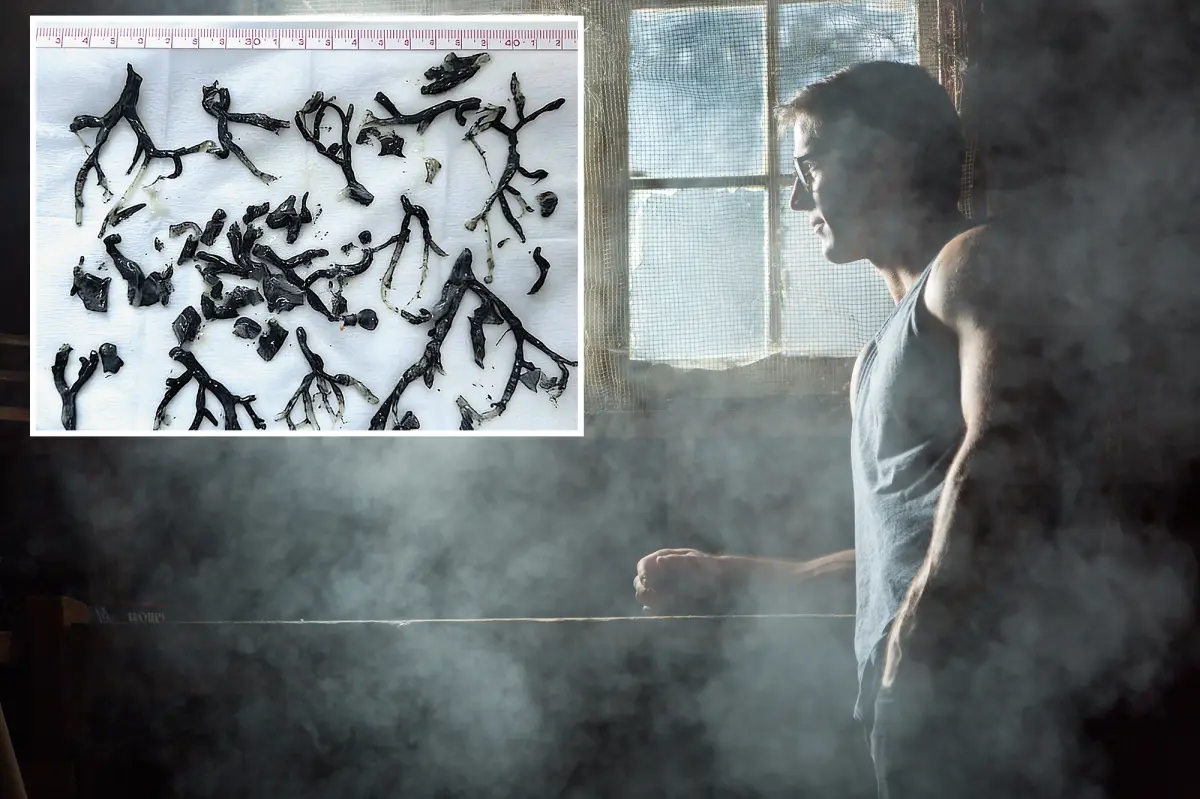
In the heart of a wildfire-ravaged wilderness, where flames danced wildly against the smoke-choked sky, an 87-year-old man named Harold exemplified the sheer unpredictability of nature’s fury. For hours, he had breathed in the acrid, thick smoke that blanketed the air, a relentless assault on his lungs that left him gasping. Harold wasn’t some reckless adventurer; he was a lifelong resident of a quiet rural town, tending his garden and sharing stories with neighbors over coffee. But that day, as the forest fire encroached on his community, he refused to evacuate, stubbornly clinging to his home amidst the chaos. By the time he stumbled into the emergency room, his face was ashen, his breath coming in ragged, shallow bursts that spoke of a body fighting for survival against an invisible enemy. The doctors, initially puzzled, wheeled him into intensive care, where machines beeped relentlessly, mirroring the urgency of his plight. Imagine the terror in Harold’s eyes as nurses hovered with masks and needles, their voices a blur of medical jargon against the haze of his pain. He wasn’t just a patient; he was a grandfather, a father, a man who had weathered storms far less mysterious than this. What unfolded next felt like a scene ripped from a dystopian thriller—black, branch-like structures invading his respiratory system, turning what should have been life-sustaining air passages into a nightmare of obstruction. The medical team, peering through bronchoscope lenses, uncovered a rarity: bronchial casts, harbingers of plastic bronchitis. These weren’t mere clots; they resembled twisted, solidified tree branches lodged deep within his trachea and bronchial tree, stifling his every inhale. Harold’s story, as chronicled in the New England Journal of Medicine the previous week, painted a vivid picture of human fragility against environmental wrath. As he drifted in and out of consciousness on the ventilator, memories flashed: fishing trips with his sons, laughter over holiday dinners, the simple joys now threatened by this smoky specter. The doctors worked tirelessly, adjusting oxygen levels and monitoring his dangerously low sats, their hands steady despite the anomaly before them. Harold’s home, once a sanctuary, now lay miles away, perhaps scarred by the same flames that had ravaged his body. In those uncertain hours, his family gathered in the waiting room, clutching tissues and prayers, wondering if this resilient old soul could outlast this bizarre affliction. Little did they know, beneath the clinical detachment of medical documentation lay a testament to resilience, urging us to ponder how something as elemental as smoke could rewrite a life’s chapter in such terrifying detail.
Delving deeper into Harold’s ordeal, the diagnosing process revealed layers of complexity that mirrored a detective novel unfolding in real time. Strapped to the ventilator, he could manage only the shallowest of breaths, his chest rising and falling like a labored bellows in an old forge. Blood oxygen levels hovered perilously low, a crimson emergency beacon alerting the team that time was slipping away. The plug-like structures weren’t mere guessing games; under magnification, they manifested as dense, rubbery masses, black and unyielding, blocking airways that branched like intricate tributaries in his lungs. Plastic bronchitis, the culprit, is a condition shrouded in medical obscurity, often whispering its presence through symptoms that mimic more common ailments like asthma. For Harold, it began subtly—perhaps a nagging cough post-smoke exposure, dismissed as post-fire irritation—but escalated into a full-blown siege. The casts, composed of mucus interwoven with cellular detritus, took on a caulk-like consistency, their surfaces smooth yet foreboding. In the trauma bay, the medical staff exchanged glances of astonishment; such findings weren’t everyday. They ordered chest CT scans that illuminated the casts like shadowy intruders on a digital map, while bronchoscopy offered a firsthand tour, the camera-tipped tube navigating Harold’s constricted passages with delicate precision. Amidst these procedures, Harold lay sedated, his mind perhaps wandering to the open skies he once cherished, now metaphorically engulfed. His case highlighted the nuances of human physiology’s betrayal—how exposure to particulate-laden air could catalyze such an extreme response. Nurses at his bedside recounted his lucid moments, where he’d murmur about the fire’s roar and the scent of burning pine, humanizing the science behind his struggle. It wasn’t just anatomy at stake; his identity, forged over decades, hung in the balance. As tests piled on—X-rays crackling with data, bloodwork swirling with markers—the team pieced together a diagnosis that demanded action. Harold, ever the stoic, bore it all with the quiet dignity of someone who’d seen hardships before, from economic downturns to personal losses. Yet, in this moment, vulnerability etched itself across his features, reminding everyone that behind every symptom is a story, a life altered by forces seen and unseen.
To truly grasp Harold’s condition, one must journey into the enigmatic world of plastic bronchitis, a disorder that transforms the body’s inner workings into a battlefield of fluid dynamics. Central to its mechanism is the lymphatic system, that intricate network of vessels often overshadowed by its circulatory counterpart yet vital for health. Picture it as a subtle sous-chef, soaking up excess fluid from organs like the lungs, heart, and intestines, then channeling it back to the bloodstream where it nourishes immunity and balance. Lymph, a clear elixir carrying white blood cells and proteins, flows unobstructed in harmony. But for Harold, post-fire inflammation disrupted this ballet. Irregular flow allowed leaks into the airways, where the fluid mingled with mucus and cells, solidifying into those ominous plugs. These casts, branching faithfully like the bronchial tree they inhabit, can be white, tan, or—as in his case—ebony, their textures ranging from jelly-like to downright rigid. The condition often strikes children with congenital heart defects or adults plagued by lymphatic anomalies, but Harold’s trigger was an external assault: smoke inhalation over prolonged hours, turning his resilient lungs into a leaky vessel. Symptoms unfolded like a tragic symphony—shortness of breath that stole his words, chest pains stabbing like betrayals, fevers burning through his resolve, and a persistent cough that echoed asthma’s disguise. Early on, it mimicked lesser evils, perhaps leading to misdiagnoses where inhalers were prescribed instead of deeper investigations. Imagine Harold, weeks prior, chalking up his discomfort to age or allergies, pushing through with habitual stoicism. But as leakage escalated, severe distress loomed, potential escalations to pneumonia or worse, even death’s door. His experience underscored the lymphatic system’s silent struggles; without proper drainage, organs drown in their own excess, a metaphor for life’s unmanaged burdens. Doctors, reflecting on similar cases, noted how environmental toxins amplify vulnerabilities, prompting calls for better wildfire response and air quality protections. Harold’s ordeal wasn’t isolated—it echoed in communities battered by climate-driven blazes, where smoke isn’t just haze but a catalyst for hidden harms. Through his eyes, we humanize the lymphatic maze, seeing it not as abstract pipes but as a lifeline disrupted, demanding empathy for those whose bodies rebel against modern perils.
Diagnosing Harold’s affliction required a blend of cutting-edge technology and old-fashioned detective work, illustrating the marriage of science and intuition in medicine. Bronchoscopy emerged as the frontline hero, a flexible tube crowned with a camera plunging into his airways for close-up reconnaissance. In real-time footage, the casts appeared as invasive effigies, their removal akin to extracting thorns from tender flesh. Chest CT scans provided a panoramic view, slicing through his thoracic cavity to map the obstructions with pixelated precision, while MRIs delved into lymphatic imagery, tracking fluid flows like digital rivers. For added flair, “blue bronchoscopy” involved injecting a special dye into the thoracic duct, that powerhouse lymph vessel in the neck, turning leaked areas a vivid azure to pinpoint breaches. These revelations weren’t mere snapshots; they narrated Harold’s internal saga, where smoke-induced irritation likely compounded lymphatic dysfunction, birthing the casts as a reflexive barricade against chaos. Treatment tailored itself to the roots—repairing lymphatic leaks through surgical finesse or addressing underlying heart issues with precision interventions. Harold received a regimen of bronchial dilators, anti-inflammatories, and supportive care, his ventilator a temporary ally in the fight. Amidst these maneuvers, the medical team humanized their approach: one doctor shared tales of childhood asthma misdiagnoses to build rapport, another held Harold’s hand during bronchoscopy, whispering reassurances. They pondered his age—87, a testament to longevity amid vulnerability—wondering how prior exposures, from cigarette days long past, might have primed his system. Complications like pneumonia shadowed his recovery, adding layers to an already intricate puzzle. Yet, each step revealed progress; loosened casts exited with suction, breaths deepened, and with every stable vitals readout, hope flickered. Harold’s collaboration in recounting his smoke ordeal became crucial, painting a fuller picture of environmental triggers often relegated to footnotes. This diagnostic journey wasn’t just procedural; it was a dialogue between man and machine, biology and environment, urging broader awareness of how wildfires wield more than visible destruction—they unleash microscopic wars within. Through Harold’s lens, we see medicine as compassionate craft, not cold calculation, healing bodies while tending to spirits weary from unseen battles.
As Harold’s treatment unfolded, the narrative of his resilience wove threads of hope through the tapestry of uncertainty, reminding us that behind every medical marvel is a human story yearning for closure. Discharged after a grueling week, where pneumonia clawed at his strength like a persistent foe, he returned home not as a broken man but as a survivor, his breathing normalized by the two-week check-in. That swift turnaround, etched in medical journals as evidence of timely intervention, spoke volumes about the condition’s prognosis when caught early. Plastic bronchitis, though rare and severe, boasts a favorable outlook with prompt action—casts removed, leaks sealed, underlying issues mended—turning potential tragedies into tales of triumph. For Harold, the ordeal distilled lessons: the importance of heeding environmental warnings, seeking care promptly for respiratory woes, and cherishing one’s health amidst life’s unpredictability. His family, once fraught with worry, now beamed with relief, integrating him back into daily rhythms—morning walks in the crisp air, albeit now with cautious gazes skyward. The doctors, reflecting on his case, advocated for wildfire preparedness, from masks to air purifiers, knowing Harold’s story could resonate with others. Humanizing this condition extends beyond his recovery; it encompasses empathy for those with chronic lymphatic woes, children whose hearts demand vigilant care, and adults facing sudden onslaughts. Harold’s experience bridges science and sentiment, where bronchial casts become metaphors for life’s blockages—removable with effort and awareness. Community gatherings post-discharge buzzed with his tales, transforming a personal calamity into communal wisdom. In reflection, plastic bronchitis emerges not as a distant anomaly but as a call to vigilance against modern perils like climate-fueled fires. Harold, now 87 and wiser, embodies perseverance, his smoke-scarred lungs a badge of battles won. This isn’t merely a medical abstract; it’s a human saga, enriched by diagnosis nuances, treatment triumphs, and the enduring spirit that fights through forgotten frontiers of the body.
Ultimately, Harold’s brush with plastic bronchitis transcends individual narrative, echoing broader imperatives for health vigilance in an era of escalating environmental threats. The lymphatic system’s vulnerabilities, once esoteric, now demand public discourse—how smoke inhalation, amplified by global warming’s wildfires, can precipitate such esoteric conditions. His case, published in a prestigious journal, underscores the need for interdisciplinary approaches: cardiologists collaborating with pulmonologists, environmentalists advising on air quality, patients empowered with knowledge. Humanized, this ailment reveals the psyche’s resilience; Harold’s mental fortitude, drawn from a lifetime of grit, buoyed him through ventilators and scopes. Symptoms like his, often misattributed to aging or allergies, necessitate swift scrutiny—bronchoscopies and dyes becoming standard probes. Treatments, evolving from basic removal to targeted therapies, promise better futures, but education is key. Communities like Harold’s, prone to fires, might invest in lymphatic imaging clinics, preempting crises through proactive health literacy. Prognoses shine when early intervention prevails, as his did, knitting families tighter and fostering gratitude for second chances. Yet, Harold’s ordeal lamentably highlights disparities: those without access to advanced care face grimmer odds. His survival advocates for accessible medicine, where wilderness dwellers aren’t left to bear nature’s burdens alone. Humanely parsing plastic bronchitis entails celebrating recoveries, learning from lapses, and advocating change. Harold, reintegrated into his garden sanctuary, now an inadvertent educator, exemplifies how one man’s smoke-choked story can ignite preventative flames worldwide, transforming rarity into rallying cry for holistic well-being. In his twilight years, breath restored and lessons learned, he personifies the invincibility of the human spirit against odds, urging us all to respect the delicate balances within and without. This summary, distilled to essence yet expansive in empathy, aims to illuminate and inspire, ensuring Harold’s tale resonates as a beacon for informed, compassionate health stewardship.