





For over a quarter of a century, the Getty Center has served as Los Angeles’s shining citadel of art and intellect, a brilliant travertine-clad sanctuary perched high atop the Santa Monica Mountains. Since its triumphant public opening in December of 1997, Richard Meier’s complex architectural masterpiece has become an indelible part of the Southern California landscape, visible to millions of commuters daily as a structural crown jewel floating above the bustling arteries of the 405 freeway. It offers visitors a serene retreat where world-class European paintings, ancient sculptures, precious manuscripts, and lush, manicured gardens exist in perfect harmony with breathtaking, panoramic views stretching from the San Gabriel Mountains to the sparkling Pacific Ocean. However, the beloved routine that has defined the Getty experience for nearly three decades—parking in the deep subterranean garage, lining up in the functional but somewhat sterile lower plaza, and waiting for the automated tram—is about to undergo a radical, historic metamorphosis that will fundamentally reshape the museum’s relationship with the city of Los Angeles. In an announcement that has stirred both profound excitement and a touch of wistfulness throughout the global art community, the J. Paul Getty Trust has unveiled details for a sweeping, campus-wide modernization project that will temporarily shut down the hilltop museum for approximately one year starting in March 2027. This ambitious undertaking, estimated to cost between an astounding $600 million and $800 million, represents the most significant construction and renovation initiative on the campus since its original inception. Positioned as a grand, visionary gift to both local Angelenos and international travelers, this extensive project is carefully scheduled to culminate in a dramatic grand reopening in early 2028, just in time to welcome the seismic influx of global tourists, athletes, and media who will descend upon Southern California for the highly anticipated 2028 Summer Olympic and Paralympic Games.
At the core of this monumental endeavor is a profound desire to democratize the arrival experience, creating a seamless, emotionally resonant connection between the bustling city below and the quiet, contemplative brilliance of the galleries above. In a brilliant stroke of architectural cross-pollination, the Getty has commissioned Gehry Partners—the world-renowned Los Angeles-based firm led by the legendary Frank Gehry—to completely rewrite the opening chapter of the visitor’s journey. This decision brings two of the most titanic architectural minds of the twentieth and twenty-first centuries into an unexpected, breathtaking dialogue: Richard Meier’s cool, rationalist, grid-based white travertine structures will now be introduced by Gehry’s trademark fluid, expressive, and human-centric forms. For years, museum officials, regular patrons, and architectural critics have noted that the bottom of the hill felt too detached from the actual museum experience, serving primarily as a utilitarian transportation hub rather than an inviting artistic portal. The parking structure and lower tram station, while highly functional marvels of engineering, often lacked the warmth, beauty, and poetic inspiration that defines the hilltop campus itself. By tasking Frank Gehry’s team with bringing the magic of the “Getty experience down the hill,” the institution aims to dismantle this physical and psychological barrier. Instead of a transaction of security screening and boarding, the new entry sequence will serve as a beautiful, welcoming gateway that prepares the mind, ignites the senses, and makes visitors feel as though their journey into the world of creative human expression begins the very moment they arrive at the Brentwood campus. This blending of Meier’s classical modernist rigor with Gehry’s organic, sculptural fluidity represents a historic milestone for Los Angeles, successfully transforming a simple, concrete transit hub into a brilliant piece of civic poetry.
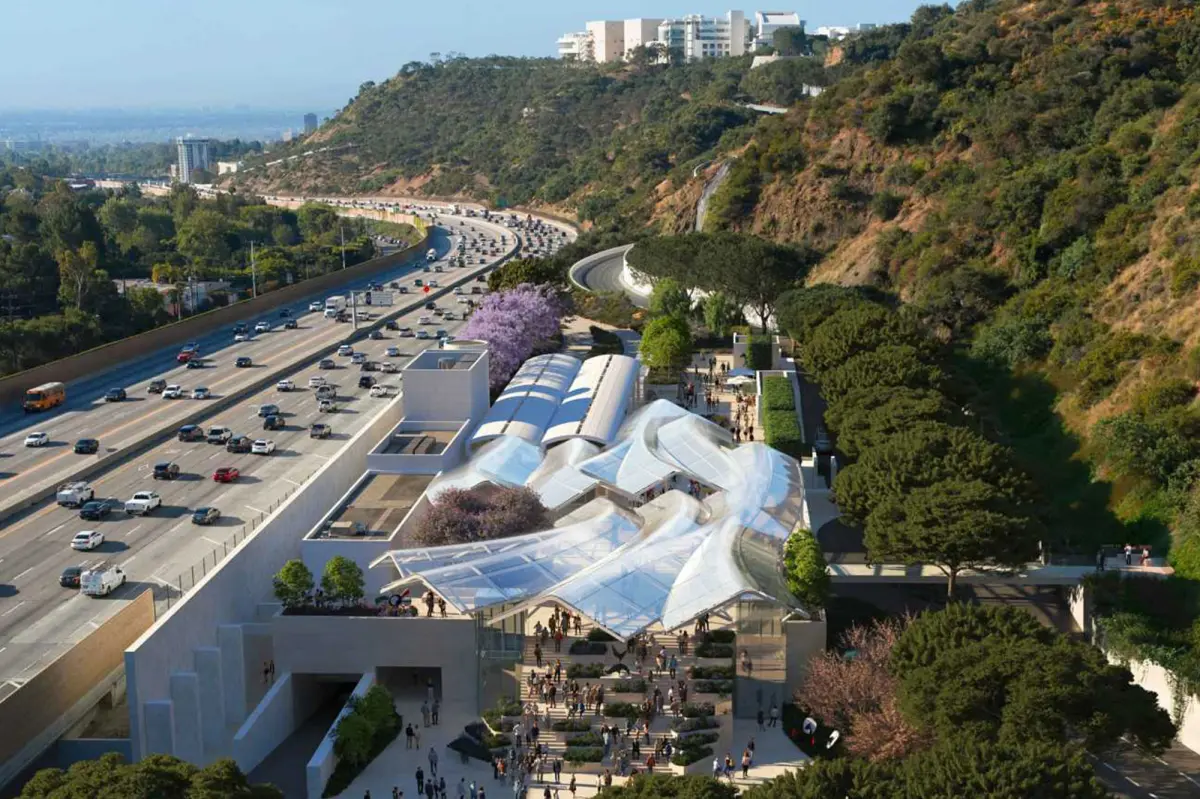
The visual and experiential centerpiece of Gehry’s revolutionary plan is a breathtaking grand staircase enveloped under a sweeping, sculptural, transparent glass canopy. This shimmering, curvilinear glass structure will arch gracefully above the lower tram station, serving as a beacon of light that mirrors the bright, iconic Southern California sun during the dry summer days and glows like a welcoming, artistic lantern against the evening sky. Unlike the previous, decades-old layout, which sheltered visitors within heavy concrete confines and obscured the natural beauty of the Brentwood hillside, this new design fully embraces the open air, weaving the native California landscape and the famous West Coast sky directly into the architecture. As visitors climb the grand staircase beneath the glass canopy, they will be treated to a theatrical sense of movement and anticipation, turning what was once a mundane transit wait into an active, inspiring prelude to the masterpieces awaiting them at the summit. This canopy is engineered not merely to protect guests from the heat and elements, but to filter the famed Los Angeles light in a way that shifts and dances across the steps throughout the day, creating a living canvas of shadows, reflections, and golden highlights. By prioritizing light, texture, and physical movement, this elegant architectural gesture redefines the act of arrival as an essential, beautiful ritual of transition. It is a space where the stress of freeway traffic, honking horns, and urban noise melts away, systematically replaced by a soaring sense of wonder and curiosity. As guests prepare to step onto the tram and ascend the hillside, they are no longer just commuters; they are active participants in a carefully choreographed journey of aesthetic discovery that honors the natural beauty of the surrounding canyon.
While the aesthetic enhancements of this massive project are undeniably spectacular, the redesign is deeply rooted in practical human empathy, addressing the diverse needs of the millions of people who visit the Getty Center each year. Every year, the museum serves as an educational wonderland for roughly 75,000 primary and secondary school children, many of whom arrive in large, energetic busloads, alongside university students, multi-generational families, and international tourists who speak a multitude of languages. Under the current, decades-old configuration, managing the sheer volume and diverse needs of these massive tour groups during peak hours has often created logistical bottlenecks, leading to stressful delays and confusing congestion at the tram platform. Gehry’s expansive layout beautifully resolves these spatial friction points by establishing designated assembly areas, wider thoroughfares, and highly intuitive pathways that allow large school groups to gather safely and comfortably without disrupting the quiet flow of individual travelers or families. Furthermore, this structural rewrite places a paramount focus on universal accessibility, ensuring that visitors of all ages, physical mobilities, and cognitive profiles can navigate the transition from arrival to the summit with dignity, safety, and ease. By prioritizing the human scale and the subtle psychology of crowd dynamics, the redesigned entrance transforms a potential point of architectural frustration into a celebratory space of shared human connection. It acknowledges that a museum’s true greatness lies not just in the rare, priceless objects it houses, but in its ability to make every single human being feel welcomed, valued, and fully capable of experiencing the transformative, bridging power of art, regardless of their cultural or physical background.
Beyond the magnificent new Gehry-designed gateway at the base of the hill, this massive capital improvement project represents a comprehensive, holistic rejuvenation of the entire Getty Center campus, breathing new life into every facet of the institution’s physical infrastructure. At the top of the hill, the iconic automated tram system—the literal lifeline of the mountain—will receive a state-of-the-art mechanical and technical overhaul to ensure whisper-quiet, ultra-efficient transit for decades to come. The interior of the museum will undergo a parallel, equally meticulous evolution; galleries will be modernized with advanced, energy-efficient lighting and state-of-the-art environmental controls that provide even safer stewardship for the Getty’s priceless collections of decorative arts, historical photographs, and Old Master paintings. The complex’s central Welcome Hall is slated for a complete internal reorganization to improve occupant traffic patterns and guest services, while existing dining terraces, cafes, and museum retail stores will be completely reimagined to offer fresh, local, and diverse culinary and shopping experiences that reflect the vibrant, contemporary tastes of modern-day Los Angeles. Crucially, the entire renovation is structurally underpinned by a deep commitment to environmental stewardship; the integration of cutting-edge green technologies, sustainable building materials, and highly efficient HVAC and electrical systems will dramatically reduce the monumental campus’s carbon footprint and water consumption. In an era dictated by climate change, this green transformation ensures the Getty Center remains an eco-friendly leader, proving that historic architectural preservation and future-focused ecological responsibility can go hand in hand on a world-class scale, securing the museum’s role as a resilient sanctuary for art and nature.
As the Getty Center embarks on this historic transition, J. Paul Getty Trust President and CEO Katherine Fleming elegantly noted that the institution is embracing an “exciting new chapter” designed to preserve and elevate this beloved cultural resource for countless future generations. The decision to temporarily close the museum’s doors in March 2027 is a bold and challenging one, but it represents a vital, necessary investment in the long-term cultural capital of Los Angeles and the global arts community. Standing on the precipice of the 2028 Olympic and Paralympic Games, the city of Los Angeles will soon become the epicenter of global attention, and a reborn, fully modernized Getty Center—representing the peak of architectural innovation, warm hospitality, and cultural preservation—will serve as the metropolis’s premier physical calling card. When the spectacular gates swing back open in early 2028, returning locals and first-time international visitors will not merely find a repaired facility, but a place that has been profoundly reimagined to be more transparent, more sustainable, and infinitely more human. From the breathtaking, sculptural glass canopy at the foot of the hill to the gleaming, climate-resilient galleries at the top, the new Getty Center will stand as an enduring monument to the power of art to elevate, unite, and inspire humanity under the eternal, golden California sky. It will be a brilliant testament to what can be achieved when legendary artistic minds collaborate, turning an already iconic museum into an even more accessible, inclusive, and radiant home where the diverse stories of human history can be celebrated by all.