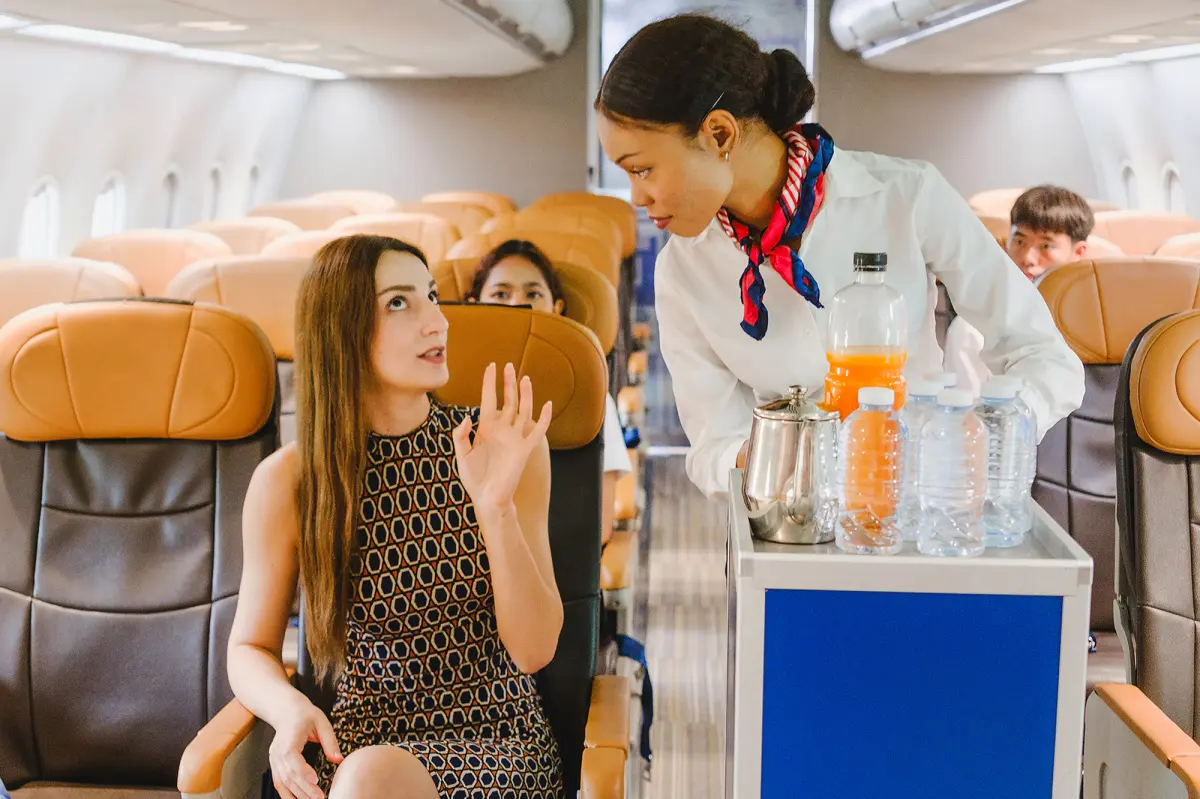
Imagine stepping into your workplace every day knowing that you will likely be poked, pinched, tapped, or grabbed by complete strangers. For flight attendants working at 35,000 feet, this unsettling reality has become so pervasive that many are now wearing “no touching” patches and pins on their uniforms just to establish basic physical boundaries. Safe within the metal tube of an airplane cabin, some passengers seem to leave their ordinary social etiquette on the tarmac, treating cabin crew members not as highly trained safety professionals, but as physical fixtures or personal servants. The problem has escalated to a point of collective exhaustion, prompting crew members to step forward and voice their frustration over an environment where their bodily autonomy is routinely ignored. Veteran flight attendant Michelle Montez, who has dedicated twenty years of her life to the skies, recently shared on the Jumpseat Chronicles Podcast that finding a flight where she is not subjected to some form of unwanted physical contact has become an exceedingly rare occurrence.
This sentiment of frustration is echoed across the entire aviation industry, uniting crew members of various airlines in a shared sense of dread over how they are physically treated in the aisle. On the same podcast, flight attendants Joshua Boyd and Darion Foy emphasized that this behavior crosses the line from a mild inflight annoyance to a systemic preservation of bad manners. Foy revealed the deeply degrading reality that he has been pinched on the rear end multiple times by passengers while carrying out his duties. Meanwhile, Sam Wilkins, a flight attendant and union leader for Southwest Airlines, pointed out the bizarre double standard of this behavior by asking a simple rhetorical question: who would ever walk into a restaurant and poke their waitress to get attention? The solution to this reach-and-grab epidemic is incredibly simple, yet seemingly difficult for many travelers to grasp: use your words. Despite years of airlines discouraging passengers from overusing the overhead call button, crew members now openly admit they would vastly prefer the chime of a call light over being physically manhandled. As Boyd passionately pleaded, passengers do not need to lay a finger on a flight attendant to get what they need; they simply need to speak up and let their voices be heard.
The root of this problem lies in a toxic mix of consumer entitlement and a fundamental misunderstanding of what flight attendants are actually there to do. In the high-stress environment of modern air travel, cramped seating, long delays, and cabin anxiety can turn the airplane into a pressure cooker of tension. However, passengers often misdirect this stress outward, viewing flight attendants as the tangible face of the airline rather than human beings earning a living under challenging conditions. Decades of historical airline marketing that sexualized or subserviently framed cabin crews still linger in the collective subconscious of some travelers, blurring the professional boundaries that exist in any other workplace. When a passenger taps an attendant’s shoulder, grabs their waist to squeeze past, or nudges them to hand over trash, they strip the employee of their personal space and professional authority. This lack of physical respect creates a slippery slope, where minor boundary crossings easily pave the way for much more aggressive, hostile, and dangerous confrontations.
When physical boundaries are entirely ignored, the cabin can quickly descend into chaos, endangering everyone on board. A stark illustration of this threat occurred aboard a Pobeda Airlines flight traveling from Novosibirsk to Moscow, where a routine flight turned into a terrifying midair crisis. Shortly after takeoff, a passenger identified as Valeria E. began behaving aggressively, alarming the people seated around her. When flight attendants courageously stepped in to de-escalate the situation and handed her paperwork outlining the airline’s code of conduct, the woman rejected the gesture entirely, crumpling the warning and throwing it. The situation turned violent when she physically assaulted two flight attendants, punching them after they refused to hand over a mobile phone. Striking video footage from the flight captured the harrowing moment when ordinary passengers had to intervene, physically dragging the hysterically laughing woman away and restraining her in her seat until the aircraft landed in Moscow, where law enforcement was waiting to arrest her. For the assaulted crew members, the physical and emotional toll of the flight ended not with rest, but with airport police reports and medical documentation of their injuries.
Physical violence is only one side of the coin; verbal degradation and sexual harassment also run rampant in the skies, particularly when alcohol is introduced to the flight. Ryanair flight attendant Chloe Harrison experienced this firsthand in 2023 during what should have been a standard flight from Manchester to Barcelona. The plane was packed with rowdy Manchester United soccer fans, who grew increasingly aggressive and abusive after the cabin run out of beer and vodka. Rather than adjusting their behavior, the groups of men turned their frustration on Harrison, launching into loud, vulgar chants targeted directly at her appearance and body. Remembering her name from the cabin crew’s introductory announcements, the crowd began chanting sexually explicit phrases, with one passenger even taking the abuse far enough to proposition her for sex in the aircraft bathroom. This degrading experience left Harrison feeling isolated and deeply unsafe in her own workplace, demonstrating how easily a group dynamic can strip a female crew member of her humanity and reduce her to a target for public humiliation.
Ultimately, these stories serve as a vital wake-up call for the traveling public to remember the human being behind the uniform. Flight attendants are first-line safety responders trained to evacuate burning aircraft, administer life-saving medical care, and manage security threats at high altitudes; they are not props for passenger convenience or targets for physical and verbal venting. Reclaiming respect in the skies starts with a conscious decision by every passenger to practice basic empathy, patience, and boundaries from the moment they step on board. By choosing to speak politely rather than reach out blindly, and by recognizing the emotional labor performed by crews on every flight, travelers can help make the skies a safer, more dignified workplace. It is time for passengers to finally keep their hands to themselves, allowing flight attendants to do their critical jobs with the dignity, safety, and respect they so richly deserve.