

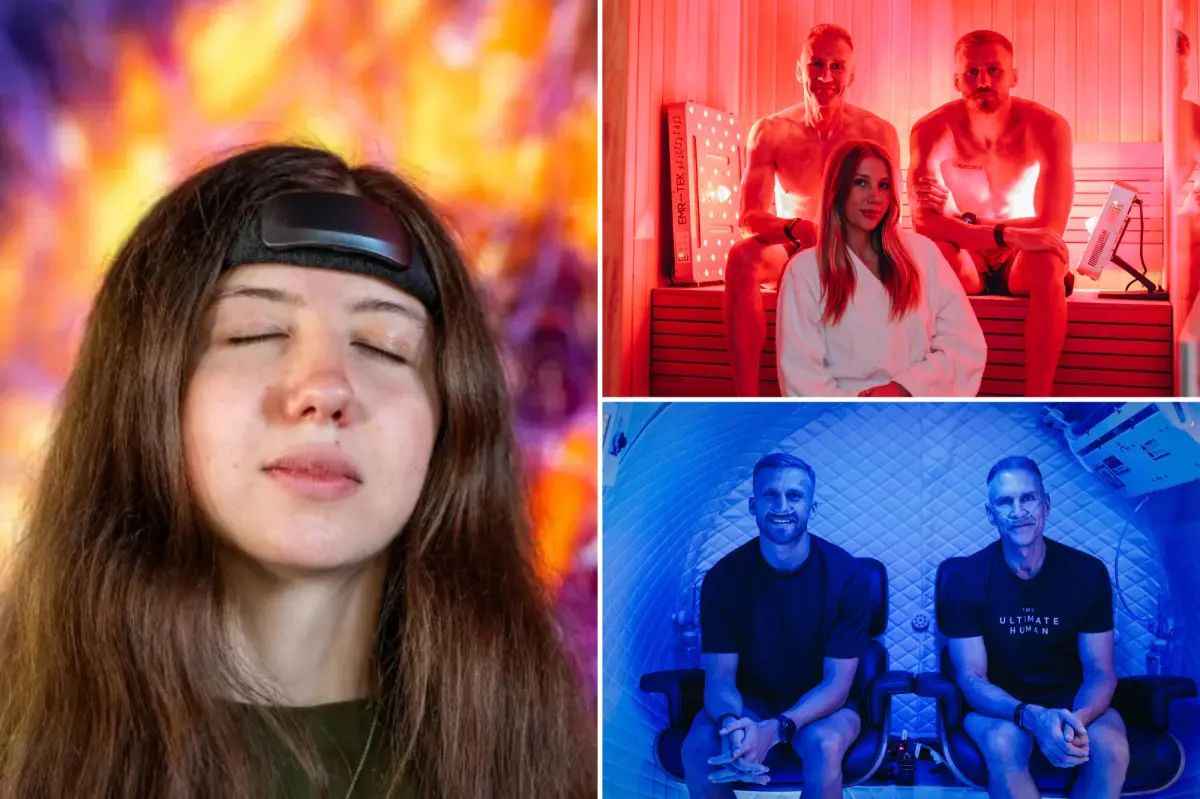
Long before biohacking became a buzzword, it was simply the air some children breathed at home. For Anna Asprey, now 19, Friday nights didn’t mean cartoons; they meant neurofeedback training, with sensors on her head teaching her brain to work more efficiently. Time with her father, Dave Asprey, the entrepreneur often credited with popularizing the biohacking movement through his Bulletproof brand, included sorting his supplements before a trip. At bedtime, she rejected a nightlight out of concern for her circadian rhythm. When she was five and wandered toward inedible wild pea plants in the yard, Dave didn’t just warn her off with a tummy ache threat. He explained chemical receptor binding and gap junctions, a crash course in biology that stuck with her. “It was actually really very effective,” Anna told The Post. “He didn’t just want me to understand what was going on, but why and how it was relevant to me.” She realizes most kids don’t get explanations like that. Long dismissed as fringe, the practices Dave and other longevity pioneers championed have since migrated firmly into the wellness mainstream. But for their children, this wasn’t a trend. It was just home. The Asprey household ran on a quiet conviction that the body could be optimized, that food was information, and that even a child could learn to understand her own biology. Anna, as a little girl, was already the “ingredient kid” who read labels, who asked to inspect nutrition facts on a school camping trip before deciding whether to eat dinner. Her teacher was stunned; Anna didn’t see the big deal. The freedom her parents gave her was not indulgence but education. They encouraged curiosity, never fear, and the result was an unusual childhood that felt completely normal to her, even when it looked strange to everyone outside their door.
For the Brecka siblings, growing up with Gary Brecka, now a prominent biohacker and host of “The Ultimate Human,” was similarly unremarkable from the inside. Cole Brecka, 25, looks back and laughs at the details. He was probably the only freshman football player in Florida taking BPC-157, an experimental peptide his father gave him after a sprained ankle, long before gym bros made it famous as part of the “Wolverine stack.” Before games, his dad would hand him a precise protocol of electrolytes, trace minerals, and amino acids. Then Cole would glance at a teammate eating a Lunchable and drinking soda as a pregame ritual. Gary also occasionally pulled him out of school at lunch for cryotherapy sessions, which drew confused looks from the office staff. At home, weekend fun meant CrossFit workouts together. “The gym is like our happy place,” Cole remembered. His older sister Madison, 28, is more of a “science brain,” and she remembers a different kind of bargain. When she got her driver’s license, her parents offered to pay for her car insurance and payments—provided she agreed to exercise. At the time, it seemed perfectly reasonable. Only later, recounting the deal to friends, did she realize how unusual it sounded. “A lot of people think it’s almost like stimulating an eating disorder,” Madison explained. But for her, it was about building habits, not policing food. The reward was a car, and the lesson was that her body was the only home she would live in for the rest of her life. Still, there were moments when the Brecka kids realized their family wasn’t like the others. Friends hated coming to Cole’s house because the cabinets held fresh fruit instead of Oreos and chips and Pringles. Madison loved visiting friends who had Pop-Tarts and Gushers, but after eating six of them, she felt awful. Her parents never punished her for it. They simply said, “See, notice you ate all that food, that’s why your stomach hurts.” It was all about paying attention, and it was all delivered with love.
Even the most devoted biohacker parents, of course, cannot engineer their way around one basic fact: kids don’t always follow orders. Anna confessed she stayed up a little later than her bedtime reading with her red light lamp, a small rebellion that feels almost adorable. Cole drew a firmer line at needles. He would lock the door when his father appeared with vitamin B12 shots or IV treatments, and there was one memorable chase around the couch. “I don’t care if I’m sick for the rest of my life,” Cole yelled, refusing the injection. Madison’s pushback came later and hit harder. In college, she drifted away from the health-conscious principles she’d grown up with. She gained a lot of weight, drank heavily to fit in, worked at a sports bar, ate whatever was around, and found herself in a bad relationship. “I almost dissociated from my morals,” she said. When the pandemic sent her home during her senior year, she barely recognized who she had become. Slowly, she turned things around—not because her parents forced her, but because she chose it for herself. She threw herself back into exercise, built a supplement regimen, and slimmed down. That struggle, she says, became a gift. Now working alongside her father in a clinic, Madison connects with patients who feel they have lost control of their health because she has been there. “I love that it was a part of my journey, because I can relate,” she said. “This is not a ‘nepobaby biohacker’ thing. I consciously made this change on my own.” The childhood lessons stayed with her, but she had to find her own way back to them.
Today, each of these “biohacking kids” has carried pieces of their fathers’ practices into adulthood, but they’ve also carved out their own paths. On ordinary mornings, Cole and Madison begin with grounding in the first light of day. Cole works out early with his dad; Madison moves through a sauna, cold plunge, and red-light bed. “I was the granola girl in 2020, and now I’m the standard 28-year-old,” Madison said. “Instead of being weird, it’s become chic.” Both Brecka siblings pursued nursing, which gave them a framework of medicine that sometimes clashed with what they’d grown up with. Eventually, they charted different courses. Cole and his father co-founded H2Tab Hydrogen Tablets, supplements designed to neutralize harmful free radicals and support muscle recovery. Cole has also taken his interest in human performance to extremes: he completed the Great World Race, seven marathons in seven days on seven continents, using a protocol he and his father designed together. Madison, after a debilitating health crisis linked in part to chronic mold exposure, launched EUCLASÉ, a luxury skincare brand using advanced biotechnology to support the skin’s natural biology. It officially launches Nov. 11. Anna, meanwhile, still does the neurofeedback brain training she began as a child and meditates nightly, a practice she started at 11. She recently worked at her father’s retreat, 40 Years of Zen, where she took part in its ketamine-assisted neurofeedback program. In September, she started her freshman year at the University of British Columbia, with an eye toward studying botany. Still particular about what she eats, she chose alternative housing with a kitchen when the dorm dining options didn’t measure up. “Heaven forbid you’re able to make any of your own food,” she quipped.
All three look back on their uncommon childhoods with genuine fondness, even gratitude. People assume being raised by biohackers must have felt restrictive, but Anna insists it was the opposite. “It actually created freedom and autonomy by giving me the knowledge I need to look after myself and the tools to feel the way I want to feel,” she said. Madison agrees completely. “I love being a biohacking baby,” she said. “I don’t know where I would be without it.” Cole remembers being the weird kid in the early days, but says that now, “it’s something cool to be a part of.” There is a certain pride in their voices, not because they had unusual parents, but because they learned early that the body responds to attention and care. They have also learned, perhaps more than their fathers sometimes do, that health is not just about extending life but about feeling good in the life you have. They are not blindly following the protocols handed down to them. They have questioned, rebelled, drifted, and returned, each on their own terms. Madison’s journey through illness and recovery gave her a sense of purpose. Cole’s endurance feats gave him proof that the principles work. Anna’s quiet daily rituals ground her in a world that is still full of discovery. The legacy of being raised by wellness evangelists is not a rigid set of rules. It is an instinct to ask why, to pay attention to how food and light and movement make them feel, and to trust that their bodies are worth caring for.
Where they most clearly differ from their fathers is in their vision of longevity. Dave Asprey has famously aimed to live to at least 180. Gary Brecka has floated 120 as a conservative target. The children, by contrast, are less interested in maximum lifespan than in the texture of the years they have. “That’d be nice if I felt good—but it’s mostly about how it makes me feel now,” Anna said. Cole put it plainly: “For me, it’s more about quality over quantity. I don’t want to live long just to live long, but I want to make the years that I am on this earth as maximized as possible.” Madison echoed that sentiment with a warm, pragmatic image. “I don’t want to live to 180,” she said. “I want to be the grandma that dies peacefully at 100 in her bed, but she was so healthy and capable up until that day.” She also hopes to shift the larger conversation around aging. “Let’s stop saying anti-aging. Let’s just focus on longevity, rejuvenation and a great happy life,” she said. “Aging is sexy. There is so much to look forward to—and I’m not scared of it.” In the end, these three children of the biohacking movement have distilled the best of what their fathers taught them into something gentler, more human, and more sustainable. They still measure electrolytes, love a good sauna, and pay attention to what their bodies need. But they also know that the goal isn’t to live forever. It’s to live fully, to stay curious, to forgive themselves for falling off the path, and to arrive at every new stage of life with grace, strength, and an open heart.