




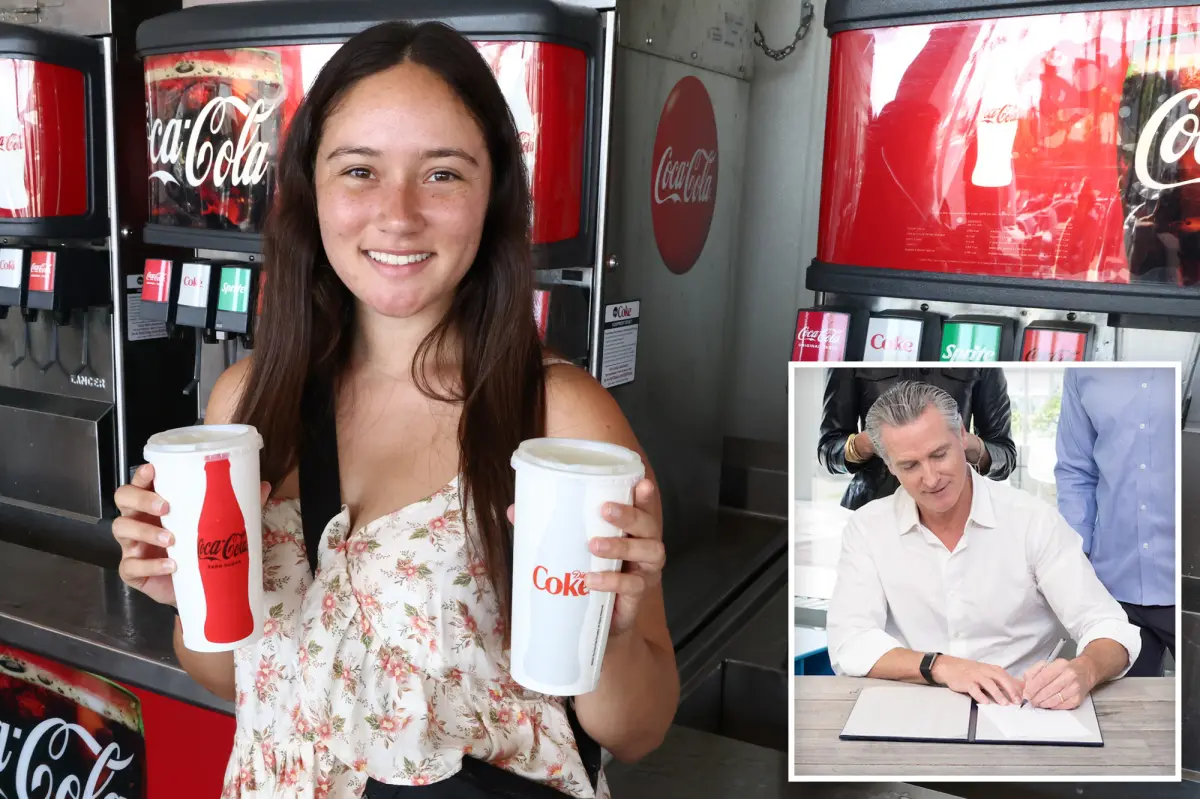
Dining out in California will soon come with an asterisk. Not the kind that sends you to the bottom of a menu in fine print, but the kind that sits right next to the drink you were about to order. Under a new law signed by Gov. Gavin Newsom on Monday, restaurant chains with 20 or more locations will have to place a warning icon on menus beside any beverage that contains an entire day’s recommended amount of added sugar. The icon is a sugar cube inside a black triangle—small, perhaps, but hard to ignore. The requirement, which must be in place by Jan. 1, 2029, applies to the kind of chains that define American dining: fast-food giants, casual dining spots, and everywhere in between. The message is straightforward: before you hand over your credit card, before you hear the ice clink, California wants you to know exactly what you’re drinking. The policy is part of a broader movement to treat food not just as fuel or pleasure, but as a public health issue. For years, menus have listed calories, salt, and saturated fat, but added sugar has remained a silent player in the American diet. The new law aims to make that invisible ingredient visible. It also places California at the front of a national conversation, one that other states may soon have to join. The asterisk, in other words, is not merely a warning; it is a statement of values. It tells consumers that the state believes they are capable of making informed choices—if they are given the information in the first place. And for a law that will not fully take effect until 2029, it gives the restaurant industry plenty of time to prepare, and consumers plenty of time to think. But not everyone will appreciate the interruption of their meal-planning routine. The law marks a shift in how California thinks about menu labeling: no longer content to tell you how many calories are in a drink, the state now wants to tell you what those calories mean. It is a change that will be felt at drive-throughs, at salad chains, and at soda fountains across the Golden State, and it will forever change the simple act of ordering a drink.
At the other end of the food pyramid, California has also approved something the country has never seen: a state-backed seal that says a finished food product is not ultra-processed. The new “Non-Ultraprocessed Certified” seal is voluntary, but for manufacturers who want to stand out in an increasingly health-conscious marketplace, it could become as familiar as the green USDA Organic label. Under the program, food manufacturers can apply through accredited certification agents to use the seal if their products meet California’s definition of not ultra-processed. That definition, established under a 2025 law targeting ultra-processed foods in public schools, is intentionally broad: products containing certain additives—flavors, colors, sweeteners, and emulsifiers—or that are high in saturated fat, sodium, or added sugar, are considered ultra-processed. The program will be overseen by the California Department of Public Health, though no manufacturer will be required to participate. The seal is modeled on the USDA Organic label, which lets shoppers identify products that meet federal organic standards without having to decipher long ingredient lists. But there is a critical difference. The USDA Organic label is mostly about how agricultural products are grown and handled—restrictions on pesticides, fertilizers, genetically modified organisms, and certain production practices. It does not guarantee that a cookie, a bag of chips, or a sugary cereal is healthy or minimally processed. In fact, processed products can carry the USDA Organic seal as long as their ingredients and production methods meet organic standards. California’s new label is different: it focuses specifically on the finished food, not the farm. It asks a question that organic labeling never quite answered: after all the processing, additives, and refining, is this still something recognizable as food? For supporters, the seal is a way to rescue consumers from the bewildering world of food marketing. As Assemblymember Jesse Gabriel, who authored the law, put it, “Parents shouldn’t need a Ph.D. in chemistry to understand what they’re feeding their kids.” The seal will not replace the FDA nutrition facts panel or the ingredients list, but it may make those labels less necessary for shoppers who simply want to avoid ultra-processed foods. It is a bet that consumers are hungry for shortcuts—but also for standards they can trust.
Health experts see the two laws as a response to an unfolding emergency, not a policy indulgence. “Ultra-processed foods are fueling a surge in chronic conditions among children, obesity, type 2 diabetes, and even mental health challenges like anxiety and depression,” said pediatrician Ravinder Khaira, speaking on behalf of the American Academy of Pediatrics. “These aren’t distant threats. They’re showing up in our exam rooms every day.” The science around ultra-processed foods has become harder to ignore. Diets heavy in sugary drinks, packaged snacks, and industrially formulated convenience items have been linked to metabolic disease, inflammation, cardiovascular problems, and a range of other health issues. Children, in particular, are vulnerable: their bodies are still developing, and their food preferences are being shaped by the same products that are making them sick. For pediatricians, the rise in type 2 diabetes among young people is especially alarming—a diagnosis that was once considered a disease of adulthood but is now seen in teenagers and even younger children. The added-sugar warning on restaurant menus is aimed directly at one of the biggest drivers of that trend: sugary beverages. A single drink may not seem like much, but consumed daily, it can alter a person’s metabolic health over time. The warning is not a ban; it is a nudge. It says, in effect, “Here is something you may not have considered.” And there is evidence that such nudges work. Researchers at the University of California, Davis have found that warning labels on restaurant menus steer diners away from sugary drinks. That may seem like a modest victory, but over millions of meals, it adds up to fewer empty calories, fewer insulin spikes, and fewer chronic conditions. The new California law is also a recognition that when it comes to food, information is a form of health care. By making the invisible visible, the state hopes to give consumers the power to make choices that align with their own well-being. It is not a replacement for medical care or nutrition education, but it is a start—and for many doctors, a long-awaited one.
But not everyone in California is celebrating. The restaurant industry, already wrestling with some of the nation’s strictest labor and health regulations, sees the new sugar warning law as yet another burden. The California Restaurant Association called the measure “duplicative,” noting that large chains are already required by law to provide calorie information for food and drinks. For an industry that has experienced mass job losses and store closures since California raised the minimum wage for fast food workers to $20 per hour, the new mandate feels like one more rule in a regulation-heavy state. “SB 869 is another example of California making small business owners comply with yet another law that is duplicative,” the association said in a statement. The complaints are not limited to restaurant owners. Consumers, too, are divided. Carter Sakamoto, who was buying a soda at Costco on Tuesday, described the new warning labels as “stupid.” “I think that as Californians, we have a lot of bigger problems than sugary sodas. It’s a waste of taxpayers’ time,” he said. His reaction captures a broader skepticism toward government intervention in personal dietary choices. For some, the asterisk feels like paternalism; for others, it is simply noise. They argue that adults already know sugary drinks are not health food, that warning labels are unlikely to change behavior, and that the state should focus its energy on more pressing issues. The debate is not just about sugar; it is about the role of government in the choices people make, the responsibilities of businesses in a competitive marketplace, and how much information consumers really need. The restaurant association’s frustration is also a reminder that regulations rarely exist in isolation. California has become known as a state that pushes the envelope on labor, environmental, and health policy, and the cumulative effect can be exhausting for businesses operating on thin margins. Every new requirement—whether a calorie count, a warning label, or a certification program—adds cost, complexity, and legal risk. For a restaurant chain with locations across the country, complying with California’s specific rules can be a logistical headache. And for local operators, it can feel like the state is treating them as the enemy rather than as partners in the community.
Yet health advocates and many shoppers see the new laws not as an intrusion but as a long-overdue act of transparency. “A single beverage may not seem like much, but over time, it can significantly impact someone’s health trajectory,” said Christine Harabedian, a lobbyist for the American Diabetes Association. “Studies show that adding just one 12-ounce sugary drink daily increases the risk of developing type 2 diabetes by 26%.” That statistic is a stark reminder that small daily choices can compound into serious health consequences. The American Diabetes Association and other advocacy groups have long pushed for clearer labeling, arguing that calorie counts alone do not capture the metabolic impact of a beverage. A 200-calorie soda is not the same as a 200-calorie protein shake, even if the numbers look similar on a menu. The sugar warning, they say, gives consumers a more meaningful frame of reference. Seri, another Costco shopper, called the sugar warning law “a long time coming.” “As humans, we should know what we’re putting into our bodies, especially foods with high sugar, like soda, that we consume every day,” she said. “Whether you choose to ignore the sign is up to you, but I fully support knowing how much sugar I’m consuming.” That sentiment captures the heart of the argument: the labels are not designed to make decisions for people, but to make sure people know what decisions they are making. Supporters also point to research showing that warning labels can change behavior. The UC Davis study on restaurant menu labels found that when diners saw warnings about added sugar, they were less likely to order sugary drinks. The effect was not dramatic, but it was measurable—and over time, small shifts in consumer behavior can reshape entire industries. If the new law encourages restaurants to reformulate their drinks, if it prompts consumers to choose water or unsweetened tea, if it sparks a conversation at dinner tables across California, then it will have achieved its purpose. For advocates, the asterisk is not a scolding; it is an invitation to think twice. And in a society where sugary drinks are everywhere, from vending machines to sports arenas, thinking twice may be exactly what is needed.
Gov. Gavin Newsom framed the two laws as part of a larger shift from “sick-care” to health care. “We should be about healthcare, not sick-care, recognizing that preventing illnesses is far preferable to finding—and affording—treatments,” he said in a statement on Monday. “California has never been afraid to challenge the status quo, and we’ll keep innovating, trying new things, and clearing the way for the rest of the country to follow.” That framing positions the sugar warning and the ultra-processed seal not as isolated policies but as pieces of a broader strategy to address the root causes of chronic disease. Prevention, the logic goes, is cheaper and more humane than treatment. But the road ahead is not without complications. Critics have already questioned whether California’s new label could confuse consumers if other states adopt their own definitions and standards for ultra-processed foods. A product might carry a “Non-Ultraprocessed Certified” seal in California and a different label elsewhere, making it harder, not easier, to know what is actually healthy. There is also the question of enforcement, certification, and the potential for companies to game the system. Still, California is betting that clarity will eventually win out. The voluntary seal gives manufacturers an incentive to meet the state’s standards; the mandatory sugar warning gives consumers a tool they have never had before. Together, they send a message that will likely reverberate far beyond the state’s borders. By 2029, when the sugar warnings appear on chain restaurant menus, the food landscape may look very different. Other states may have followed California’s lead; manufacturers may have reformulated their products; consumers may have grown accustomed to seeing the tiny black triangle next to their favorite sodas. Whether it becomes a model for the nation or a cautionary tale, California has once again chosen to act. The asterisk is now part of the menu, and that is precisely the point. In a country where diet-related disease is the leading cause of poor health, knowing what we consume is not a luxury—it is the first step toward something better.