




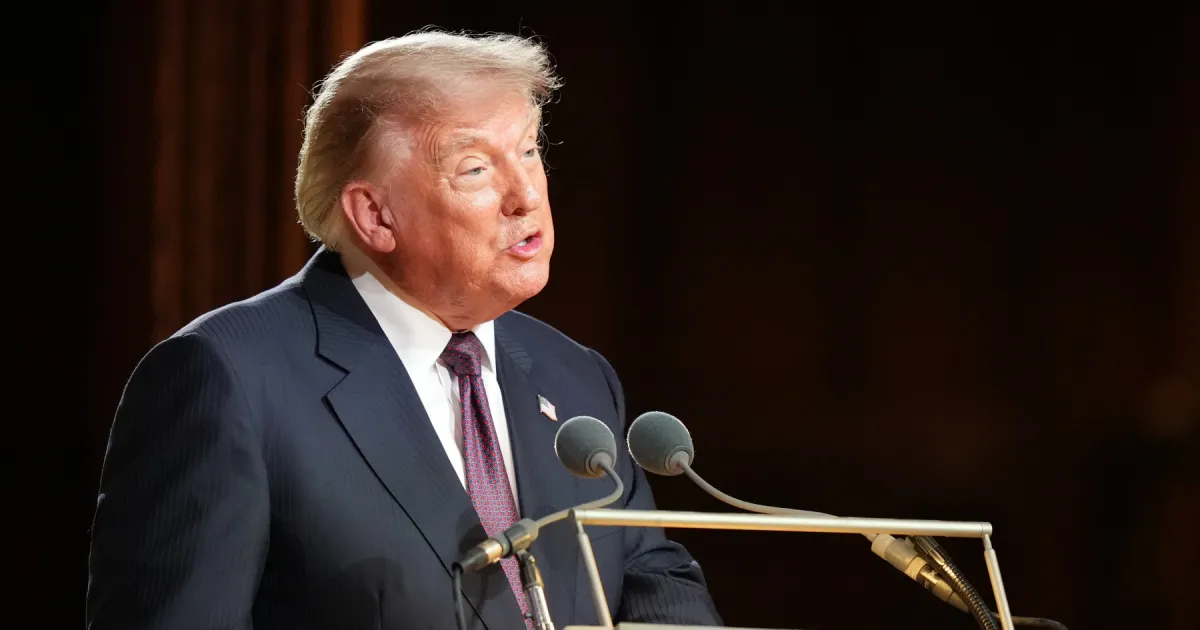
The quiet, vaulted chambers of the Cathedral Church of Saint Peter and Saint Paul, usually reserved for solemn prayers and quiet contemplation, became the latest battleground in America’s endless cultural and political wars following the funeral of Senator Lindsey Graham. The service, meant to honor the life and long-standing legacy of the South Carolina statesman who passed away suddenly at the age of seventy-one, was quickly overshadowed by a viral media storm. Television cameras and press photographers, trained relentlessly on the congregation of high-profile delegates, captured a brief moment where President Donald Trump sat with his eyes closed. In an era dominated by hyper-partisan scrutiny, this split-second image of stillness was instantly interpreted by critics as a sign of physical weakness and a lack of respect, with accusations spreading across social media that the commander-in-chief had succumbed to exhaustion and fallen asleep during the service. What should have been a moment of collective national mourning was rapidly converted into a digital battleground, illustrating the modern reality where no gesture, however brief or ambiguous, escapes the polarizing lens of contemporary political warfare. The incident highlights a deeply human struggle at the center of public life: the impossibility of finding a private moment of grief, weariness, or silent reflection when one is constantly positioned beneath the unforgiving glare of the global spotlight.
In rapid response to the mounting public chatter, the White House launched a fierce counteroffensive to protect the president’s reputation and redirect the narrative. White House spokesperson Davis Ingle did not mince words when addressing the media, issuing highly charged statements that sought to dismiss the allegations as completely baseless and politically motivated. In an initial statement to People, Ingle sought to humanize the president’s behavior, explaining that Trump was not asleep but was instead deeply immersed in private reflection, quiet contemplation, and grief for a man who had transitioned from a fierce political rival into one of his most trusted confidants on Capitol Hill. Ingle pointed out that the president had just completed the emotionally demanding task of delivering a deeply personal eulogy and was simply recovering his composure in the quiet of the sanctuary, adding that anyone implying otherwise was a “depraved moron.” However, as the story refused to die down, the administration’s rhetoric grew noticeably sharper; in a subsequent statement to Us Weekly, Ingle labeled the accusations as “Fake News” manufactured and spread by individuals whom he described as suffering from an incurable and severe obsession known as “Trump Derangement Syndrome.” This deliberate shift in language, moving quickly from a defense of the president’s personal grief to a biting political counterattack, reflects the standard operating procedure of a modern executive branch that treats every minor observation as an existential threat to be neutralized with aggressive rhetoric.
The intense focus on this single moment of stillness stands in stark contrast to the genuine history and emotional complexity of the relationship between Donald Trump and Lindsey Graham. Their political journey was anything but simple; they began as fierce, bitter rivals during the fiercely contested 2016 Republican presidential primary, where Graham had been one of Trump’s most vocal and biting critics. Yet, in a testament to the unpredictable and pragmatic nature of Washington politics, Graham eventually evolved into one of Trump’s most loyal, influential, and consistent allies in the Senate, bridging the gap between the traditional Republican establishment and the populist movement. In his eulogy, Trump spoke directly to this complicated legacy, describing Graham as a tireless force of nature who spent over three decades influencing every major policy decision and piece of legislation in the nation’s capital. Trump’s words, noting that Graham had given “the full measure of his good and mighty heart until that heart itself just gave out,” suggested a deep appreciation for the senator’s relentless work ethic and ultimate sacrifice to public service. By focusing on the accusation of sleep rather than the content of this tribute, the public conversation largely missed the opportunity to contemplate this unique political friendship, showcasing how easily genuine human connection and shared history can be lost in the noise of sensationalized media reporting.
The funeral itself was a massive gathering of the nation’s political elite, bringing together figures from across the political spectrum who came to pay their respects to a man who had spent his life navigating the corridors of power. Among the mourners gathered in the grand cathedral were Vice President JD Vance, former Vice President Mike Pence, Fox News host Sean Hannity, and Supreme Court Justice Brett Kavanaugh, representing a powerful coalition of conservative leadership alongside numerous other politicians from both sides of the aisle. For these high-profile individuals, attending such an event is not only a matter of personal respect but also a highly visible public performance where every expression, gesture, and movement is watched and analyzed. The physical demands of these long, emotionally heavy services—especially for older leaders who manage grueling, non-stop daily schedules—are immense, yet the expectation is that they must remain perfectly alert, stoic, and engaged at every single second. When the human body naturally seeks a moment of quiet or rest, even if only to close one’s eyes and let the weight of a friend’s passing sink in, the modern media apparatus is ready to package that moment as a scandal. This reality turns a sacred space of mourning into a high-stakes performance arena, where the natural physical limitations of aging and grieving human beings are weaponized for political advantage.
This controversy is not an isolated incident but rather the latest chapter in a long-standing public obsession with the alertness and physical stamina of the nation’s leaders. The White House, under the direction of Chief of Staff Susie Wiles, has repeatedly had to issue denials regarding allegations that the president struggles to stay awake during important meetings, briefings, and public appearances. These rumors have been fueled by past events, including a highly publicized NBA Finals game in June where Trump, attending to watch the New York Knicks, appeared to match the rhythm of the game with moments of deep, motionless relaxation that critics quickly labeled as dozing. In a highly demanding 24-hour news cycle, the physical health, biological needs, and mental sharpness of aging politicians are constantly questioned, with sleepiness treated not as a natural human necessity but as a sign of cognitive decline or professional negligence. This constant tracking of a leader’s physical state reflects a broader societal anxiety about the capacity of our leaders to handle the immense pressure of governance, leading to a culture where even the most basic human functions, like resting one’s eyes after hours of taxing public appearances, are viewed with intense suspicion.
Trump himself has addressed this relentless scrutiny in the past, offering his own perspective on the demands of his position during a high-profile meeting with Saudi Crown Prince Mohammed bin Salman in late 2025. When questioned by reporters about his work ethic and sleep habits, Trump insisted that his deep love for his country and his profound sense of duty kept him constantly focused, stating simply, “I think about my country. I don’t want to sleep.” This statement captures the impossible standard that modern leaders often set for themselves and that the public, in turn, demands of them: an idealized, almost superhuman expectation of endless energy, constant vigilance, and immunity to physical exhaustion. Yet, beneath the political theater, the aggressive press statements, and the partisan defense strategies lies a very simple and universal human truth. Whether a president is delivering a eulogy for a close friend, sitting through a long and exhausting state funeral, or managing the affairs of a nation, they remain bound by the same biological realities that affect everyone else. Ultimately, the controversy at Lindsey Graham’s funeral serves as a powerful reminder of the unforgiving nature of modern public life, where even the most natural human responses to grief, physical fatigue, and deep personal loss are denied their half-second of privacy, leaving little room for the quiet humanity that exists behind the political persona.