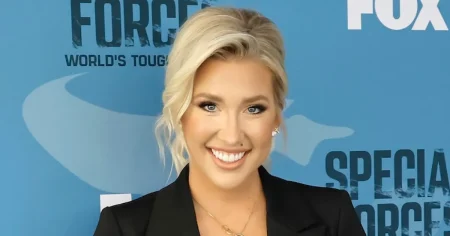



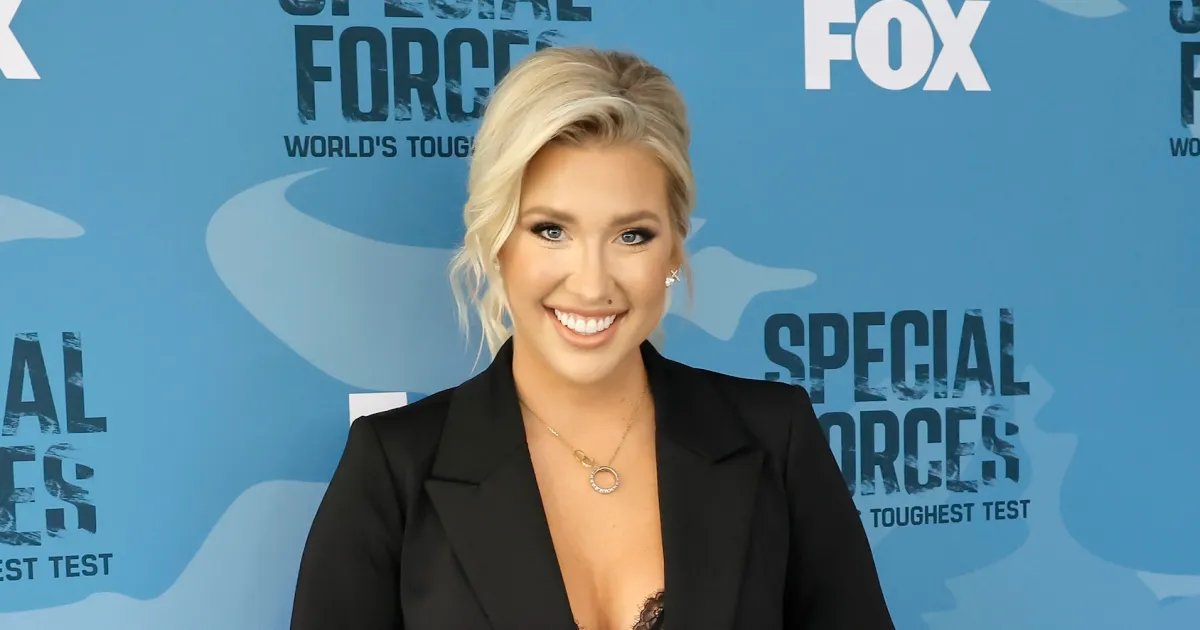
Savannah Chrisley, the Chrisley Knows Best alum who has spent much of her life in front of cameras, has now delivered her most personal message yet—not for audiences, but for one tiny, thumb-sucking life growing inside her. On a Tuesday in late October, the 29-year-old reality star shared an Instagram Story that stopped fans mid-scroll: a black-and-white ultrasound, a heartbeat, a child not yet born, and a letter written with the kind of fierce tenderness only a mother can summon. “My sweet thumb-sucking baby … you are worth it ALL!” she wrote. The words landed like a gut punch of pure emotion. “You are not a headline. You are not a controversy. You are not defined by anyone’s past, anyone’s mistakes, or anyone else’s opinions.” In an era when celebrity pregnancies are often polished announcements with brand deals and staged photo shoots, Savannah went low-tech and deeply personal. She was not selling anything; she was proclaiming something. She called her unborn child innocent, deeply loved, and “the greatest blessing God could have ever entrusted your daddy and I with.” The letter was a shield. It was also a warning to the world: say what you want about the adults, but leave this baby out of it. For anyone who has ever felt their life being picked apart, the subtext was unmistakable. Savannah knows what it is like to be reduced to a headline. She has lived through family legal dramas, public scrutiny, and endless commentary. Now, standing at the threshold of motherhood, she decided that her child would not inherit any of that noise. “No amount of noise,” she added, would ever overshadow the joy of being this child’s mama. The words were simple, but the conviction behind them was monumental. It is the kind of love that begins long before a baby opens its eyes—love that instinctively builds walls, sings quiet songs, and whispers promises to a squirming little shape on a sonogram screen.
The pregnancy announcement itself arrived with dramatic surprise in the early hours of Tuesday, sweeping away any idea that Savannah had planned a perfectly timed reveal. Sharing a video that documented her pregnancy so far, she wrote a caption that read like a private diary page made public: “I’ve prayed for this life. I’ve cried for this life. And there were moments I truly wondered if this life would ever be mine.” The admission carried weight. For years, Savannah had kept her romantic world private, learning the hard way that public positions can become volatile. But in this moment, she was ready to say who had changed everything: a man she called J. “And then God sent me J”—that sentence explained it all. She described him in a cascade of loving phrases: “My protector. My fiercest fighter. My most loyal person. My lover. My safe place. A man with the patience of Job (and Lord knows he needs it). The one who makes me laugh even on my hardest days.” The playful aside about needing Job-like patience revealed the easy intimacy between them; this was not a couple posing for the cameras, but two people who know each other’s quirks and still choose each other. Later, on her “Unlocked” podcast, Savannah explained why she had kept the relationship a secret for so long. “I have learned that in order to protect my own peace that I had to keep things closer to the chest for a little while,” she said. “That’s just for my own mental health.” It was a healthy boundary from someone who grew up in a family reality show, where privacy was always a luxury. She revealed that she had actually been engaged for nearly a year, and that the wedding—originally planned for January 2027—had been moved up to May of the coming year because of the pregnancy. The timeline made her two pieces of news, engagement and baby, feel less like a rushed announcement and more like a long-awaited harvest finally ready to be shared.
As fans began to dig, the man behind the initial J was revealed to be Jason Galanis, a 56-year-old businessman who is exactly 27 years older than Savannah. The age gap quickly became an alternative headline, but Savannah was already several steps ahead. On her podcast, she addressed the questions with characteristic directness. “He doesn’t look his age. He doesn’t act his age,” she said. “His body is great. His mind is even sharper. So I really don’t care, OK? Like, this person is the love of my life.” There was no apology in her voice, no wobble of uncertainty. She made clear that Galanis had earned the role of partner, father, and protector. Their connection, by her telling, ran through deeper waters than birthdays. He was the one who made the hardest days bearable; he was the safe place she had been praying for. In a society that loves to scrutinize relationships, Savannah refuses to let a number define a bond. She sees a man who loves her, who is loyal, who fights for her, who makes her laugh. She is not asking for permission to be happy. The secrecy she maintained for months had not been because she was ashamed; it was because she was guarding something precious. She wanted to let love grow away from the hot lights of public opinion. Now, with a baby on the way, she is stepping into the light with her head high and her hand in his. For any woman who has had to justify her own choices in love, Savannah’s defiance is familiar. She isn’t explaining herself so much as stating facts: “I really don’t care.” That kind of certainty doesn’t happen overnight; it comes from a relationship that has already weathered storms and still feels like home.
Still, the fuller story of Jason Galanis is not without complications. He is a businessman and a former associate of Hunter Biden. He was previously convicted of fraud and spent time in prison before President Donald Trump commuted his sentence in March 2025. Those are the kinds of facts that tend to overshadow any romantic narrative. But Savannah has chosen to see the whole man rather than the criminal record. She knows that the world may never fully understand why she loves him, and she seems at peace with that. The letter she wrote to her unborn child contained a line that felt like a deliberate message to the wider world: “You are not defined by anyone’s past, anyone’s mistakes, or anyone else’s opinions.” In that sentence, one can hear the echo of her own philosophy. She is not naive; she has lived enough life to know that people carry histories, that mistakes are real, and that redemption is also real. She is not asking anyone to forget what Galanis did, nor is she making excuses. She is simply drawing a boundary: the child she is carrying is innocent, and the love they have built is not up for negotiation. Human stories are rarely tidy. There are chapters we wish were not there, gray areas, and people who have done both wrong and right. Savannah’s approach to Galanis seems rooted in something deeply personal: she believes he is a changed man, that he has walked through fire and come out more faithful, more patient, more present. Only she knows the hours they have spent together, the promises exchanged in private, the quiet support he gives her when the cameras are off. Public records can tell you what a person did; they cannot tell you who a person has become. Savannah is betting her life and her child’s life on the latter, and she is not looking back.
At the center of all the noise is the most delicate, powerful thing: a mother’s love for a child she has not yet held. Savannah’s letter ended with words that deserve to be read slowly: “You are my answered prayer. And I will never apologize for celebrating you.” There is an almost defiant joy in those lines. She has waited, prayed, and cried through the moments when it seemed this life would never arrive. Now that it has, she will not dim her light to make others comfortable. The announcement video, with its documentation of early pregnancy, was not just a reveal—it was a celebration. Every mother knows the particular vulnerability of those first weeks and months, when a pregnancy can feel both deeply real and impossibly fragile. There is a desire to hold breath, to guard the secret until the risk passes. Savannah chose to announce with her whole heart, allowing the public to share in her joy even as she drew a fierce boundary around her child’s identity. By calling the baby “sweet thumb-sucking baby,” she turned a grainy ultrasound into an intimate portrait. She could already imagine the little habit, the comfort-seeking gesture, the human being with preferences and a soul. That is what motherhood does: it transforms an abstract idea into a person, a heartbeat, a thumb. The world may see a scandal or a story, but Savannah sees a life. She is determined that her child will grow up knowing a simple truth: from the very beginning, they were wanted, cherished, and celebrated. No headline, no controversy, no past mistake can rewrite that.
In the end, the public has two choices: to make Savannah Chrisley’s pregnancy another tabloid chapter, or to witness a very human moment of grace. She has already made her choice. She will celebrate her baby, marry the man she loves, and build a home with all the courage and humor she has shown on screen. She has learned to protect her peace, to keep things close until they are strong enough to be shared. Her announcement was not a plea for approval; it was an invitation to celebrate a miracle. Her story contains complications—age, legal history, public scrutiny—but human stories always contain complications. What matters is what happens in the quiet spaces: a mother talking to her unborn child, a father-to-be holding her through anxious days, a woman who once wondered if she would ever have this life, now living it. Savannah’s letter was addressed to her baby, but it spoke to something universal. Every child deserves to be seen as innocent, deeply loved, and more than the sum of circumstances. Every person deserves a chance to be known by their present, not their past. Savannah has spent years in front of cameras, but this moment is not about performance. It is about prayer, gratitude, and a love that refuses to apologize. In a world that too often turns people into headlines, she is doing something quietly radical: she is loving out loud. And to her baby, she has already given the greatest gift a mother can give—the certainty that they are worth it all.