





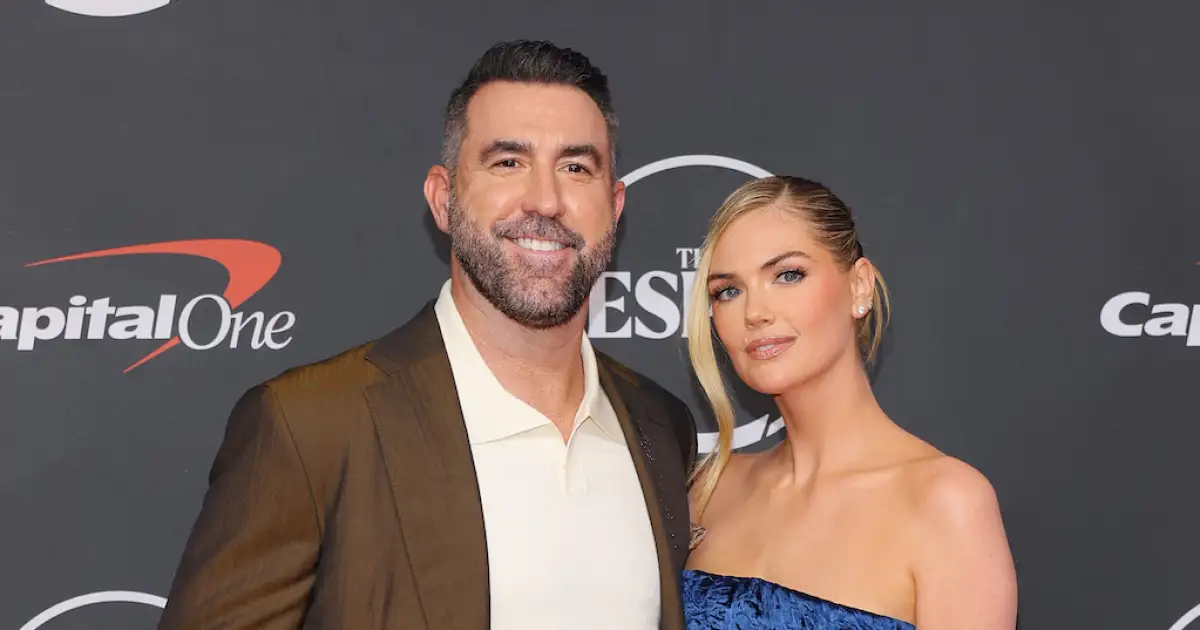
On a cool late-September evening in Detroit, the weight of an entire baseball life seemed to settle gently onto the grass of Comerica Park. Justin Verlander, forty-three years old and worn in all the ways that matter, stood at the center of a pregame ceremony that was equal parts farewell and thank-you. His wife, Kate Upton, thirty-four, stood close by, holding their one-year-old son Bellamy, while their seven-year-old daughter Genevieve took in the scene with the wide-eyed gravity that children bring to moments they only half understand. For twenty-one seasons, Verlander had been defined by his arm, his fire, his refusal to give in to hitters or to age. But on this Friday, September 25, as the Detroit Tigers honored him before what would be the final start of his career, the definition shifted. The spotlight was not on the strikeouts or the no-hitters or the MVP trophies; it was on the family behind him and the person he had become because of them. There was something tender, even fragile, in the air. The man who had once been a rookie phenom and then a Detroit legend and then a Houston champion was now simply a father and husband, saying goodbye to a craft that had consumed him and made him, and given him everything except the one thing he could no longer sacrifice.
That tension—between devotion to a game and devotion to a family—was at the heart of what Verlander shared with reporters that afternoon. He did not hide behind statistics or brave clichés. Instead, he allowed himself to be honest about the cost of greatness. “I feel like I ran my race. I gave it everything I had,” he said, according to MLive. But then he went deeper, into terrain that athletes rarely visit in public. He spoke about his daughter, Genevieve, and how her seven-year-old childhood had swept by in what felt like an instant. He spoke of the time he had already missed, the moments of her growing up that he could never get back because he was on a baseball field somewhere, chasing a title or rehabbing an injury. And he spoke of his son, Bellamy, who just turned one in June, and the quiet promise he now makes to himself: that this time, he will be present. He will be there for the bedtime routines, the school drop-offs, the small ordinary days that make up a childhood. That kind of admission is not common in the hyper-masculine world of professional sports, where vulnerability is often mistaken for weakness. But Verlander is at a point in life where the clock feels more real than the scoreboard. He is no longer running from something. He is running toward something—his family, his future, the version of himself that exists after the cleats are hung up.
It is impossible to understand that transformation without understanding how profoundly marriage and fatherhood reshaped him. Verlander acknowledged as much when he said that getting married and having children had “tremendously” impacted his career, not by taking something away, but by showing him a new way to see everything. He did not just mean that he had new priorities or a softer landing at home. He meant that he had become a different person, and that this difference had made him better. He shared a quote that he said he loved: “What’s the point of living life if you don’t let life change you?” And in that single sentence, you can hear the philosophy that guided his late career. He could have retired years ago, bitter about injuries or grateful for his trophies, but instead he allowed himself to be open to transformation. Upton and their children were not distractions from his greatness; they were co-authors of the second act of his life. They gave him permission to be weak, to be tired, to be afraid, and in doing so, they gave him the strength to keep competing at the highest level. That is the kind of alchemy that no training regimen can replicate. It only happens when a person is brave enough to stop guarding his own heart and let other people inside it.
The love story that led to that moment began, as so many modern romances do, in the odd and unglamorous world of commercial production. Verlander and Upton first met in February 2012 on a set for a Major League Baseball 2K12 video game advertisement. She was already a globally famous Sports Illustrated Swimsuit model; he was a superstar pitcher at the peak of his powers. And yet, for all their charisma and beauty, their relationship was not an instant fairy tale. They dated on and off, navigating the strange currents of fame and distance and complicated schedules. But they kept finding their way back to each other, until finally in May 2016, Verlander proposed. The next year, in a rolling ceremony in Tuscany, Italy, surrounded by family and friends, they made it official. Upton marked the occasion with a tweet that still feels achingly sincere: “I feel so lucky that I got to marry my best friend!! Thank you to our family and friends for making this weekend so fun and magical!” It is a reminder that even for two people who seem to live on magazine covers, the most important things are quite ordinary. The magic, as she put it, was not in the celebrity or the extravagance. It was in the community of people who loved them, and in the quiet certainty that they had found in each other the kind of partner who would not let go.
Over the years, that partnership has been tested in ways that were not always glamorous. In August 2018, Verlander gave an interview to Bleacher Report that remains stunning for its raw honesty. He was recovering from hernia surgery, and he was not recovering well, at least not mentally. He described being depressed, upset at the world, and trying to hide his own pain from everyone around him. And then he said something that few elite athletes would dare to say: “She was instrumental in me not … like, jumping off a bridge. I was depressed and kind of just upset at the world and trying to hide my own s–t.” He went on to explain how Upton had become his therapist, his confidante, the one person he could talk to about his fears—whether he could make it back, whether he still had greatness left in his arm, whether he was falling apart. He used the language of a man who had hit bottom and found a hand reaching down for him. “She was what I needed,” he said, and that line carries more weight than any pitching stat he ever amassed. In that period, before they had children, Upton was already showing him the kind of love that does not need stages or rings. It was the everyday, unglamorous, relentless love that says, I will sit with you in the dark, and I will not leave.
Now, with their daughter and son as witnesses, Verlander closes this chapter with a fullness of heart that he might not have imagined in his younger, more isolated years. Genevieve was born in November 2018, and Bellamy followed in June 2025, and between those two births lies the whole arc of a man learning to be a father. It is a strange and beautiful thing to watch a legend become ordinary, not in skill, but in desire. Verlander no longer needs to prove that he can strike out a lineup or pitch a perfect game. What he needs now is far simpler and far harder: to be there. To watch his daughter grow through her formative years, to hold his son as he takes his first steps, to make up for the moments he missed, not with grand gestures, but with daily presence. As he stood at that podium in Detroit, surrounded by the roar of a grateful crowd and the quiet love of his family, he looked like a man who had finally figured out what it means to win. The baseball career was ending, but something else was beginning. He had run his race, yes. But he had also crossed the finish line and found that the people cheering loudest were not the fans in the stands—they were his wife and his two children, waiting to take him home. And in that, he had found a victory that no ring or trophy could ever measure.