






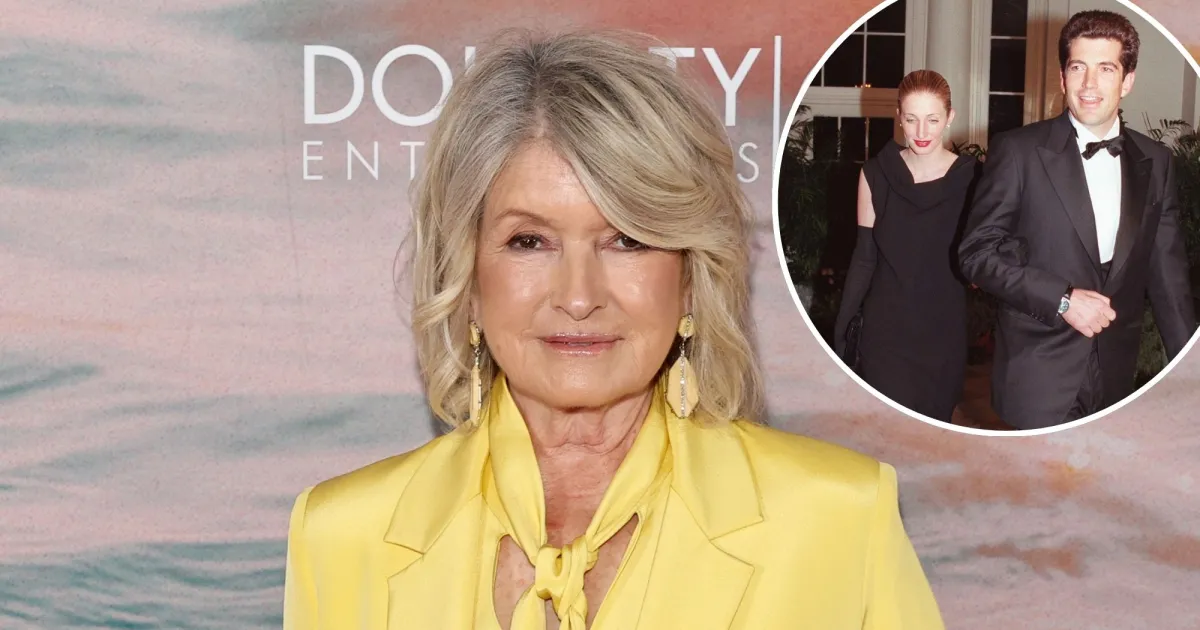
There are moments on reality television that feel less like entertainment and more like an accidental window into a life that has brushed against history’s most intimate corners. During the season 16 premiere of The Real Housewives of New York City, Martha Stewart provided exactly such a moment. At eighty-five, Stewart sat down with Daisy Toye, a makeup artist who has worked with her for more than a decade and who now appears on the series as a new cast member. The setting was classic RHONY—glamorous, slightly surreal, full of overlapping conversations—but the story Stewart told was anything but typical. She mentioned that she had been watching Love Story: John F. Kennedy Jr. & Carolyn Bessette, Ryan Murphy’s limited series about the golden couple who captivated the world and lost their lives too soon. Then, almost casually, she shared a secret she had carried for decades. “I was with John-John—this is JFK Jr.—I was with him the Monday before the Friday when they died,” she said. The room seemed to shift. Daisy, who knew Martha in a professional context, was visibly stunned. It was one of those rare television moments where the celebrity gloss fades away and a real person emerges—someone who lived through a moment that the rest of the world grieved from a distance, and who has never stopped thinking about what she might have done differently.
Martha went on to explain the circumstances with the kind of vivid detail that makes memory feel like a living thing. She was running Martha Stewart Living magazine at the time, busy building an empire that redefined American homemaking and turned lifestyle advice into an art form. But when JFK Jr. called, everything else paused. He told her he was in trouble and asked if he could talk to her about George, the political magazine he had founded in the mid-1990s. It was a bold, ambitious project, born from his desire to make politics feel accessible and even glamorous, but it had struggled to find its footing. Martha, naturally, said yes. “Of course, anything you want,” she recalled telling him. The two shared what she described as “a very nice dinner,” the kind of conversation that probably felt like two old friends catching up, except that one of them was carrying the weight of a faltering publication and the pressures of being the most famous son of Camelot. During that dinner, JFK Jr. mentioned that he would be flying to Martha’s Vineyard that weekend for a wedding, joined by his wife, Carolyn Bessette, and her sister Lauren. Martha asked the practical question that might have seemed simple at the time—so simple, in fact, that it has haunted her ever since. “Well, who’s flying?” she remembered asking. He said he was flying. She pressed further: “You have a copilot, right?” And he answered, in what must have sounded like confident reassurance but now reads as something more tragic: “No, I don’t need a copilot.”
That exchange carries a weight that only grew larger in the days that followed. On July 16, 1999, JFK Jr. climbed into his Piper Saratoga with Carolyn and Lauren for the short flight to Martha’s Vineyard. He was an experienced pilot, but not as experienced as he needed to be for night flying under hazy conditions, over open water, with no instrument rating fully in hand. The plane went down off the coast of the island, killing all three passengers. The nation was devastated. For days, the world watched as search teams scoured the Atlantic, hoping against hope for a miracle that never came. The loss felt deeply personal to millions of people who had grown up watching John-John, the little boy who saluted his father’s casket with heartbreaking dignity, evolve into a handsome young man who seemed to carry the promise of a new generation. His marriage to Carolyn Bessette, a fashion executive with a striking presence and a fiercely private nature, had only intensified public fascination. They were beautiful, complicated, endlessly scrutinized, and utterly human. And Martha Stewart, who had sat across from him just days before, could not shake the memory of telling him to get a copilot. “I’ve thought about that so many times, that I told him to get a copilot,” she said, the regret still visible even from behind mascara and camera filters. It is the kind of what-if that has no satisfying answer, only the endless echo of a question that can never be resolved.
For Carole Radziwill, the tragedy is not a distant memory or a narrative arc in a prestige television series. It is the texture of her own life, the shape of a grief that reshaped her understanding of love and loss. Carole, who returns to The Real Housewives of New York City this season, was married to Anthony Radziwill, John F. Kennedy Jr.’s cousin and close friend. She knew John and Carolyn not as icons but as family, as people who filled rooms with laughter and impossible warmth. When Love Story premiered in February, it arrived at the same time Carole began filming the new season of RHONY. She told USA Today that the coincidence made the experience feel almost unbearable. “It was a very emotional time for me. That show, really, it was like a body slam,” she said. She did not watch it, but she could not escape it. Martha Stewart had watched it. Other cast members were curious about it. Again and again, she found herself being pulled back into a moment in history that she had spent years trying to make peace with. “I didn’t watch it, but you couldn’t get away from it,” she explained. The feelings she thought she had transformed into something manageable came rushing back, fresh and raw, coloring the entire season of filming.
Carole made it clear that she did not need a dramatization to process what happened. Years earlier, she had written What Remains: A Memoir of Fate, Friendship, and Love, a devastatingly honest account of losing both her husband and her close friends in a short, brutal stretch of time. Anthony Radziwill died of cancer less than two months after the plane crash, leaving Carole to grieve multiple losses at once. In the book, she reflected on the strange intersection of fate and friendship that bound them all together, and she wrote about John and Carolyn with tenderness and insight, capturing them not as legends but as people caught in circumstances far bigger than themselves. During the RHONY premiere, Daisy Toye revealed that she was reading What Remains, which brought the memoir back into conversation at a moment when Carole was already feeling vulnerable. Carole acknowledged that the emotions came back during filming, something viewers will witness across the season. “It’s a little grief that I felt, almost the whole time I was filming,” she said. She hinted that the arc of that grief plays out in unexpected ways, culminating in a moment at the end of the season that even she did not anticipate. “You’ll see the arc of that story throughout, I think, the whole season. Certainly in the beginning, and then it comes up really big at the end, and that was completely unplanned.”
What makes this story so compelling is the way it brings together two very different women, each connected to the same loss, each carrying her own burden of memory. Martha Stewart’s relationship to the tragedy is defined by a moment of ordinary advice that turned into an emblem of survivor’s guilt. She did not know what would happen. She cannot know whether a copilot would have made any difference. And yet she has spent twenty-five years repeating those words in her own mind, searching for a version of the conversation where everything turns out differently. Carole’s relationship to the tragedy is deeper, more personal, more entwined with the daily fabric of her life. She lost her husband, her cousin-in-law, and her friend in a matter of weeks. She has had to move through the world carrying a grief that does not have a neat ending. Both women show us that grief is not a linear process. It lingers, resurfaces, changes shape. It appears in the middle of a reality show, in a conversation about a Ryan Murphy miniseries, in a sentence about a copilot. There is no final closure, only the ongoing practice of living with what remains.
As the new season of The Real Housewives of New York City continues to air on Bravo Tuesdays at 8 p.m. ET, viewers are being offered something more than the usual reality television spectacle. They are being given a window into the ways that history and memory intersect with everyday life. Martha Stewart, a woman known for perfectly arranged flowers and precisely measured recipes, revealed a crack in that perfect surface—a moment of human vulnerability that no amount of planning could protect against. Carole Radziwill, a writer and former publicist who has spent years crafting her own story, is discovering that the past never stays neatly in the past. It returns, uninvited, in the middle of production schedules and cast dinners and conversations with people who think they know what it was like. This is the deeper truth of the show, and perhaps of all storytelling: we can try to summarize the events, to make sense of them, to transform them into tidy narratives, but the emotions resist reduction. The grief remains. The regret remains. The love remains. And sometimes, all it takes is one sentence from Martha Stewart to remind us that the people we lost are never truly gone—they live on in the questions we keep asking ourselves, the moments we keep replaying, and the stories we find the courage to tell.