

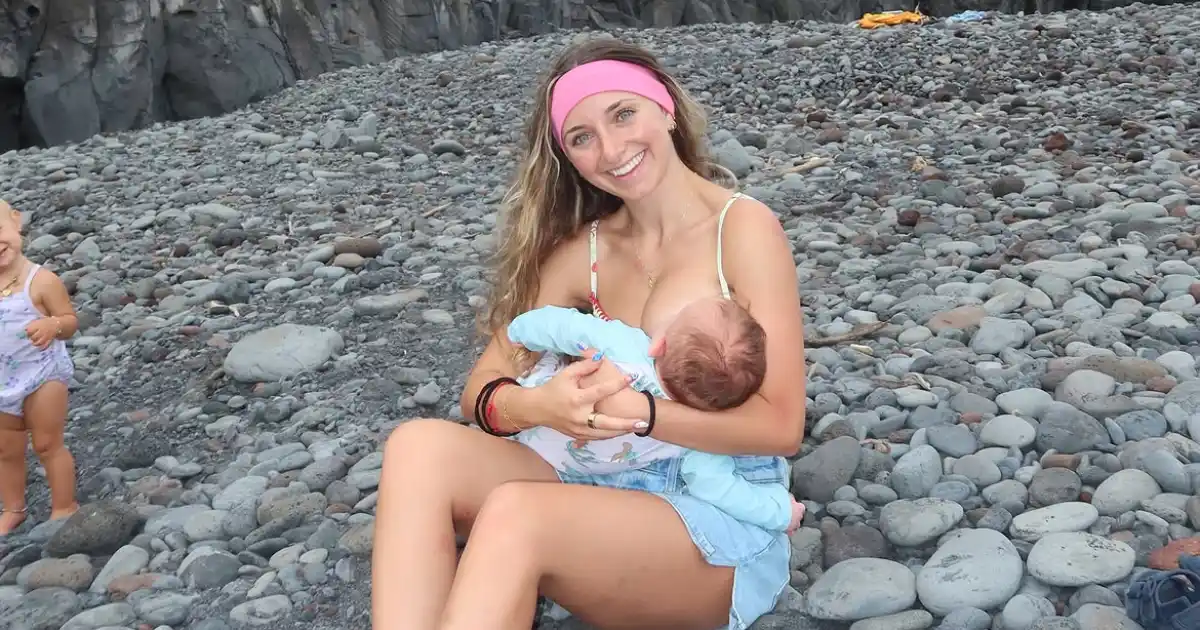
On a Wednesday in late September, Brooklyn McKnight sat down to scroll through social media and found herself face-to-face with a familiar, infuriating argument: women should not breastfeed in public. The 26-year-old influencer, mother to a toddler named Archer, affectionately called Archie, felt the words land like a slap. She had heard this before, of course; every nursing mother has. But this time, she decided not to let it pass. She picked up her phone, selected photos of herself feeding her 21-month-old son in the middle of everyday life, and wrote a caption that would quickly spread across the internet. “Saw something recently that talked about how women shouldn’t breastfeed in public, and I personally couldn’t disagree more,” she began. Then came the sentence that said everything: “Feed your babies wherever and however you want!!” The photos were not posed or polished; they were real. There was a mother in a parking lot, a mother at an outdoor spot, a mother tending to her child the way mothers have always done. McKnight was not trying to shock anyone. She was simply refusing to treat breastfeeding as a shameful secret. For a woman who built her following online, this was a deliberate choice. She knew the post would invite debate; she counted on it. Her followers had watched her fall in love, get married, and become a mother. Now she was inviting them to watch her feed her child too—not because she wanted their approval, but because she wanted to make a point: public breastfeeding should not be a spectacle, and it also should not be an outrage. And for anyone who might have missed that point, she closed her caption with an unmistakable gesture: a salute emoji and a confession that she was posting the images “just to give the middle finger to that side of the internet.”
For McKnight, breastfeeding is not merely a way to nourish a baby; it is the most natural thing she has ever done. She wrote that openly, and then added a confession that might surprise people who see only the boldness of her public posts: “I’ve never felt more feminine than when I’m nursing.” Those words are important. They challenge the idea that a woman’s body is somehow made more modest or less powerful by motherhood. McKnight feels more like herself, more like a woman, more connected to her own strength when she is breastfeeding. That sense of femininity is not about performance; it is about purpose. It is the quiet, unshakeable confidence that comes from knowing her body is doing exactly what it is meant to do. Perhaps that is why her post struck such a nerve. In a culture that often sexualizes breasts while simultaneously policing how mothers use them, McKnight’s message was a welcome reminder that a breast is, first and foremost, a biological source of nourishment. And she wanted other mothers to feel that confidence too. By putting her own nursing photos out there, she created a small space where a woman could stop apologizing. She pushed back against the whispered shoulds that follow new mothers around—the suggestion to cover up, to go into another room, to think about other people’s comfort before their own child’s hunger. McKnight’s answer, repeated in every photo she shared, was a simple no. No, she would not hide. No, she would not let a stranger’s gaze make her child wait for food. No, she would not trade “feminine” for “invisible.” Her body was hers, and her baby’s needs came before anyone else’s opinions.
The comment section quickly filled with the voices of women who understood. Some were blunt: “God forbid we use our breasts for their intended purposes,” one wrote, with an eye-roll so powerful you could almost hear it. Another pointed out the absurd double standard: “If men can walk around shirtless, women can too.” But the most telling comment came from a mother who had clearly been in McKnight’s shoes. “Most important thing is that baby is fed,” she wrote. “I’m not going to starve my baby just so I can find a private place to feed her.” The face-palm emoji that followed said the rest. Supporters kept coming. They shared their own stories of nursing in public, of being covered with a blanket, of retreating to bathroom stalls because they were made to feel disgusting for doing something natural. They thanked McKnight for being brave enough to post the photos. In a way, her post became a rallying point—a reminder that motherhood already asks women to give so much. It asks them to give their bodies, their sleep, their time. It should not also ask them to give up their dignity. “Fed is best” is more than a slogan; it is a liberation. And in the comment section, that liberation took the form of solidarity. Woman after woman said, “Yes. This.” The judgment against public breastfeeding was not inevitable. It was cultural. And culture could be changed.
But as with any conversation about motherhood, the comments were not unanimous. Some women agreed with McKnight in principle but hesitated over the details. “I do agree but I also enjoy being modest at the same time. I think they can both exist,” one person wrote. The word “enjoy” is telling—modesty was not a burden for this woman, but a personal preference. Another commenter was more direct: “My ‘problem’ is when your whole boob is out without any type of modesty at all. I know it’s a hot take, a fed baby is the best baby, I just think a little ‘class’ wouldn’t hurt either.” A third echoed the same idea, saying, “Breastfeeding is natural, of course, but for me, that doesn’t mean intimate parts of the body need to be exposed in public. You can breastfeed while still keeping yourself covered.” These comments represent a middle ground that is impossible to dismiss. They are not against breastfeeding; they are against visibility. The question they raise is uncomfortable but fair: Does the right to breastfeed in public include the right to do it with absolute openness? For McKnight, the answer was clearly yes. For others, the answer was more complicated. The debate is unlikely to be settled in an Instagram comment section, but the fact that it is being had at all is a sign of progress. A generation ago, many women did not even feel comfortable asking for what they needed. Now, they are debating the exact shape of the line—where comfort ends and judgment begins, how much of a body belongs to the public eye, and whether “modesty” is a virtue or a weapon. McKnight’s post did not end the conversation. It gave the conversation a new center, and perhaps that is exactly what she wanted.
The woman at the center of this debate, however, is more than a symbol. She is a mother, a wife, and a content creator whose life has been unfolding in front of an audience for years. McKnight welcomed Archie in January 2025 with her husband, Dakota Blackburn. Their relationship began in front of the camera: the couple met while filming a “10 dates in 10 days” series for McKnight’s YouTube channel in August 2020. What was meant to be a social experiment turned into something real, and by the spring of 2021, they were dating. The following year, Blackburn proposed, and they did not waste any time planning a future together. In September 2022, they were married in an intimate ceremony surrounded by the towering California redwoods—a setting that felt both grounded and magical, much like their relationship. McKnight looked like a vision in an off-the-shoulder A-line dress with a tulle skirt covered in delicate lace embellishments. Her veil swept across the forest floor, and pearl jewelry caught the dappled light. Blackburn wore a tan suit that complemented the natural tones of the redwoods, and together, they looked like the kind of couple that belongs in a romance novel. The path from first meeting to marriage was fast, but it never felt rushed; every step seemed deliberate, a choice made with the same confidence McKnight would later show as a mother. It was a wedding that promised a long life of shared adventures, and now, with Archie in their arms, that promise is being fulfilled in the most ordinary, extraordinary ways.
It is easy to look at McKnight’s latest Instagram post and think only about the controversy. But the true story is more personal. The same woman who once stood in a lacy gown among ancient trees is now standing in public places with a toddler on her breast, and she is unafraid. The thread that connects those moments is a refusal to be someone she is not. She did not pretend to be the kind of bride who wanted a huge production; she chose intimacy and nature. She does not pretend to be the kind of mother who can wait for privacy when her baby is hungry; she acts. In a world that constantly tells women to be smaller, quieter, and more accommodating, McKnight’s public breastfeeding photos are a reminder that there is another way. Her post did not solve the debate over modesty, and it was never supposed to. It was a testament to a simple truth: a mother’s body is her own, and a baby’s hunger does not wait for a convenient moment. Every woman deserves to feed her child wherever and however she wants—without shame, without judgment, and without having to explain herself. Motherhood is rarely black-and-white, and the choice to nurse in public is deeply personal. The critics will always have something to say, but McKnight has already shown what she thinks of that. She posted the photos, added the salute, and moved on. “The rest,” as she might tell you, “is just noise.” And for the thousands of mothers who have ever felt the sting of judgment, that noise was drowned out by a much louder message: You are not wrong. You are not alone. Keep doing what you’re doing.