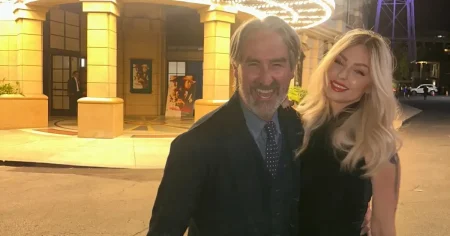




Scott “Carrot Top” Thompson is a name that has become synonymous with the relentless, high-energy, prop-driven comedy that defines a certain golden era of Las Vegas entertainment. For over two decades, he has been a staple of the Strip, performing thousands of shows at the Luxor, a venue that practically houses an extension of his own persona: loud, colorful, over the top, and somehow always inviting. When he bounds across that stage, toting bright laundry baskets filled with inventions and gags, audiences know what to expect—silly, outrageous, unapologetic fun. But on the evening of Monday, October 19, the stage meant something entirely different. After a month of silence, of speculation, of worry, the comedian returned to the spotlight, and the weight of that moment was felt by every single person who had gathered to see him. The audience at the Luxor had not come just for a show; they had come to witness a recovery, a homecoming of sorts. As Thompson emerged, the room erupted. A standing ovation swelled from the front rows to the back of the auditorium, lasting so long that the comedian himself seemed uncertain how to proceed. Footage shared to social media captured the scene beautifully—a man visibly moved, holding his gratitude close, standing under the kind of unconditional affection that few performers ever truly experience. It wasn’t just applause. It was the sound of a community exhaling. For Thompson, who has spent a career making people laugh with rubber chickens and ridiculous props, the simplest expression of this moment was beyond words. “Thank you so much,” he said, his voice thick with emotion. “God bless all my fans and my family, my mom, my brother, everybody here tonight.” Then, in a flash of trademark wit that reminded everyone exactly who he was, he added, “I would have done this a long time ago if I could get this kind of love.” The room laughed, and for a moment, it felt like everything might be okay again.
The evening continued to balance delicately between heartache and humor, and Thompson seemed determined to honor both. “It’s an emotional night for everybody,” he shared, settling into his routine as if he were navigating a new kind of territory. “It’s been a rough month. Trying to figure out what is appropriate for a night like tonight.” The admission was raw, honest, and deeply human. He acknowledged the elephant in the room in a way that only a prop comic could—with a physical joke. “It’s been a month of trying to figure out what’s appropriate,” he continued, pulling out a noose. “So I figured this would probably not be appropriate.” The audience drew a collective breath; the joke was dark, but it was also a way of reclaiming the narrative, of taking the tragedy and bending it toward something he could control. This is the territory of the stand-up: to find the absurdity in the unbearable. And Thompson, in his return, was demonstrating that comedy is not always about escaping pain but about sitting with it and making it bearable for others. His honesty disarmed the crowd. He went on, “I don’t know what to talk about. My first time in my career, I have no idea. What is there to talk about really?” At that moment, the screens behind him lit up with a photograph of an elephant wearing a red, curly wig—a classic Carrot Top absurdity that punctured the weight of the moment. The crowd howled. It was a calculated, playful pivot, and it worked. The local blog Vital Vegas captured the mood perfectly, sharing a clip of the introduction later that night with the observation that “Following an extended ovation, Carrot Top handled his return to the stage with grace, humility and a smidge of irreverent humor. Pitch perfect.” They were right. It was exactly the kind of performance that couldn’t be rehearsed—one that required a man to stare down his own recent past and choose, deliberately, to make the audience feel safe while he was still figuring out his own safety. The return was not about pretending nothing had happened; it was about acknowledging everything and choosing to move forward.
To understand the meaning of that standing ovation, it is necessary to rewind the calendar to a single day—September 18—when the world received news that no one expected. Scott Thompson was hospitalized in Las Vegas following what was widely reported as a suicide attempt. The news shook his fans, his colleagues in the comedy world, and the city that had adopted him as its own. Carrot Top, the man who made his living turning the mundane into the ridiculous, had been silently struggling in ways that the public never saw. The initial statement from his representative, Jami Schlicher, was brief and careful: “Mr. Thompson is recovering in the hospital and is receiving the care and support he needs. His family and those closest to him are deeply grateful for the concern, prayers and respectfully ask for privacy.” It was a plea for space in the middle of a media storm. Two days later, a second update followed, offering a glimmer of hope. “Scott remains hospitalized and under close medical care,” Schlicher told Entertainment Weekly. “He is now awake, breathing on his own and continuing to improve, surrounded by his family and those closest to him.” The details were sparse, deliberately so, but the trajectory was clear: a man who had been on the brink was now turning back, slowly, with the support of people who loved him. In the days that followed, fans and fellow comedians took to social media to send their wishes, lighting a virtual vigil of hope for a performer who had given so many nights of laughter. The silence that followed was deafening. Thompson stayed away from the stage, away from posting, away from the public eye. His absence was felt acutely in the comedy circuit, and the fragility of the human behind the persona became a topic that transcended gossip. The entertainment industry, often reluctant to discuss mental health, found itself holding space for a different kind of conversation—one about the pressures of performance, the isolation that can accompany celebrity, and the quiet battles that people fight behind closed doors.
On Saturday, October 17, exactly one month after his hospitalization, Thompson broke his silence of his own accord. His return to social media was marked by a heartfelt Instagram post that stripped away the usual celebrity gloss. “I’m truly overwhelmed by the outpouring of love, support, prayers, and well wishes I’ve received over the past couple of weeks,” he wrote. The words were simple, but the sentiment was profound. “Every message, text, and kind thought has meant more to me than you know. While I haven’t been able to respond to everyone individually, please know that I’ve felt your love and appreciate each and every one of you from the bottom of my heart.” For viewers, reading those words felt like a privilege, a rare glimpse into a vulnerable moment for someone who has spent his entire career being loud and outrageous. “Thank you for being there for me during this time,” he concluded. “It truly means the world to me.” The post was a humanizing moment, a reminder that behind the prop table and the curly red wig is a man who navigates the same kinds of struggles that touch so many lives. The response was immediate and overwhelming; the comments section flooded with warmth, encouragement, and admiration for his courage. Publicly acknowledging a mental health struggle is a difficult act for anyone, but it carries particular weight in the entertainment industry, where vulnerability is often mistaken for weakness. Thompson’s willingness to thank his supporters rather than retreat into silence signaled a new chapter. It showed a mature perspective on the relationship between performer and audience—not one where he receives applause and gives jokes, but one where he is allowed to be human, to be imperfect, and to let the room hold him for a change. The post also implicitly set the stage for what came next: the return to the Luxor that Monday. It was as if he knew that thanks were not enough, that the only true way to honor the support he had received was to do what he does best—to go back to work, to make people laugh, and to prove to himself and everyone else that he could still find the light.
The story of Carrot Top’s return is not just about a celebrity recovering from a difficult episode. It is a reflection on the nature of comedy itself, and the peculiar relationship between the person who makes the jokes and the people who laugh at them. Comedians often speak of the stage as a sanctuary, the one place where their pain can be transmuted into something light. For Thompson, returning to the Luxor after a month of hospital beds and quiet recovery was an act of profound resilience. It takes a particular kind of bravery to stand in front of a crowd and admit that you have been broken—and then to ask them to laugh with you anyway. His performance on that Monday night was not flawless; he admitted he was unsure of what to say, and that uncertainty was part of the beauty. He pulled out a noose and called it inappropriate, then moved on, carrying the room with him. The audience played a role too. They were not passive spectators; they were participants in a shared act of healing. Their standing ovation at the start of the show was a message: we are here, we see you, we still love you. When they laughed at his jokes, especially the darker ones, they were not laughing at his pain—they were laughing in solidarity, releasing their own tension alongside his. The clip shared by Vital Vegas captured a man “handling his return with grace, humility and a smidge of irreverent humor,” but it also captured an audience that responded with empathy and restraint. This mutual exchange is the hidden contract of live performance. The comedian offers vulnerability disguised as entertainment, and the audience offers permission to fail, to be messy, to be real. In a world that so often demands perfection from public figures, Thompson’s messy, honest, imperfect comeback was a powerful reminder that healing is not a linear path. It is a process of small steps, uncertain jokes, and the quiet courage to keep showing up, even when the room feels heavier than it used to.
As Thompson continues his Las Vegas residency, the days ahead will undoubtedly carry their own challenges. Recovery from a crisis of the kind he endured is not a single triumphant evening on stage; it is a long, ongoing journey that will involve hard days and quiet moments of doubt. But the significance of his first night back should not be underestimated. He walked out into the light, took the applause, made an uncomfortable joke about a noose, and kept going. That is a testament to his resilience as a performer and as a human being. His story serves as a broader reminder of the importance of mental health awareness, especially within the entertainment industry where the pressure to perform, maintain a persona, and constantly seek approval can take a heavy toll. The outpouring of love for Carrot Top shows that audiences are capable of enormous compassion when their favorite stars drop the facade and show their true selves. By addressing his fans directly, by thanking them for their love, and by returning to the stage, Thompson has opened a conversation that is desperately needed. He has shown that it is possible to stumble, to fall, to be hospitalized, to face the deepest kind of darkness, and still find a way back to the microphone, to the laughter, to the community that holds him. For anyone who has ever felt that same darkness, his return is a light. The crisis resources included in the coverage of his story—the 988 Suicide and Crisis Lifeline—are a vital part of this narrative, reminding us all that help is available and that no one needs to suffer in silence. As Carrot Top sets aside the noose joke and picks up his next prop, he continues to do what he has always done, but with new meaning: making people laugh, and in doing so, reminding us what it means to be human. The stage is his home, and he is home again, not alone, not perfect, but moving forward one show, one evening, one breath at a time.