





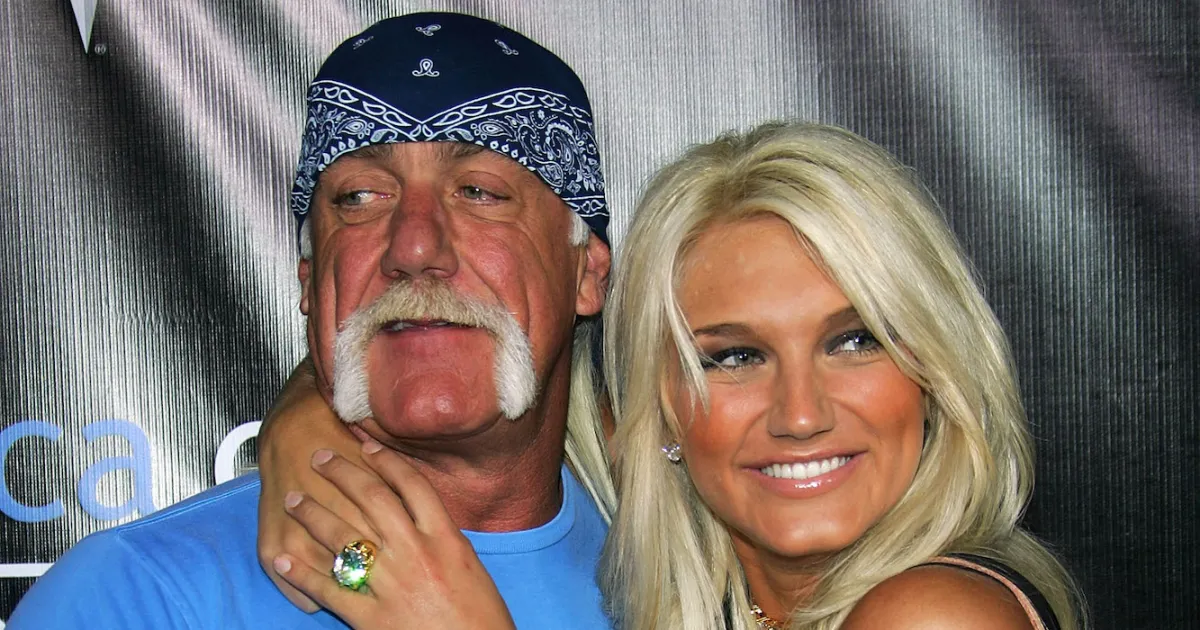
Grief is one of the most painfully universal human experiences, yet when it is thrust into the glaring spotlight of celebrity, it often morphs into a spectacle for public consumption and cruel judgment. The policing of sorrow has become a bizarre side effect of our hyper-connected digital age, where strangers on the internet feel entitled to dictate exactly how a grieving daughter should look, feel, and behave. Recently, Brooke Hogan, the 38-year-old daughter of wrestling icon Hulk Hogan, found herself at the center of this toxic cultural intersection. After sharing a vulnerable, deeply personal tribute to her late father, she was met with a tidal wave of unsolicited criticism from onlookers who prioritized her choice of attire over her emotional reality. It is a striking testament to how easily collective empathy can erode when viewed through the cold, mocking lens of social media, forcing a mourning daughter to expend her precious emotional energy defending the validity of her own broken heart against a barrage of online keyboard warriors.
The controversy began when Brooke sought solace in a place that held some of her fondest childhood memories: the beach. On a quiet Wednesday in late May, she posted a selfie of herself sitting in the sand, wearing a two-piece bikini as she stared out at the endless horizon. Her physical appearance in the photo was juxtaposed with a caption of genuine, poetic vulnerability—a rare, unvarnished window into the raw mechanics of her mourning process. She wrote of needing quiet time to connect with her thoughts, her father, and the vast ocean that he had loved so passionately during his lifetime. In her caption, she beautifully articulated how the natural world around her became a conduit for his memory, noting that every crashing wave hit her heart like a vivid, fresh recollection, carrying the deep, unmistakable bass of his booming voice. She described how the cold saltwater mimicked the protective warmth of his hugs and how the familiar, salty breeze evoked countless sunny afternoons spent laughing together on their family boat. It was a sensory-rich love letter to a lost parent, yet parts of the internet quickly ignored the emotional depth of her words, reducing her sacred moment of remembrance to a superficial, attention-seeking “thirst trap.”
Refusing to let online trolls hijack her narrative or diminish her relationship with her father, Brooke struck back with a combination of fierce resilience and exasperated common sense. She pointed out the sheer absurdity of the backlash, reminding her critics that her choice to wear a swimsuit while sitting on a beach was not a grand, provocative statement, but a simple reflection of her geographical and personal reality. Having grown up on the coastlines of Florida, swimsuits were never a taboo or a costume—they were the fabric of her everyday life, her home comfort, and her natural uniform. She posed a series of rhetorical questions to highlight the arbitrary double standards of her detracting audience, asking if her grief would be deemed more acceptable or less shocking if she were a professional surfer, a swim instructor, or if she possessed a different body type entirely. By asserting that her beachside mourning was just one of many deeply private, painful days she had dedicated to processing her father’s absence, she drew a definitive line in the sand, fiercely defending her right to exist in her natural habitat without her morality being called into question by anonymous critics hiding behind digital screens.
The heavy backdrop to this digital confrontation is the immense, real-world loss of Terry Bollea, known globally as the legendary wrestling superstar Hulk Hogan. The larger-than-life pop-culture titan passed away in July 2025 at the age of 71 after suffering a sudden, fatal heart attack, leaving behind a sprawling, complicated family legacy and millions of mourning fans worldwide. He is survived by his wife, Sky Daily, as well as his children, Nick and Brooke, and his grandchildren. The sudden departure of such a mythic paternal figure naturally shattered the private lives of his family, bringing to the surface the unique and often difficult dynamics that exist within famous households. In her public defense, Brooke touched upon a profound, often overlooked truth about family grief, noting that even her closest relatives do not truly know the full scope of what she experienced, understood, or shared privately with her father. Her words highlighted the beautifully unique, isolated bond that exists strictly between a parent and a child—a private universe of shared secrets, struggles, and love that remains entirely invisible to the outside world, including other family members, and certainly to the judgmental public.
This powerful commitment to preserving the absolute privacy and authenticity of her grief was also the driving force behind Brooke’s highly debated decision to skip her father’s public memorial service in August 2025. While her brother Nick, 35, and her mother Linda, 66, chose to attend the formal funeral, Brooke made the conscious, soul-aligned choice to stay away, navigating the milestone in a way that honored her father’s true spirit rather than societal expectations. She later explained to her followers that her father had harbored a deep-seated hatred for the heavy, somber morbidity of traditional funerals and absolutely did not want one. Acknowledging that everyone processes loss differently, Brooke expressed sincere gratitude for the public celebrations and events organized by others to honor his legendary career, but declared that as his daughter, she had to honor him in the most genuine way she knew how. For her, that meant shunning the artificiality of a formal viewing and instead taking her husband, Steven Oleksy, and their twin babies, Oliver and Molly, to the wild freedom of the beach—paying tribute to his memory in the simple, quiet, and expansive environment where he felt most alive.
In the end, Brooke Hogan’s unapologetic stance serves as a powerful, much-needed modern commentary on the boundaries of grief and the human right to heal on one’s own terms. Her refusal to bow to the demands of internet trolls who police the aesthetics of sorrow highlights a universal truth: there is no correct way, no proper uniform, and no standardized timeline for surviving the agonizing loss of a parent. By standing firm in her truth, embracing the ocean that still whispers her father’s name, and protecting her small, beautiful family unit of her husband and twins, she demonstrates that the most profound tributes are not those designed to please a critical audience. Instead, they are the quiet, private choices we make to survive the weight of our love and loss, finding peace in the simple, untamed beauty of the world our parents left behind, far beyond the reach of the critics who live under the digital bridges of our modern world.