






XRP Teeters on a Critical Pivot Point as Technical Compression Yields to Bearish Pressure
The digital asset market is currently witnessing a high-stakes struggle for dominance within the order books of XRP, Ripple’s native utility token, as a prolonged period of narrow, highly compressed consolidation has ultimately given way to a distinct downward drift. After spending several weeks winding into an increasingly constrictive trading range—a phenomenon that typically signals an impending and highly explosive breakout—the market has finally begun to lean heavily toward the sell side following yet another failed attempt to secure sustainable footing above key resistance near $1.36. This failure to capture ground above overhead structural barriers carry significant weight for modern market participants; classical technical theory dictates that repeated, unsuccessful tests of a specific price level invariably exhaust the momentum of buyers over time, leaving the asset highly vulnerable to gravitational pull. As buying pressure decelerates, XRP has gradually drifted back toward the critical $1.30 price territory, a highly contentious node that professional traders have long categorized as the defining line between a healthy multi-week consolidation and a much broader, structurally damaging breakdown. The psychological importance of this zone cannot be overstated, as a sustained breach beneath it would dismantle the foundational support that has buttressed XRP’s mid-term bullish narrative, effectively signaling to macro investors that the asset’s micro-structure has fundamentally shifted from accumulation to distribution.
A Divided Market: Technical Analysts Clash Over Triangular Breakouts and Macro Consolidation
Market Sentiment Split on XRP Structure
[Bearish Structure] [Bullish Structure]
Triangle Breakdown Macro Compression
Target: $1.14 Target: Upside Breakout
———————–|———————–
$1.30 Support Line
As the asset hovers precariously near these multi-week lows, the broader cryptocurrency analyst community has fractured into two distinctly opposing camps, each utilizing divergent charting methodologies to forecast the token’s next major directional shift. On one side of the intellectual ledger, prominent classical chartists point to the recent price action as a textbook confirmation of a bearish symmetrical triangle breakdown, noting that the asset’s descent below the lower ascending boundary of this pattern projects a highly probable technical downside target toward the $1.14 region. These bearish forecasters emphasize that XRP is currently trading beneath several critical moving averages on the lower-timeframe charts—including the highly sensitive 50-period and 200-period exponential moving averages (EMAs)—which have effectively inverted from dynamic support levels into formidable overhead resistance barriers that systematically suppress short-term price spikes. Conversely, a more optimistic cohort of market analysts argues that the recent downward trajectory is merely a manifestation of late-stage technical compression rather than an outright macro structural collapse, arguing that the integrity of the broader bullish market cycle remains entirely intact so long as XRP preserves the defenses of the $1.30 support zone. This camp views the current correction as a necessary phase of market-cleaning, cleansing the system of late-stage, over-leveraged retail longs to establish a healthier, more sustainable structural foundation from which a massive institutional breakout can eventually be launched.
Institutional Horizons: How CME Group’s Upcoming 24/7 Futures Launch Reshapes the Structural Landscape
Beneath the immediate noise of intraday price charts lies a highly significant fundamental catalyst that could fundamentally revolutionize the structural liquidity profile of the asset: CME Group’s impending launch of 24/7 XRP-linked futures trading later this month. This highly anticipated expansion from one of the world’s premier derivatives platforms represents a monumental leap forward in institutionalizing the digital asset, offering multi-national family offices, hedge funds, and corporate treasuries a highly regulated, continuous hedging instrument capable of mitigating the severe weekend gap risks that have long plagued the crypto ecosystem. Financial institutions operating on standard Wall Street trading hours have historically hesitated to deploy massive capital reserves into digital tokens that trade non-stop globally, largely due to the inability to manage risk positions over traditional exchange closures; the introduction of a continuous, round-the-clock futures contract on a major regulated venue bridges this traditional divide. The anticipated influx of institutional-grade market makers, arbitrageurs, and systematic desks to this new venue is widely expected to drastically tighten bid-ask spreads, optimize institutional price discovery, and establish a robust, reliable cross-exchange benchmark rate that could serve as the bedrock infrastructure for future exchange-traded funds (ETFs) and complex structured financial products.
Whales Retreat to the Shadows: On-Chain Data Reveals a Sharp Decline in High-Net-Worth Transactions
While institutional infrastructure prepares for a grand evolutionary leap, on-chain ledger metrics paint a starkly quiet picture of current high-net-worth market activity, revealing a significant cooling of whale participation across the XRP Ledger (XRPL). Quantitative data shows that the total count of large transactions—typically defined as on-chain transfers exceeding a valuation of $100,000—experienced a massive, precipitate decline of over 57% within a brief nine-day monitoring window, signaling a broader retreat of deep-pocketed market participants to the sidelines. This dramatic reduction in whale transactional velocity often indicates a structural regime of caution, suggesting that large-scale accumulators and institutional allocators are actively choosing to preserve cash reserves rather than aggressively defending key technical zones or buying local dips. When these primary market engines withhold active buy support and reduce their overall market-making behavior, the underlying order books naturally thin out, rendering the asset far more susceptible to erratic retail-driven price volatility and allowing even relatively minor, low-volume sell programs to exert disproportionate downward pressure. This temporary institutional dormancy explains why the token has struggled to absorb localized sell-offs, as the massive block-buys that typically define cyclical accumulation zones have temporarily vanished, leaving the asset’s price trend to be dictated by shorter-term speculative momentum.
Whale Transaction Count (Over $100k)100% |
|
50% | -57% Decline
| Over 9 Days
0% |_____
Days 1 9
Decoding the Daily Tape: Inside the High-Volume Reversal and Short-Term Bearish Shift
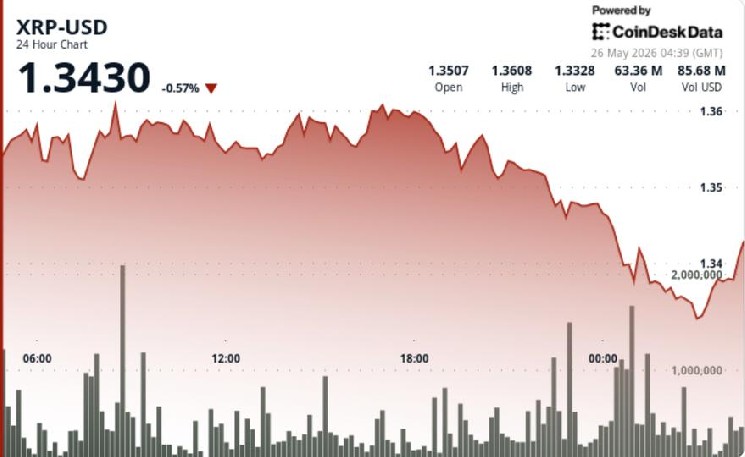
A microscopic examination of the most recent 24-hour trading session underscores this precise dynamic, revealing a highly calculated battle on the daily tape where initial bullish optimism was swiftly met with overwhelming selling pressure. The token initiated the trading session at $1.3457, moving within a highly restricted 1.9% intraday price range that initially gave the illusion of steady, low-velocity accumulation before a sudden spike in buying volume propelled the asset to a session high of $1.3620. However, this brief excursion above key overhead resistance was rapidly intercepted by an aggressive wall of limit-sell orders, causing a rapid, volume-heavy reversal that transformed what initially appeared to be a promising bullish expansion into a classic “bull trap.” As late-stage momentum buyers found themselves trapped at local highs, the ensuing liquidation of short-term leveraged positions accelerated the descent, forcing the asset back below the key $1.35 psychological threshold and culminating in a slow, persistent drift toward a daily close near $1.3366. This particular micro-structure—characterized by a failed high-volume breakout followed by a low-volume drift to the absolute lows of the daily range—indicates that market sellers retain dominant near-term control over the order book, systematically capitalizing on every minor upward push to distribute excess inventory back into the market.
The Road Ahead: Safeguarding Key Boundaries and Navigating Upcoming Volatility Catalysts
As market participants stand on the precipice of a highly catalytic few weeks, the immediate analytical road map for XRP remains exceptionally clear, bounded by highly defined technical zones that will dictate the macro trend going forward. On the downside, the $1.30 to $1.31 support zone represents an absolute line in the sand for bullish market structures; a decisive daily or weekly close beneath this structural fortress would likely trigger an extensive stop-loss cascade among spot holders and leveraged longs, opening the floodgates for a rapid slide toward the macro targets at $1.14. On the upside, the $1.35 level has now hardened into the immediate, high-priority resistance area that bulls must definitively reclaim on high volume to neutralize the short-term bearish bias and restore structural stability to the charts. While these short-term technical dynamics dominate the daily conversation, the broader, overarching reality is that the impending launch of the CME Group’s futures products will likely introduce an entirely new dimension of liquidity and volatility to the asset, creating a highly complex trading environment where traditional chart patterns may easily yield to institutional hedging programs. Consequently, both retail day traders and institutional allocators must navigate this transitional phase with immense discipline, carefully managing risk exposures while the market decides whether XRP will utilize its fundamental institutional upgrades to stage a major macro reversal, or succumb to prevailing structural headwinds and undergo a deeper corrective phase.